The image of President George Washington is seen on an engraving plate for a one dollar bill at the Bureau of Engraving and Printing in Washington November 14, 2014. (Photo by Gary Cameron/Reuters)
A large variety of weapons were for sale at the Washington County Fairgrounds Gun Show that drew thousands of people over the weekend, on March 22, 2013. (Photo by Gary Porter)
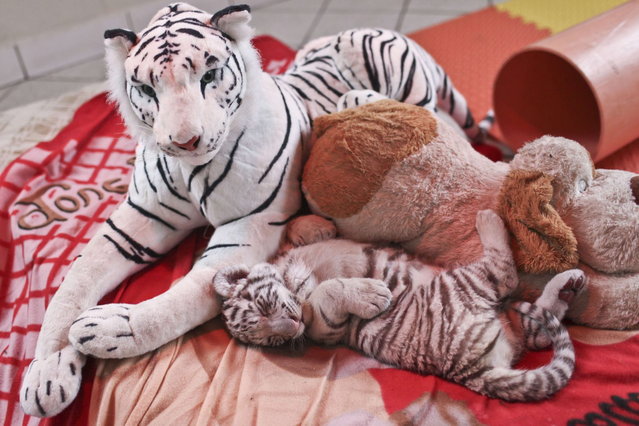
A 42-day-old white bengal tiger cub (bottom), the first of its kind born in Peru, sleeps between toys as he is presented at the Huachipa's zoo in Lima on August 6, 2013. (Photo by Ernesto Benavides/AFP Photo)
“I wonder about everyone that I photograph, what are they thinking at the moment, what is going on in their life, what are they really like. Photographs are such abstractions of real life, both true and false at the same time and so limited in the scope of what can be captured, yet limitless in how it stimulates our imagination. Indeed, photography is a rich medium”. – Mike Peters. Photo: Meatpacking District, NYC, September 28, 2012. (Photo by Mike Peters)
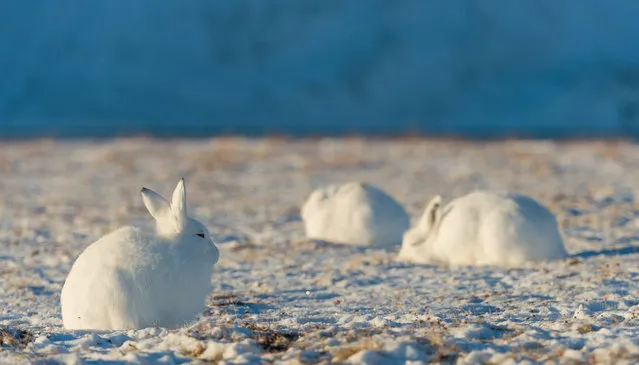
The arctic hare, or polar rabbit, is a species of hare which is adapted largely to polar and mountainous habitats. The arctic hare survives with a thick coat of fur and usually digs holes in the ground or under snow to keep warm and sleep. Arctic hares look like rabbits but have shorter ears, are taller when standing, and, unlike rabbits, can thrive in cold climates. They can travel together with many other hares, sometimes huddling with dozens or more, but are usually found alone, taking, in some cases, more than one partner. The arctic hare can run up to 60 kilometres per hour (40 mph). Its predators include the arctic wolf, arctic fox, and ermine.
Participants celebrate during the “Chupinazo” (start rocket) to mark the kickoff at noon sharp of the San Fermin Festival, in front of the Town Hall of Pamplona, northern Spain, on July 6, 2018. (Photo by Jaime Reina/AFP Photo)
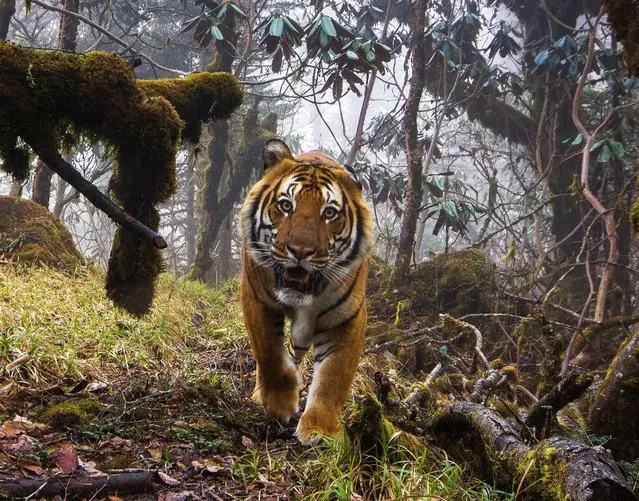
Rare images of wild tigers in Bhutan, captured by camera traps, show tigers and other animals using high-altitude wildlife corridors which are lifelines to isolated tiger populations and critical to genetic diversity, conservation and growth. Here: A wild Bengal tiger (Panthera tigris tigris) captured on a camera trap in corridor eight at an altitude of 3,540 metres in Trongsa, Bhutan. (Photo by Emmanuel Rondeau/WWF UK/The Guardian)
This photo taken on March 29, 2017 shows a young woman offering shots of liquer at a dance bar in Walking Street in Pattaya. Two hours east of Bangkok, Pattaya's bawdy reputation hails from the Vietnam War era when US GIs partied in their downtime. (Photo by Roberto Schmidt/AFP Photo)