Loading...
Done
Women place candles on the half-submerged tomb of family members at flood-prone Holy Spirit Memorial Park in Masantol, Pampanga province, Philippines after heavy rains from recent tropical storm Trami caused water to become higher than usual, ahead of All Saints Day, Thursday October 31, 2024. (Photo by Aaron Favila/AP Photo)

Women place candles on the half-submerged tomb of family members at flood-prone Holy Spirit Memorial Park in Masantol, Pampanga province, Philippines after heavy rains from recent tropical storm Trami caused water to become higher than usual, ahead of All Saints Day, Thursday October 31, 2024. (Photo by Aaron Favila/AP Photo)
Details
20 Nov 2024 02:29:00
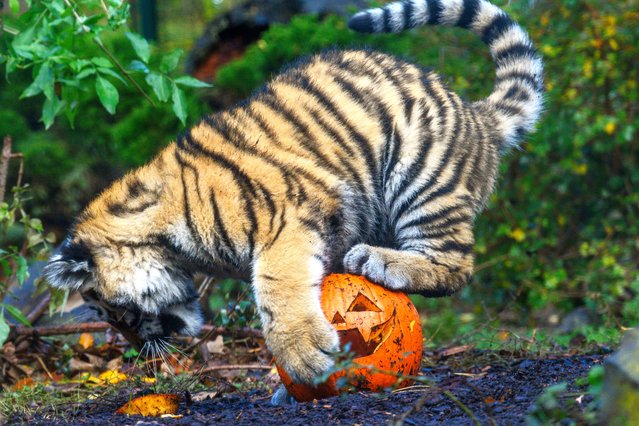
A young tiger tries to get at poultry parts hidden in a pumpkin at Magdeburg Zoo, Germany on October 30, 2025. The zoo is celebrating Halloween from October 31, 2025 to November 1, 2025. In addition to the puppet theater, children's carousel and children's train, visitors can carve their own pumpkins, which are then distributed to the zoo animals and serve as food. (Photo by Klaus-Dietmar Gabbert/Avalon)

A young tiger tries to get at poultry parts hidden in a pumpkin at Magdeburg Zoo, Germany on October 30, 2025. The zoo is celebrating Halloween from October 31, 2025 to November 1, 2025. In addition to the puppet theater, children's carousel and children's train, visitors can carve their own pumpkins, which are then distributed to the zoo animals and serve as food. (Photo by Klaus-Dietmar Gabbert/Avalon)
Details
02 Nov 2025 05:02:00
Aymara witchdoctor Ricardo Quispe, also called “Lord of the Lake”, throws coca leaves during a ritual to predict the future, at the witches market of El Alto, on the outskirts of La Paz, December 31, 2014. Dozens of witch doctors tend to a warren of stalls in El Alto, making offerings to give thanks, to promise luck at work or in love, or to call up spirits and banish curses at the end of the year. (Photo by David Mercado/Reuters)

Aymara witchdoctor Ricardo Quispe, also called “Lord of the Lake”, throws coca leaves during a ritual to predict the future, at the witches market of El Alto, on the outskirts of La Paz, December 31, 2014. Dozens of witch doctors tend to a warren of stalls in El Alto, making offerings to give thanks, to promise luck at work or in love, or to call up spirits and banish curses at the end of the year. (Photo by David Mercado/Reuters)
Details
01 Jan 2015 14:05:00
A devotee takes a holy bath in River Saali in Sankhu on the first day of Swasthani Brata Katha festival in Kathmandu January 5, 2015. During the month long festival, devotees recite one chapter of a Hindu tale daily from the 31-chapter sacred Swasthani Brata Katha book that is dedicated to God Madhavnarayan and Goddess Swasthani, alongside various other gods and goddess and the miraculous feats performed by them. (Photo by Navesh Chitrakar/Reuters)

A devotee takes a holy bath in River Saali in Sankhu on the first day of Swasthani Brata Katha festival in Kathmandu January 5, 2015. During the month long festival, devotees recite one chapter of a Hindu tale daily from the 31-chapter sacred Swasthani Brata Katha book that is dedicated to God Madhavnarayan and Goddess Swasthani, alongside various other gods and goddess and the miraculous feats performed by them. (Photo by Navesh Chitrakar/Reuters)
Details
06 Jan 2015 12:22:00
Devotees take a holy bath during the Swasthani Brata Katha festival in Kathmandu January 20, 2015. During the month-long festival, devotees recite one chapter of a Hindu tale daily from the 31-chapter sacred Swasthani Brata Katha book that is dedicated to God Madhavnarayan and Goddess Swasthani, alongside various other gods and goddesses and the miraculous feats performed by them. (Photo by Navesh Chitrakar/Reuters)

Devotees take a holy bath during the Swasthani Brata Katha festival in Kathmandu January 20, 2015. During the month-long festival, devotees recite one chapter of a Hindu tale daily from the 31-chapter sacred Swasthani Brata Katha book that is dedicated to God Madhavnarayan and Goddess Swasthani, alongside various other gods and goddesses and the miraculous feats performed by them. The devotees also go on pilgrimages to various temples, perform religious rituals, take a holy bath in the rivers and fast for a month, especially among women who believe fasting helps in their family's well-being or in getting them a good husband. (Photo by Navesh Chitrakar/Reuters)
Details
21 Jan 2015 13:50:00
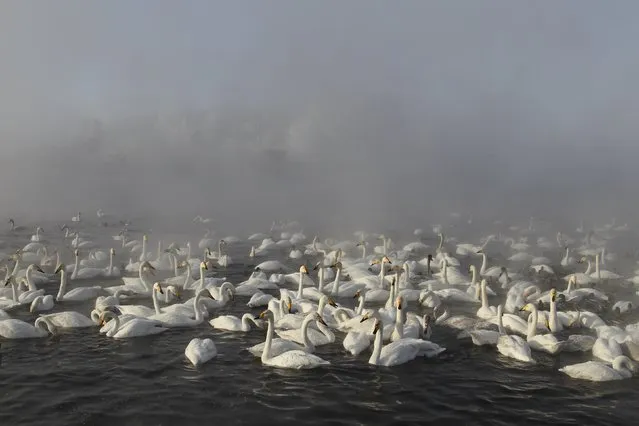
Swans swim over a lake, with the air temperature at about minus 35 degrees Celsius (minus 31 degrees Fahrenheit) as steam ascends above the water during sunset near the village of Urozhainy, Sovetsky district of Altai region, January 26, 2015. (Photo by Andrei Kasprishin/Reuters)

Swans swim over a lake, with the air temperature at about minus 35 degrees Celsius (minus 31 degrees Fahrenheit) as steam ascends above the water during sunset near the village of Urozhainy, Sovetsky district of Altai region, January 26, 2015. About 600 swans annually migrate to the lake, which is heated by warm springs, where they spend their winter being fed by yagers, which helps them to survive the severe cold. (Photo by Andrei Kasprishin/Reuters)
Details
28 Jan 2015 11:40:00
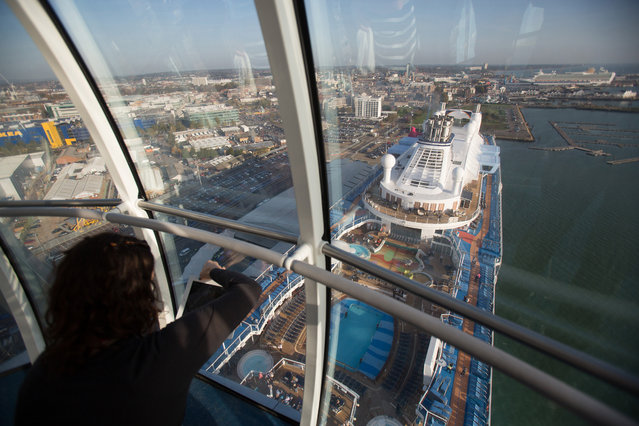
A visitor takes a photograph from the North Star observation capsule onboard the cruise ship Quantum of the Seas which is currently docked at Southampton on October 31, 2014 in Southampton, England. (Photo by Matt Cardy/Getty Images)

A visitor takes a photograph from the North Star observation capsule onboard the cruise ship Quantum of the Seas which is currently docked at Southampton on October 31, 2014 in Southampton, England. Billed as the world's first smartship, Royal Caribbean's Quantum of the Seas is claimed to be the most high-tech cruise ship in the world, with high tech modifications such as virtual balconies in windowless rooms and features such as the first dodgem ride on water, and a skydiving simulator. The ship will shortly begin its voyage from Southampton, where it docked earlier this week, to New York before relocating to the Caribbean for the 2014-15 season. (Photo by Matt Cardy/Getty Images)
Details
11 Nov 2014 11:44:00
On August 31, 2012, a long filament of solar material that had been hovering in the sun's atmosphere, the corona, erupted out into space at 4:36 p.m. EDT. The coronal mass ejection, or CME, traveled at over 900 miles per second. The CME did not travel directly toward Earth, but did connect with Earth's magnetic environment, or magnetosphere, causing aurora to appear on the night of Monday, September 3. (Photo by NASA/GSFC/SDO)

On August 31, 2012, a long filament of solar material that had been hovering in the sun's atmosphere, the corona, erupted out into space at 4:36 p.m. EDT. The coronal mass ejection, or CME, traveled at over 900 miles per second. The CME did not travel directly toward Earth, but did connect with Earth's magnetic environment, or magnetosphere, causing aurora to appear on the night of Monday, September 3. (Photo by NASA/GSFC/SDO via The Atlantic)
Details
14 Sep 2012 09:01:00