Loading...
Done
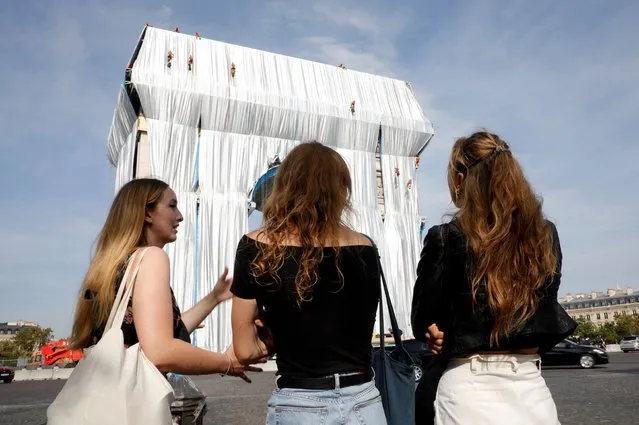
Bystanders look on as workers arrange silver blue fabric, part of the process of wrapping L'Arc de Triomphe in Paris on September 13, 2021, designed by the late artist Christo. Work has begun on wrapping the Arc de Triomphe in Paris in silvery-blue fabric as a posthumous tribute to the artist Christo, who had dreamt of the project for decades. Bulgarian-born Christo, a longtime Paris resident, had plans for sheathing the imposing war memorial at the top of the Champs-Elysees while renting an apartment near it in the 1960s (Photo by Geoffroy Van der Hasselt/AFP Photo)

Bystanders look on as workers arrange silver blue fabric, part of the process of wrapping L'Arc de Triomphe in Paris on September 13, 2021, designed by the late artist Christo. Work has begun on wrapping the Arc de Triomphe in Paris in silvery-blue fabric as a posthumous tribute to the artist Christo, who had dreamt of the project for decades. Bulgarian-born Christo, a longtime Paris resident, had plans for sheathing the imposing war memorial at the top of the Champs-Elysees while renting an apartment near it in the 1960s (Photo by Geoffroy Van der Hasselt/AFP Photo)
Details
01 May 2022 04:48:00
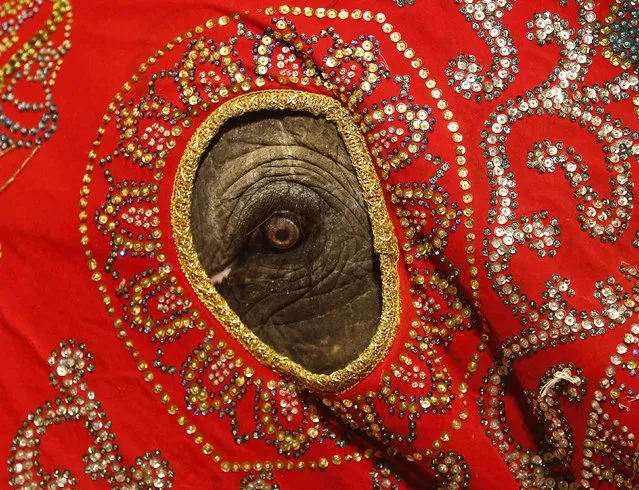
A decorated elephant march at the Navam Perahera, a Buddhist pageant of elephants, dancers and drummers, in Colombo February 3, 2015. (Photo by Dinuka Liyanawatte/Reuters)

A decorated elephant march at the Navam Perahera, a Buddhist pageant of elephants, dancers and drummers, in Colombo February 3, 2015. Over 50 elephants participated in the street parade for Gangaramaya temple's annual Perahera festival, along with a nightly procession of traditional dancers, fire twirlers and traditional musicians. (Photo by Dinuka Liyanawatte/Reuters)
Details
05 Feb 2015 12:49:00
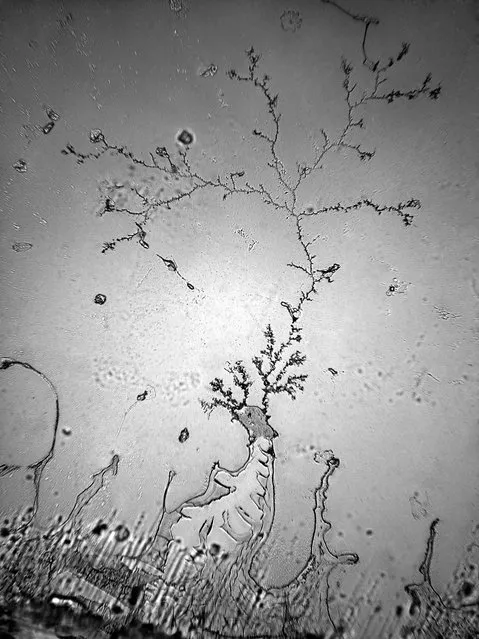
The Topography Of Tears By Rose-Lynn Fisher

Do tears of joy look the same as ones of woe—or ones from chopping onions? In “The Topography of Tears,” the Los Angeles-based photographer Rose-Lynn Fisher explores the physical terrain of one hundred tears emitted during a range of emotional states and physical reactions. Using a Zeiss microscope with an attached digital camera, she captures the composition of tears enclosed in glass slides, magnified between 10x and 40x. “There are many factors that determine the look of each tear image, including the viscosity of the tear, the chemistry of the weeper, the settings of the microscope, and the way I process the images afterwards,” she says.
Details
21 May 2014 17:46:00
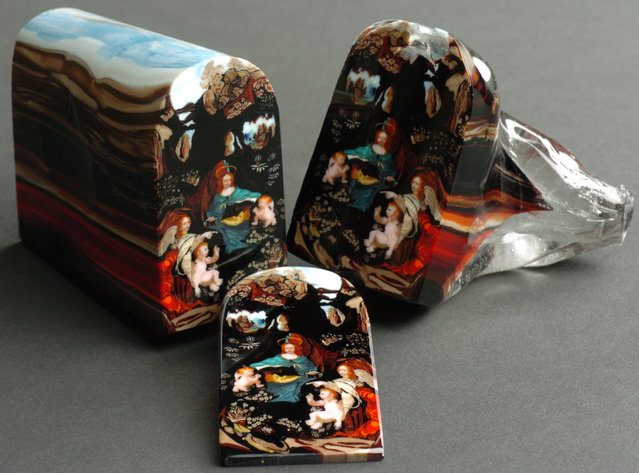
Glass Paintings By Loren Stump

California-based glass artist Loren Stump specializes in a form of glasswork called murrine, where rods of glass are melted together and then sliced to reveal elaborate patterns and forms. While the murrina process appeared in the Mideast some 4,000 years ago, Stump has perfected his own technique over the past 35 years to the point where he can now layer entire portraits and paintings in glass before slicing them to see the final results. His most complex piece to date is a detailed interpretation of Leonardo da Vinci’s Virgin of the Rocks, which involved hundreds of glass components that were melted into a final piece.
Details
11 Jun 2014 14:11:00
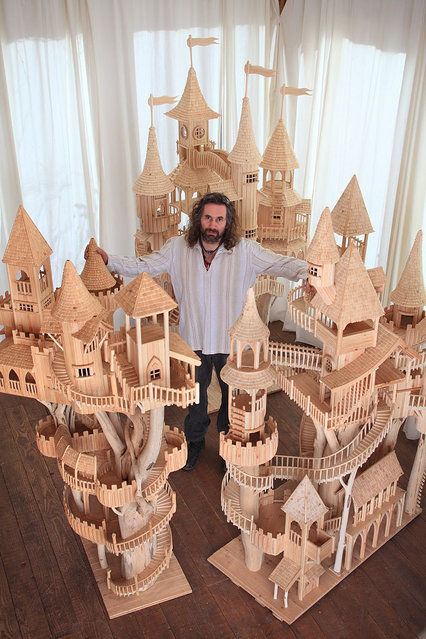
Rob Heard's Wooden Bough House

Living on the edge of Exmoor, Rob takes his inspiration from the rolling countryside surrounding his home, where each Bough House sculpture takes several months to construct. The designs do not follow an explicit plan or process, each piece is unique. They evolve and flow freely, as part of a creative journey which has no natural limit, whilst also revealing great logic and engineering integrity. Every aerial walkway or staircase leads to a room - there are no dead-ends and every turret and tower can be reached.
Details
29 May 2013 10:31:00
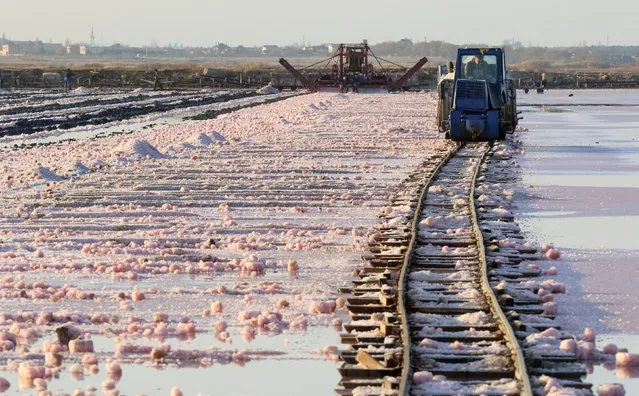
A train drives along a field at a salt production site at the Sasyk-Sivash lake near the city of Yevpatoria, Crimea, November 14, 2017. (Photo by Pavel Rebrov/Reuters)

A train drives along a field at a salt production site at the Sasyk-Sivash lake near the city of Yevpatoria, Crimea, November 14, 2017. A saltwater lagoon known as Lake Sasyk-Sivash on Ukraine's Crimea peninsula is the source of a rare resource: pink salt. The mineral is tinted by tiny algae that produce the pigment beta-carotene. Each autumn, seasonal workers collect thousands of tons of pink salt for processing and export. (Photo by Pavel Rebrov/Reuters)
Details
16 Nov 2017 08:18:00
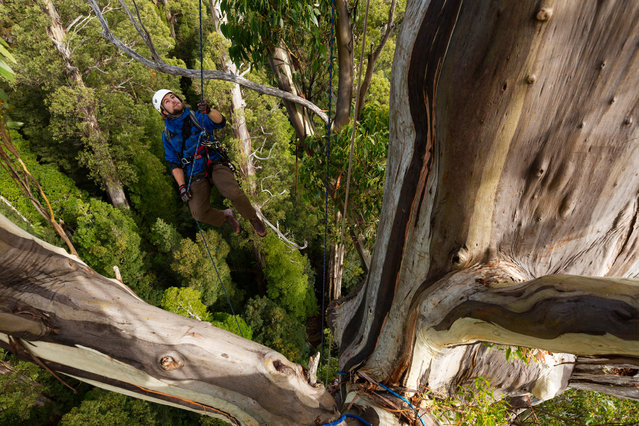
Haley nears the top of the tree. (Photo by Steven Pearce/The Tree Projects/The Guardian)

The Tree Projects team spent 67 days documenting one eucalyptus regnans in the Styx valley of Tasmania. Using a combination of tree-climbing and elaborate arboreal rigging techniques, they produced an intimate portrait from an impossible perspective of one of the world’s largest individual flowering trees, which goes by several common names. These photos document the process that resulted in an extraordinary ultra high-definition photograph. Here: Haley nears the top of the tree. (Photo by Steven Pearce/The Tree Projects/The Guardian)
Details
01 Feb 2017 06:37:00
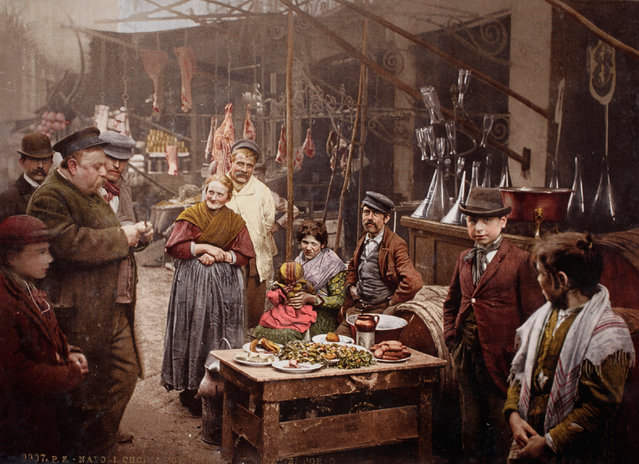
The finished photochromes were produced using at least six different tint stones, although many more were often used. Here: Street food in the Strada del Porto in Naples, Italy, 1899. (Photo by Swiss Camera Museum/The Guardian)

Photochromes are vibrant and nuanced prints hand-coloured from black-and-white negatives. Created using a process pioneered in the 1880s, these images offer a fascinating insight into the world when colour photography was still in its infancy. A Tour of the World in Photochromes is at the Swiss Camera Museum, Vevey, until 21 August. Here: Street food in the Strada del Porto in Naples, Italy, 1899. (Photo by Swiss Camera Museum/The Guardian)
Details
07 Jul 2016 10:56:00