Loading...
Done
Myanmar revellers take part in celebrations on the fifth and last day marking Thingyan, a water festival which brings in the country's new year, in Yangon on April 16, 2016. The Buddhist festival of water pouring symbolizes spiritual cleansing and begin the new year free from worldly impurities with celebrants devoting the four days of Thingyan in merry making of water dousing until the eve of new year. (Photo by Romeo Gacad/AFP Photo)

Myanmar revellers take part in celebrations on the fifth and last day marking Thingyan, a water festival which brings in the country's new year, in Yangon on April 16, 2016. The Buddhist festival of water pouring symbolizes spiritual cleansing and begin the new year free from worldly impurities with celebrants devoting the four days of Thingyan in merry making of water dousing until the eve of new year. (Photo by Romeo Gacad/AFP Photo)
Details
17 Apr 2016 10:53:00
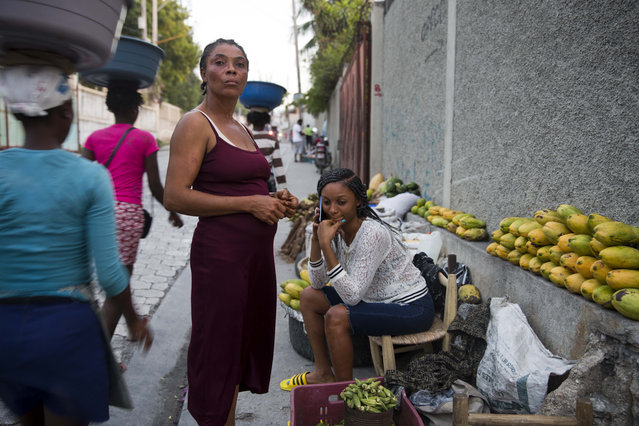
In this November 27, 2019 photo, Wadlande Pierre, right, talks on her mobile phone as she helps her mother, Vanlancia Julien, center, at their fruit and vegetable stand on a sidewalk in Delmas, a district of in Port-au-Prince, Haiti. Pierre, 23, said she temporarily moved in with her aunt in the southwest town of Les Cayes to escape the violent protests in Port-au-Prince. However, she had to move back to the capital because there was no gas, power or water in Les Cayes, and food was becoming scarce. (Photo by Dieu Nalio Chery/AP Photo)

In this November 27, 2019 photo, Wadlande Pierre, right, talks on her mobile phone as she helps her mother, Vanlancia Julien, center, at their fruit and vegetable stand on a sidewalk in Delmas, a district of in Port-au-Prince, Haiti. Pierre, 23, said she temporarily moved in with her aunt in the southwest town of Les Cayes to escape the violent protests in Port-au-Prince. However, she had to move back to the capital because there was no gas, power or water in Les Cayes, and food was becoming scarce. (Photo by Dieu Nalio Chery/AP Photo)
Details
01 Feb 2020 00:05:00
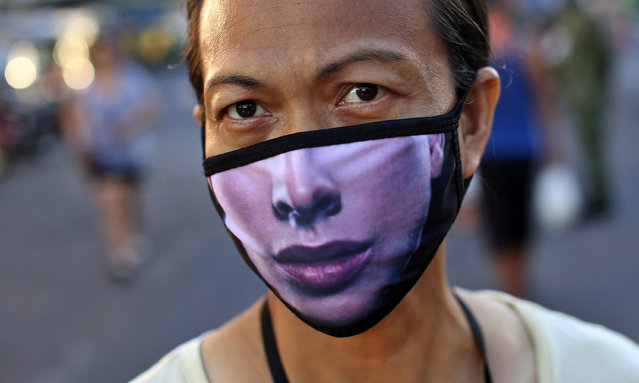
A Filipino woman wears a mask to try and protect against the spread of coronavirus in Malate district, Manila City on March 24, 2020. The Philippines has taken drastic measures to combat the spread of Covid-19. The entire country is under strict quarantine and the army is on the streets to monitor compliance. According to official figures, there are 462 positive cases and 33 dead in the Philippines, but it is thought that thousands of cases remain undetected due to lack of resources in a country where millions of people have no access to health care. In the poorest and most crowded areas, it’s almost impossible to adhere to the physical distancing required during quarantine. (Photo by Alejandro Ernesto/The Guardian)

A Filipino woman wears a mask to try and protect against the spread of coronavirus in Malate district, Manila City on March 24, 2020. The Philippines has taken drastic measures to combat the spread of Covid-19. The entire country is under strict quarantine and the army is on the streets to monitor compliance. According to official figures, there are 462 positive cases and 33 dead in the Philippines, but it is thought that thousands of cases remain undetected due to lack of resources in a country where millions of people have no access to health care. In the poorest and most crowded areas, it’s almost impossible to adhere to the physical distancing required during quarantine. (Photo by Alejandro Ernesto/The Guardian)
Details
08 Apr 2020 00:01:00
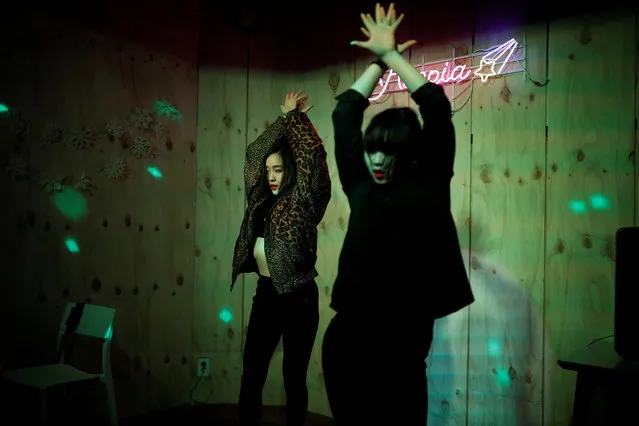
Japanese Yuuka Hasumi, 17, and Ibuki Ito, 17, also from Japan, who want to become K-pop stars, perform at an Acopia School party in Seoul, South Korea, March 16, 2019. Acopia is a prep school offering young Japanese a shot at K-pop stardom, teaching them the dance moves, the songs and also the language. (Photo by Kim Hong-Ji/Reuters)

Japanese Yuuka Hasumi, 17, and Ibuki Ito, 17, also from Japan, who want to become K-pop stars, perform at an Acopia School party in Seoul, South Korea, March 16, 2019. Acopia is a prep school offering young Japanese a shot at K-pop stardom, teaching them the dance moves, the songs and also the language. (Photo by Kim Hong-Ji/Reuters)
Details
06 Jun 2019 00:01:00
Actor Candis Cayne performs at John Varvatos + OUT Support the Gay Men's Chorus of LA on September 29, 2016 in Los Angeles, California. (Photo by Matt Winkelmeyer/Getty Images for John Varvatos)

Actor Candis Cayne performs at John Varvatos + OUT Support the Gay Men's Chorus of LA on September 29, 2016 in Los Angeles, California. (Photo by Matt Winkelmeyer/Getty Images for John Varvatos)
Details
01 Oct 2016 11:34:00
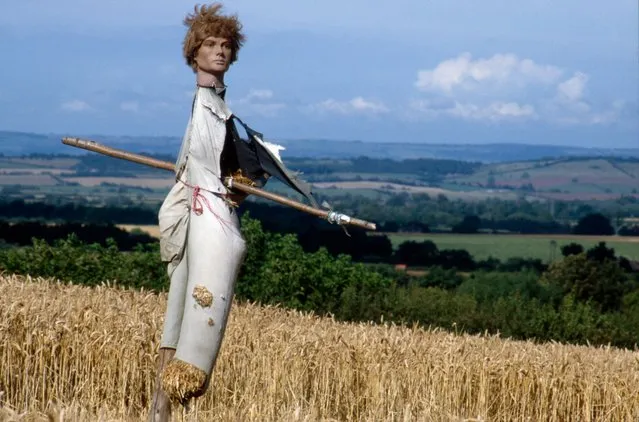
“The ripening crops eloquently signify that the scarecrow’s work is done. Few remain to see their task fulfilled because if they become entangled in the harvesting machinery it causes serious damage”. (Photo by Colin Garratt)

When Colin Garratt went to photograph the traditional sentinels of the British countryside, he found they ranged from the dapper to the downright sinister. “They are not from the anaesthetised world of the craft fair”, says Colin Garratt, “but are the direct descendants of the ancient spectres which have haunted the landscape for centuries”. The Scarecrow Exhibition is at Geddes Gallery, London, from 25 to 30 March. (Photo by Colin Garratt)
Details
29 Mar 2016 11:46:00
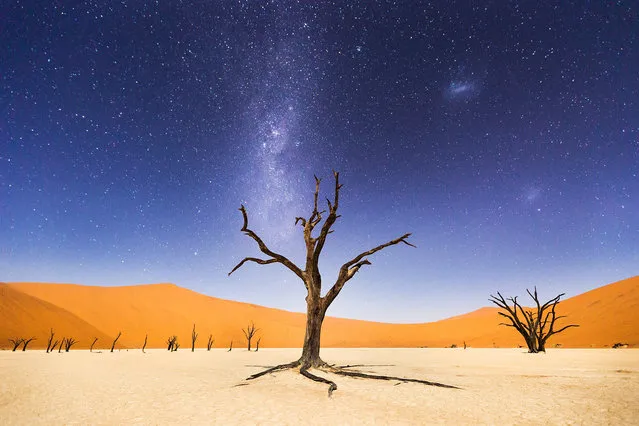
Merit: A Night at Deadvlei. The night before returning to Windhoek, we spent several hours at Deadveli. The moon was bright enough to illuminate the sand dunes in the distance, but the skies were still dark enough to clearly see the milky way and magellanic clouds. Deadveli means “dead marsh. (Photo and caption by Beth McCarley/National Geographic Traveler Photo Contest)

Merit: A Night at Deadvlei. The night before returning to Windhoek, we spent several hours at Deadveli. The moon was bright enough to illuminate the sand dunes in the distance, but the skies were still dark enough to clearly see the milky way and magellanic clouds. Deadveli means “dead marsh. The camelthorn trees are believed to be about 900 years old, but have not decomposed because the environment is so dry. (Photo and caption by Beth McCarley/National Geographic Traveler Photo Contest)
Details
04 Aug 2015 11:50:00
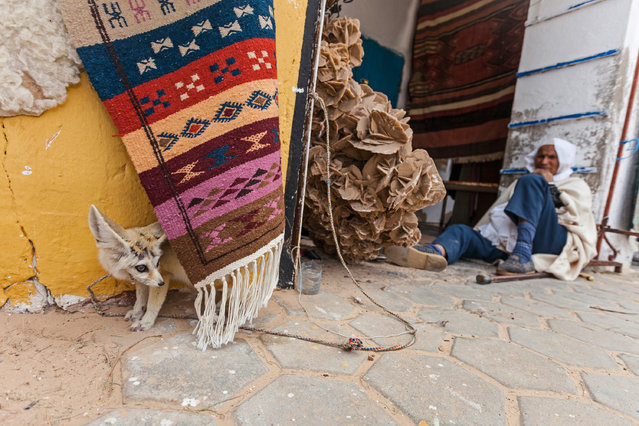
Sultan, a famous captive fennec that is displayed tied on a rope in front of a tourist shop, is the main attraction in the souk of Douz, a desert town in Tunisia. By the display of such a charismatic animal, tourists are often lured to buy things or pay for pictures. On inquiry, although Sultan has been caught as a pup in the wild, the owners of the shop reassure the foreigners stating that the animal is ‘domestic’. (Photo by Bruno D’Amicis/Fritz Pölking Prize/GDT EWPY 2015)

Sultan, a famous captive fennec that is displayed tied on a rope in front of a tourist shop, is the main attraction in the souk of Douz, a desert town in Tunisia. By the display of such a charismatic animal, tourists are often lured to buy things or pay for pictures. On inquiry, although Sultan has been caught as a pup in the wild, the owners of the shop reassure the foreigners stating that the animal is ‘domestic’. (Photo by Bruno D’Amicis/Fritz Pölking Prize/GDT EWPY 2015)
Details
23 Nov 2015 08:02:00