Loading...
Done
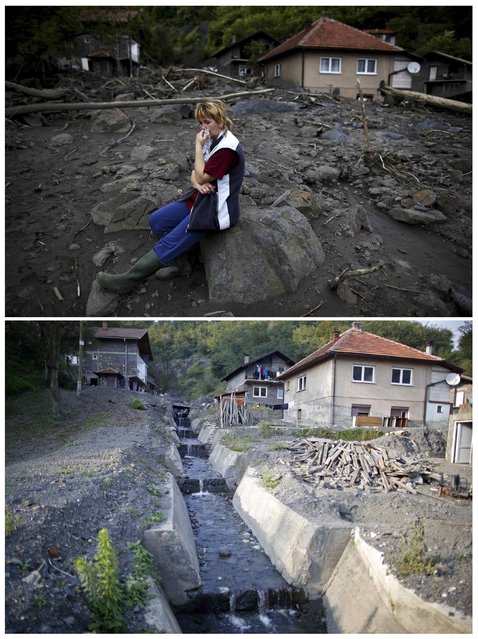
A combination photo shows Fata Kovacevic reacting near her flood-damaged house during floods May 20, 2014 (top) and the same place after floods October 8, 2014 in Topcic Polje. (Photo by Dado Ruvic/Reuters)

A combination photo shows Fata Kovacevic reacting near her flood-damaged house during floods May 20, 2014 (top) and the same place after floods October 8, 2014 in Topcic Polje. (Photo by Dado Ruvic/Reuters)
Details
09 Oct 2014 12:18:00
In this photo taken Sunday, October 5, 2014, a library official shows a 13th-century German prayer book containing the earliest evidence of the Yiddish language, at Israel's National Library in Jerusalem. (Photo by Sebastian Scheiner/AP Photo)

In this photo taken Sunday, October 5, 2014, a library official shows a 13th-century German prayer book containing the earliest evidence of the Yiddish language, at Israel's National Library in Jerusalem. This week, Israel's National Library gave The Associated Press a rare peek at a selection of rare historical manuscripts in its collection. (Photo by Sebastian Scheiner/AP Photo)
Details
09 Oct 2014 12:38:00
Dancers from the British theater company Motionhouse perform a show with excavators entitled “Traction” on the Prado beach in Marseille, France, on May 10, 2013. (Photo by Boris Horvat/AFP Photo)

Dancers from the British theater company Motionhouse perform a show with excavators entitled “Traction” on the Prado beach in Marseille, France, on May 10, 2013. (Photo by Boris Horvat/AFP Photo)
Details
11 May 2013 12:36:00
An Indian Sikh devotee takes a dip in the holy sarover (water tank) at the Golden Temple on the eve of “Ghallughara Diwas”, the 29th Anniversary of Operation Bluestar, in Amritsar on June 5, 2013. The 1984 assault on the Golden Temple complex by the Indian army was conducted in an attempt to arrest separatists Sikh leader Sant Jarnail Singh Bhindranwale and his militant followers who had initiated a movement for a separate Sikh state. (Photo by Narinder Nanu/AFP Photo)

An Indian Sikh devotee takes a dip in the holy sarover (water tank) at the Golden Temple on the eve of “Ghallughara Diwas”, the 29th Anniversary of Operation Bluestar, in Amritsar on June 5, 2013. The 1984 assault on the Golden Temple complex by the Indian army was conducted in an attempt to arrest separatists Sikh leader Sant Jarnail Singh Bhindranwale and his militant followers who had initiated a movement for a separate Sikh state. (Photo by Narinder Nanu/AFP Photo)
Details
08 Jun 2013 11:00:00
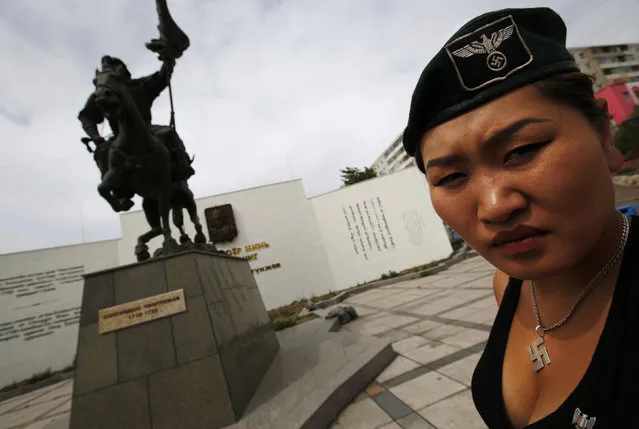
Uranjargal, a leader of the Mongolian neo-Nazi group Tsagaan Khass, stands next to a statue of Chingunjav, a Mongolian national hero, in Ulan Bator June 22, 2013. (Photo by Carlos Barria/Reuters)

Uranjargal, a leader of the Mongolian neo-Nazi group Tsagaan Khass, stands next to a statue of Chingunjav, a Mongolian national hero, in Ulan Bator June 22, 2013. The group has rebranded itself as an environmentalist organisation fighting pollution by foreign-owned mines, seeking legitimacy as it sends Swastika-wearing members to check mining permits. Over the past years, ultra-nationalist groups have expanded in the country and among those garnering attention is Tsagaan Khass, which has recently shifted its focus from activities such as attacks on women it accuses of consorting with foreign men to environmental issues, with the stated goal of protecting Mongolia from foreign mining interests. This ultra-nationalist group was founded in the 1990s and currently has 100-plus members. (Photo by Carlos Barria/Reuters)

Details
09 Jul 2013 07:23:00
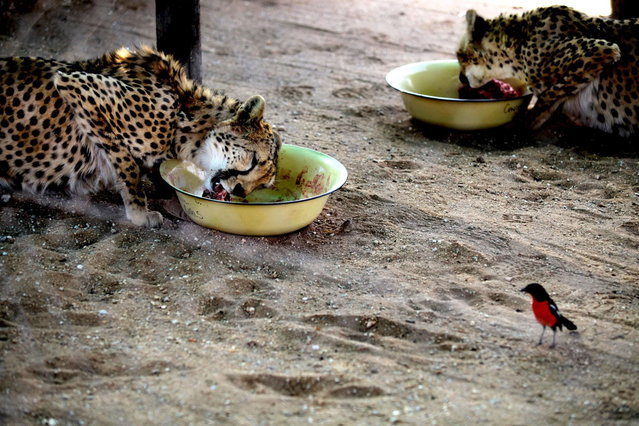
Young cheetahs eat meat at The Cheetah Conservation Fund (CCF) center in Otjiwarongo, Namibia, on August 13, 2013. The CCF started breeding Anatolian livestock dogs to promote cheetah-friendly farming after some 10,000 big cats – the current total worldwide population – were killed or moved off farms in the 1980s.  Up to 1,000 cheetahs were being killed a year, mostly by farmers who saw them as livestock killers. But the use of dogs has slashed losses for sheep and goat farmers and led to less retaliation against the vulnerable cheetah. (Photo by Jennifer Bruce/AFP Photo)

Young cheetahs eat meat at The Cheetah Conservation Fund (CCF) center in Otjiwarongo, Namibia, on August 13, 2013. The CCF started breeding Anatolian livestock dogs to promote cheetah-friendly farming after some 10,000 big cats – the current total worldwide population – were killed or moved off farms in the 1980s. Up to 1,000 cheetahs were being killed a year, mostly by farmers who saw them as livestock killers. But the use of dogs has slashed losses for sheep and goat farmers and led to less retaliation against the vulnerable cheetah. (Photo by Jennifer Bruce/AFP Photo)
Details
29 Aug 2013 10:56:00
Two women pose as they drink real ale at the Great British Beer Festival in the Olympia exhibition centre on August 13, 2013 in London, England. The festival, which runs until August 17, 2013, has over 24 bars serving over 800 different beers, ciders and perries. (Photo by Oli Scarff/Getty Images)

Two women pose as they drink real ale at the Great British Beer Festival in the Olympia exhibition centre on August 13, 2013 in London, England. The festival, which runs until August 17, 2013, has over 24 bars serving over 800 different beers, ciders and perries. (Photo by Oli Scarff)
Details
04 Sep 2013 08:18:00
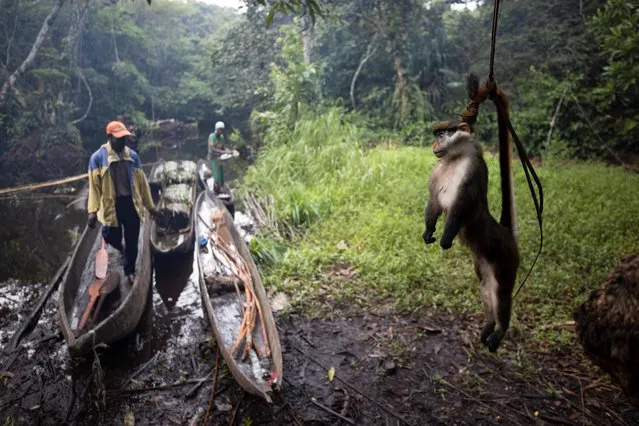
A dead red-tailed monkey hangs by its tail above the ground, in order to keep it away from ants, in the forest near the city of Mbandaka, Democratic Republic of the Congo, April 5, 2019. Bushmeat hunters are emptying Central Africa's forests at a high rate, researchers say. A growing appetite for wild meat in cities has ramped up the scale of hunting. Research shows around 6 million tonnes of bushmeat are sourced annually from the Congo Basin, whose forest spans across six countries and is second in size only to the Amazon. (Photo by Thomas Nicolon/Reuters)

A dead red-tailed monkey hangs by its tail above the ground, in order to keep it away from ants, in the forest near the city of Mbandaka, Democratic Republic of the Congo, April 5, 2019. Bushmeat hunters are emptying Central Africa's forests at a high rate, researchers say. A growing appetite for wild meat in cities has ramped up the scale of hunting. Research shows around 6 million tonnes of bushmeat are sourced annually from the Congo Basin, whose forest spans across six countries and is second in size only to the Amazon. (Photo by Thomas Nicolon/Reuters)
Details
14 Oct 2019 00:03:00