Loading...
Done
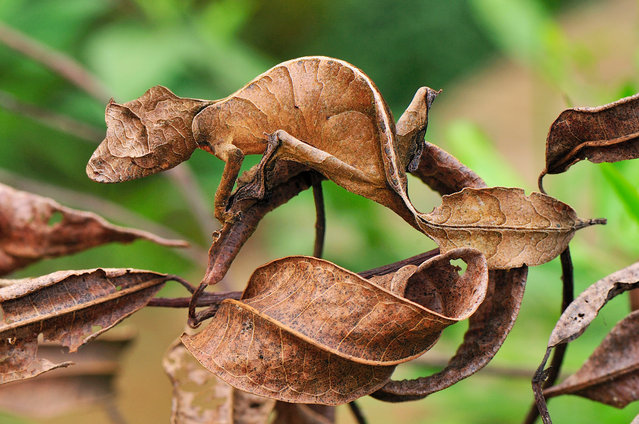
Is it a leaf? Is it tree bark? No, it’s the Satanic leaf-tailed gecko. Cleverly disguised as a rotting leaf, Madagascar’s camouflage king has red eyes, pointy horns and a taste for night hunting: it’s nature’s most devilish deceiver. (Photo by Thomas Marent/ARDEA)

Is it a leaf? Is it tree bark? No, it’s the Satanic leaf-tailed gecko. Cleverly disguised as a rotting leaf, Madagascar’s camouflage king has red eyes, pointy horns and a taste for night hunting: it’s nature’s most devilish deceiver. The twisted body and veiny skin echo the detail of a dry leaf, which ensures the gecko blends in with its forest home. The mottled tail appears to have sections missing, as though it has withered over time. This mini-monster epitomises survival of the fittest, having adapted gradually to become today’s extraordinary leaf impersonator. (Photo by Thomas Marent/ARDEA)
Details
20 Nov 2015 08:03:00
A member of the “Sibspas” Siberian search and rescue group dressed as Santa Claus (R), waits for his team mate, dressed as Father Frost, the Russian equivalent of Santa Claus, as he climbs the rock named “The Fourth Stolb” (the Fourth Pillar) at the Stolby national nature reserve during a training session of the Russian Emergencies Ministry, outside the Siberian city of Krasnoyarsk, Russia December 15, 2015. (Photo by Ilya Naymushin/Reuters)

A member of the “Sibspas” Siberian search and rescue group dressed as Santa Claus (R), waits for his team mate, dressed as Father Frost, the Russian equivalent of Santa Claus, as he climbs the rock named “The Fourth Stolb” (the Fourth Pillar) at the Stolby national nature reserve during a training session of the Russian Emergencies Ministry, outside the Siberian city of Krasnoyarsk, Russia December 15, 2015. (Photo by Ilya Naymushin/Reuters)
Details
16 Dec 2015 12:32:00
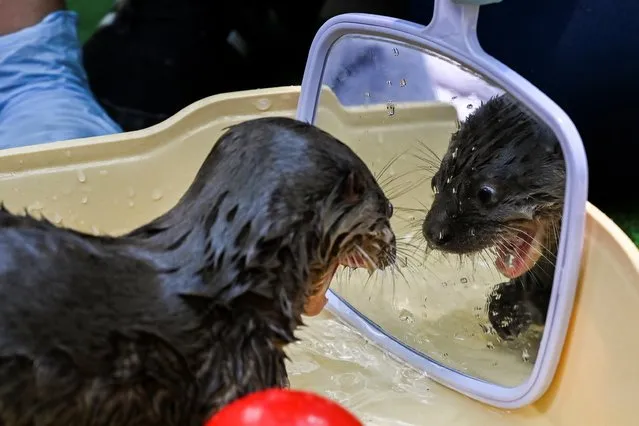
A river otter (lontra longicaudis) of 6-weeks-old looks in the mirror during a bath in the Animal Welfare Unit of the Zoo in Cali, Colombia, on October 22, 2019. The baby otter was found abandoned brought to the Cali Zoo for breeding, for its extensive experience in raising these species. According to the International Union for Conservation of Nature the river otter (lontra longicaudis) are in danger of extinction, because of mining, agriculture, pollution of rivers and housing construction in their habitat. (Photo by Luis Robayo/AFP Photo)

A river otter (lontra longicaudis) of 6-weeks-old looks in the mirror during a bath in the Animal Welfare Unit of the Zoo in Cali, Colombia, on October 22, 2019. The baby otter was found abandoned brought to the Cali Zoo for breeding, for its extensive experience in raising these species. According to the International Union for Conservation of Nature the river otter (lontra longicaudis) are in danger of extinction, because of mining, agriculture, pollution of rivers and housing construction in their habitat. (Photo by Luis Robayo/AFP Photo)
Details
27 Oct 2019 00:03:00
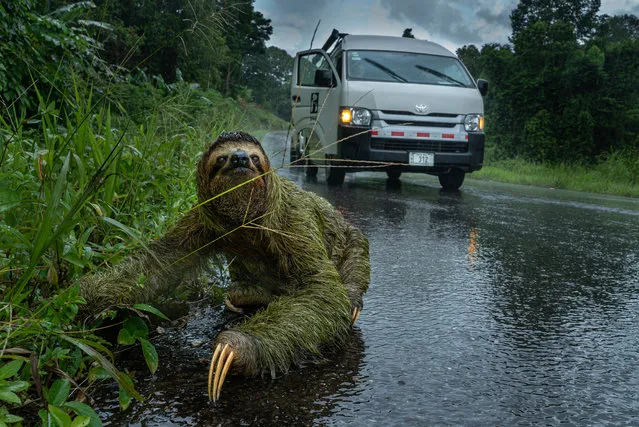
People and Nature category winner: Why did the sloth cross the road? by Andrew Whitworth (Osa Conservation and University of Glasgow), taken in Osa Peninsula, Costa Rica. “I was driving out from the Osa Peninsula, located on the southern Pacific coast of Costa Rica on a dark, stormy day. This female three-toed sloth (Bradypus variegatus) had luckily just about made it across the road, and the drivers of the Toyota on this occasion had spotted her in good time”. (Photo by Andrew Whitworth/2019 British Ecological Society Photography Competition)

People and Nature category winner: Why did the sloth cross the road? by Andrew Whitworth (Osa Conservation and University of Glasgow), taken in Osa Peninsula, Costa Rica. “I was driving out from the Osa Peninsula, located on the southern Pacific coast of Costa Rica on a dark, stormy day. This female three-toed sloth (Bradypus variegatus) had luckily just about made it across the road, and the drivers of the Toyota on this occasion had spotted her in good time”. (Photo by Andrew Whitworth/2019 British Ecological Society Photography Competition)
Details
30 Nov 2019 00:05:00
View of colourful rock formations at the Zhangye Danxia Landform Geological Park in Gansu Province, China. The Zhangye Danxia Landform Geological Park is 40km from Zhangye city. The park spans more than 400 square kilometers in Gansu. The unusual terrain is the result of red sandstone and mineral deposits carved over the years by natural forces. A number of boardwalks have been built to encourage visitors to explore the rock formations. (Photo by ImagineChina/The Grosby Group)

View of colourful rock formations at the Zhangye Danxia Landform Geological Park in Gansu Province, China. The Zhangye Danxia Landform Geological Park is 40km from Zhangye city. The park spans more than 400 square kilometers in Gansu. The unusual terrain is the result of red sandstone and mineral deposits carved over the years by natural forces. (Photo by ImagineChina/The Grosby Group)
Details
02 Dec 2013 09:12:00
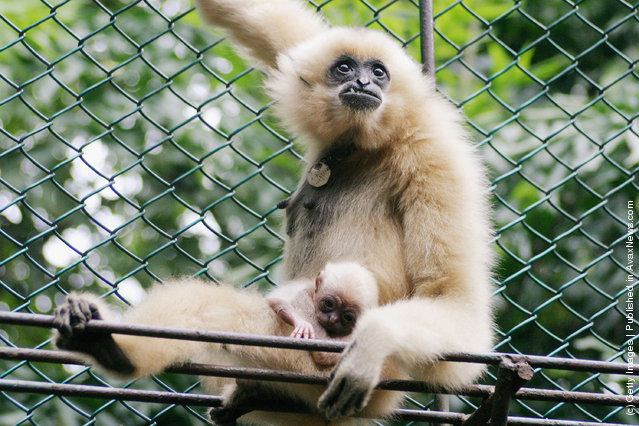
Newborn White-Cheeked Gibbon Nomascus

“Nomascus is the second most speciose genus of gibbons (family Hylobatidae). Originally this genus was a subgenus of Hylobates, and all individuals were considered one species, Hylobates concolor. Species within Nomascus are characterized by 52 chromosomes. Some species are all black, some light with a distinct black tuft of crown fur, and some by distinct, light-colored cheek patches. Nomascus is found from southern China (Yunnan) to southern Vietnam, and also on Hainan Island. One of the genus' species, Nomascus nasutus, has been deemed “the most critically endangered ape species in the world”. All of the species in this genus are endangered or critically endangered”. – Wikipedia

Photo: A newborn White-Cheeked Gibbon clings to its mother in the Nanning Zoo on April 12, 2004 in Nanning, Guangxi province, China. The White-Cheeked Gibbon's natural habitat is Southern China as well as Vietnam and Laos. They are classified as highly endangered and are on the brink of extinction due to poaching and reduction of natural rainforests. (Photo by Getty Images)
Details
12 Aug 2011 11:51:00
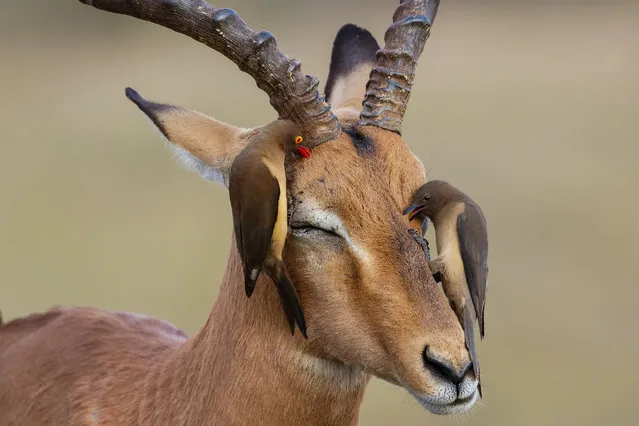
Red-billed oxpecker on an impala, Kruger National Park, South Africa. (Photo by Edmund Aylmer/BPOTY/Cover Images/The Guardian)

The shortlist for the coveted Bird Photographer of the Year awards has been announced by Nature Photographers and the British Trust for Ornithology. Here: Red-billed oxpecker on an impala, Kruger National Park, South Africa. (Photo by Edmund Aylmer/BPOTY/Cover Images/The Guardian)
Details
13 Mar 2018 00:05:00
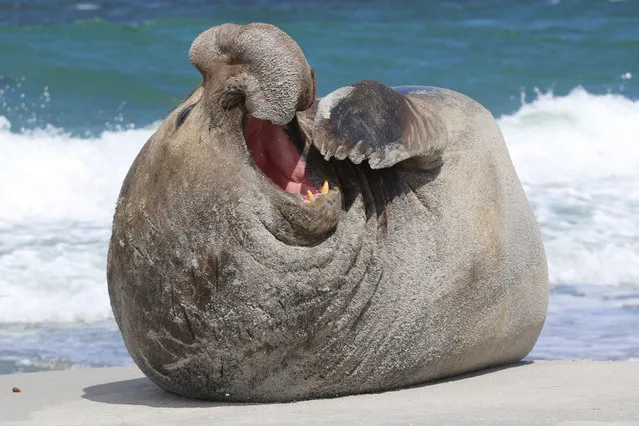
Elephant Seal. (Photo by David Crocker/Caters News Agency)

These hilarious photos show some of nature’s mightiest animals — yawning away! (Actually – not always; AvaxNews). The images were taken by photographers across the world, from the African savannas to the Pacific Ocean. Here: Elephant Seal. (Photo by David Crocker/Caters News Agency)
Details
20 Sep 2019 00:01:00