Loading...
Done
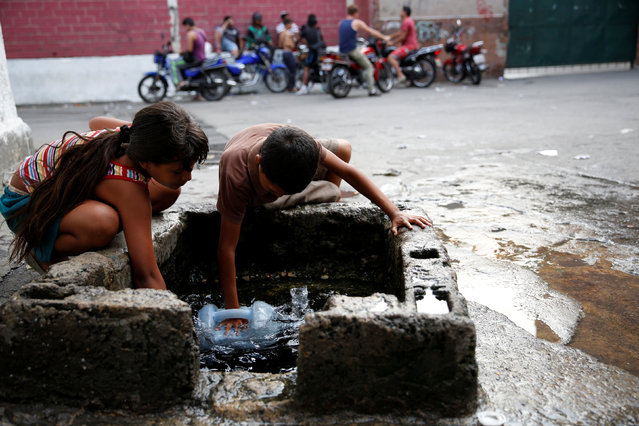
Children fill plastic containers with water from a well on a street, close to a neighbourhood called “The Tank” in the slum of Petare in Caracas, Venezuela, March 17, 2016. (Photo by Carlos Garcia Rawlins/Reuters)

Children fill plastic containers with water from a well on a street, close to a neighbourhood called “The Tank” in the slum of Petare in Caracas, Venezuela, March 17, 2016. Although their nation has one of the world's biggest hydroelectric dams and vast rivers like the fabled Orinoco, Venezuelans are still suffering water and power cuts most days. The problems with stuttering services have escalated in the last few weeks: yet another headache for the OPEC nation's 30 million people already reeling from recession, the world's highest inflation rate, and scarcities of basic goods. President Nicolas Maduro blames a drought, while the opposition blames government incompetence. (Photo by Carlos Garcia Rawlins/Reuters)
Details
08 May 2016 11:15:00
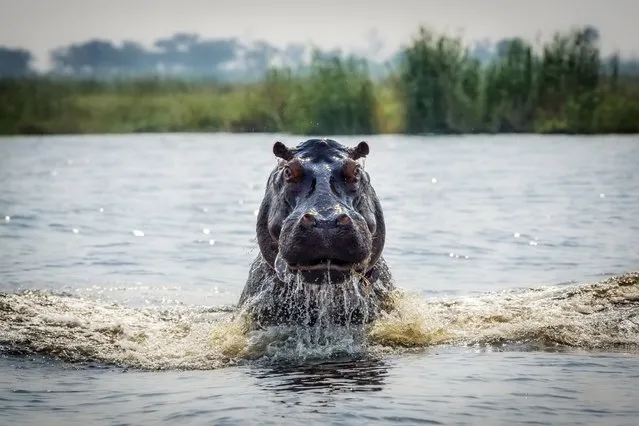
“Hippo Chase”. As we approached the camp the Selinda Reserve of northern Botswana our boat passed by a hippo resting in the water. I turned around to look back at the boat's wake and saw the hippo charging after us! The hippo must've been tired from an all-nighter because he was angry. (Photo and caption by Curtis Simmons/National Geographic Photo Contest)

“Hippo Chase”. As we approached the camp the Selinda Reserve of northern Botswana our boat passed by a hippo resting in the water. I turned around to look back at the boat's wake and saw the hippo charging after us! The hippo must've been tired from an all-nighter because he was angry. He rose way up out of the water three times trying to chase our boat! He was coming at us with such force that he created a wake of his own. Photo location: Selinda Reserve of northern Botswana. (Photo and caption by Curtis Simmons/National Geographic Photo Contest)
Details
06 Nov 2014 08:59:00
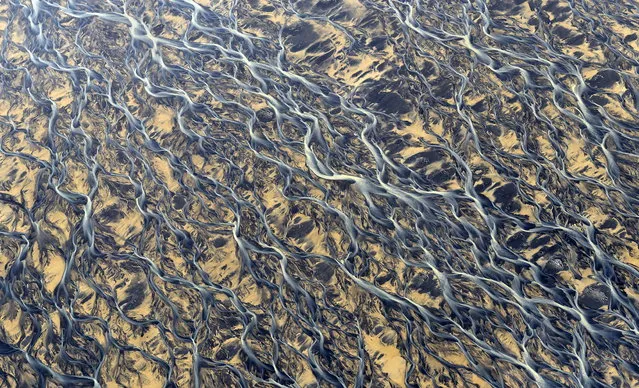
These pictures look like an artist has painted abstract patterns on canvas – but in fact they are natural rivers captured on camera. The spectacular rivers in Iceland's central highlands and southern parts originate from glaciers, which is why the water is a milky colour. (Photo by Andrey Ermolaev/Solent News)

These picture look like an artist has painted abstract patterns on canvas – but in fact they are natural rivers captured on camera. The spectacular rivers in Iceland's central highlands and southern parts originate from glaciers, which is why the water is a milky colour. They are shallow rivers and the water spreads quickly over a flat and sandy surface, creating random and beautiful patterns. Photographer Andrey Ermolaev from Moscow, Russia, flew 500ft above the unique sight in a small plane. (Photo by Andrey Ermolaev/Solent News)
Details
05 May 2014 10:57:00


“Pilot whales are cetaceans belonging to the genus Globicephala. There are two extant species, the long-finned pilot whale (G. melas) and the short-finned pilot whale (G. macrorhynchus). The two are not readily distinguished at sea and analysis of the skulls is the best way to tell the difference between the two species. Between the two species, pilot whales range in waters nearly worldwide with long-finned pilot whales living in cooler waters and short-finned pilot whales living in warmer waters. Pilot whales are among the largest of the oceanic dolphins, exceeded in size only by the killer whale. They and other large members of the dolphin family are also known as blackfish”. – Wikipedia

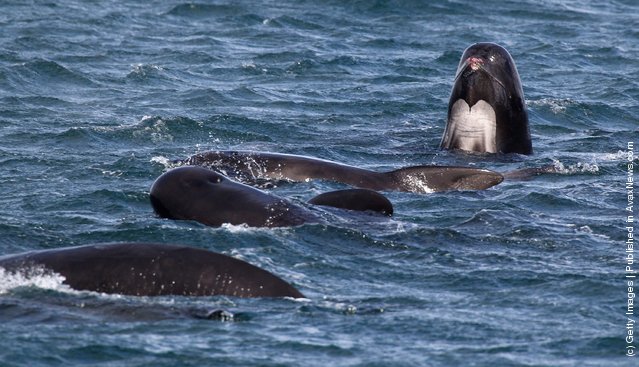
Photo: Pilot whales swim in Loch Carron on May 20, 2011 in South Uist, Scotland. A major operation is underway to prevent up to 100 pilot whales from stranding on the rocky shoreline of Loch Carron on South Uist in the Western Isles. (Photo by Jeff J Mitchell/Getty Images)
Details
21 May 2011 07:58:00
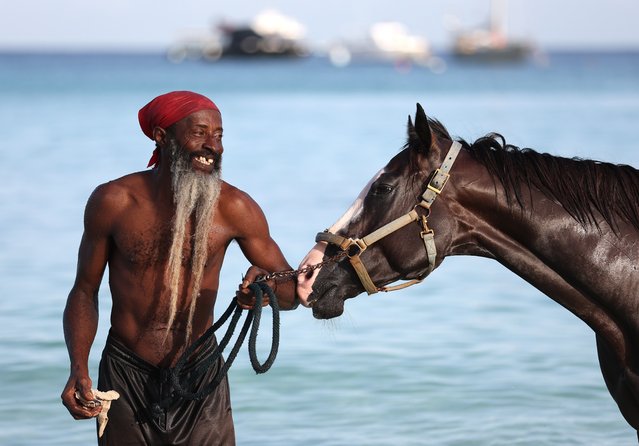
A horse trainer takes his horse into the water at Pebble Beach on June 28, 2024 in Bridgetown, Barbados. The swimming horses of Barbados offer a unique and remarkable experience at Pebbles Beach, where racehorses from the nearby Garrison Savannah enjoy their morning swim almost daily between 5:30 am and 7 am. During this ritual, horses swim out surprisingly far to the moored boats before returning to shore, with some staying longer in the water if recovering from injury or soreness after a race. Visitors can observe the horses' individual personalities as they swim and interact with the water, but are advised to respect the guidance of the grooms and maintain a safe distance, as horses can behave unpredictably, especially if frightened. (Photo by Robert Cianflone/Getty Images)

A horse trainer takes his horse into the water at Pebble Beach on June 28, 2024 in Bridgetown, Barbados. The swimming horses of Barbados offer a unique and remarkable experience at Pebbles Beach, where racehorses from the nearby Garrison Savannah enjoy their morning swim almost daily between 5:30 am and 7 am. During this ritual, horses swim out surprisingly far to the moored boats before returning to shore, with some staying longer in the water if recovering from injury or soreness after a race. Visitors can observe the horses' individual personalities as they swim and interact with the water, but are advised to respect the guidance of the grooms and maintain a safe distance, as horses can behave unpredictably, especially if frightened. (Photo by Robert Cianflone/Getty Images)
Details
07 Jul 2024 03:07:00
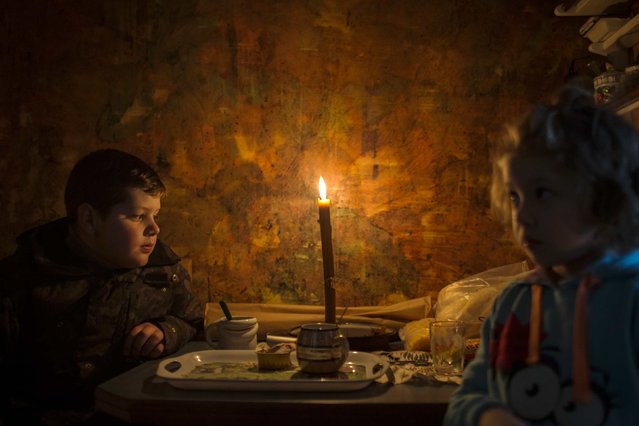
Lazar and his sister Andjelka sit by a candle in their home in the eastern Serbian town of Majdanpek, December 4, 2014. Electricity workers in Serbia struggled through snow, ice and treacherous terrain on Thursday to restore electricity to an eastern town left shivering without power, heating or running water for a fourth day. (Photo by Marko Djurica/Reuters)

Lazar and his sister Andjelka sit by a candle in their home in the eastern Serbian town of Majdanpek, December 4, 2014. Electricity workers in Serbia struggled through snow, ice and treacherous terrain on Thursday to restore electricity to an eastern town left shivering without power, heating or running water for a fourth day. (Photo by Marko Djurica/Reuters)
Details
08 Dec 2014 12:20:00
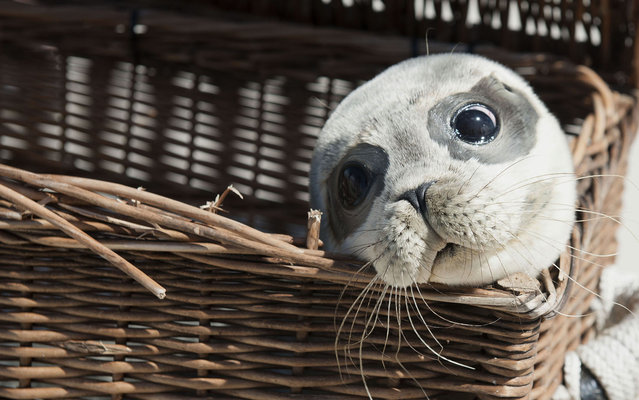
Seehund “Bruno” looks out of his transport box before making his way to the water on the beach of the island of Juist, Germany on August 14, 2013. Four young seals were released after six weeks of recovery at a rescue station in Norden-Norddeich. (Photo by Carmen Jaspersen/AFP Photo/DPA)

Seehund “Bruno” looks out of his transport box before making his way to the water on the beach of the island of Juist, Germany on August 14, 2013. Four young seals were released after six weeks of recovery at a rescue station in Norden-Norddeich. (Photo by Carmen Jaspersen/AFP Photo/DPA)
Details
31 Aug 2013 14:16:00
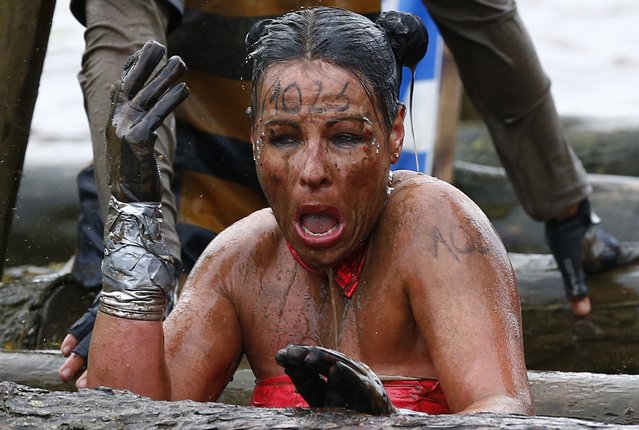
A competitor reacts as she emerges from the water during the Tough Guy event in Perton, central England, January 26, 2014. (Photo by Darren Staples/Reuters)

A competitor reacts as she emerges from the water during the Tough Guy event in Perton, central England, January 26, 2014. The annual Tough Guy race – “the toughest race in the world” – at Perton in Staffordshire. Tough Guy claims to be the world’s most demanding one-day survival ordeal. First staged in 1987, the Tough Guy Challenge has been widely described as one of the hardest races of it’s type with up to one-third of the starters failing to finish in a typical year. (Photo by Darren Staples/Reuters)
Details
29 Jan 2014 10:49:00