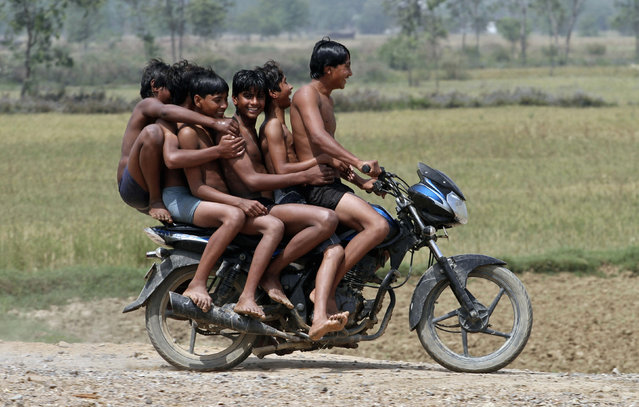
Boys ride a motorbike on their way back home after taking a bath in a canal at Chachura village, in Uttar Pradesh April 4, 2012. (Photo by Parivartan Sharma/Reuters)
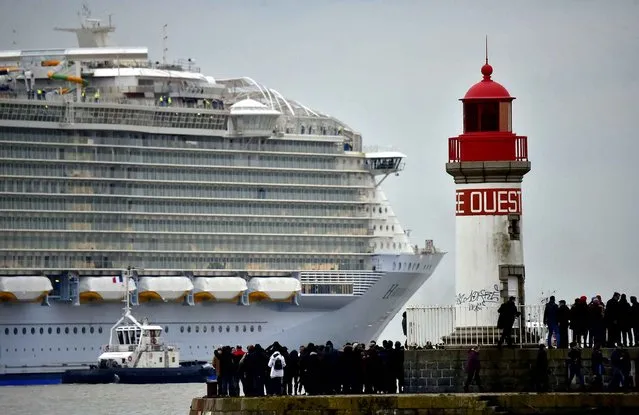
People look at the Harmony of the Seas cruise ship leaving the STX shipyard of Saint-Nazaire, western France, for a three-day test offshore, on March 10, 2016. With a capacity of 6.296 passengers and 2.384 crew members, the Harmony of the Seas, built by STX France for the Royal Caribbean International, is the world's largest ship cruise. (Photo by Loic Venance/AFP Photo)
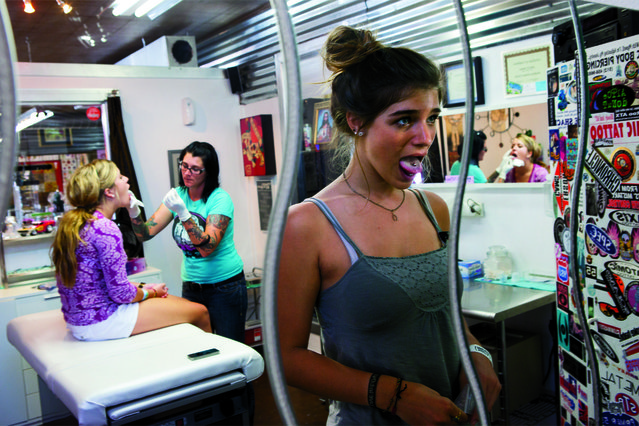
Getting her tongue pierced was “exciting and scary” says a teen who succumbed to pressure from her best friend in Austin, Texas, February 22, 2008. This image is featured in National Geographic's exhibition “Women of Vision: National Geographic Photographers on Assignment”, on view at the Palm Beach Photographic Centre, Jan. 22 - Mar. 22, 2015. (Photo by Kitra Cahana/National Geographic)
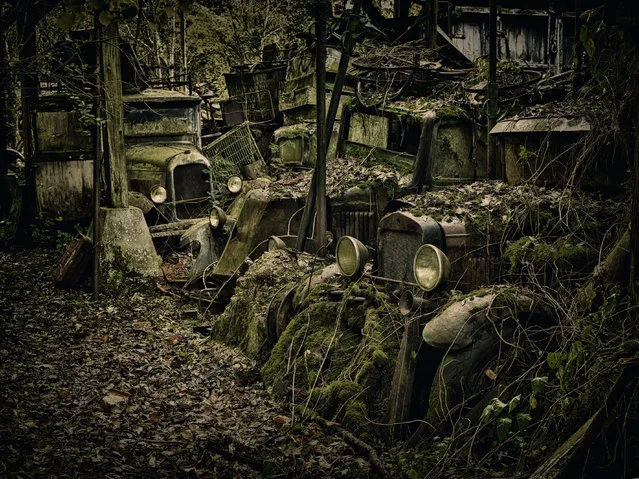
Leaves and forest foliage claim abandoned motors at makeshift car graveyards. German photographer Dieter Klein travels the world to find vintage automobiles left to rust in leafy forests and fields. Here: Seemingly camouflaged cars are stacked on top of each other causing them to blend in with the landscape, in 2013, France. (Photo by Dieter Klein/Barcroft Media)
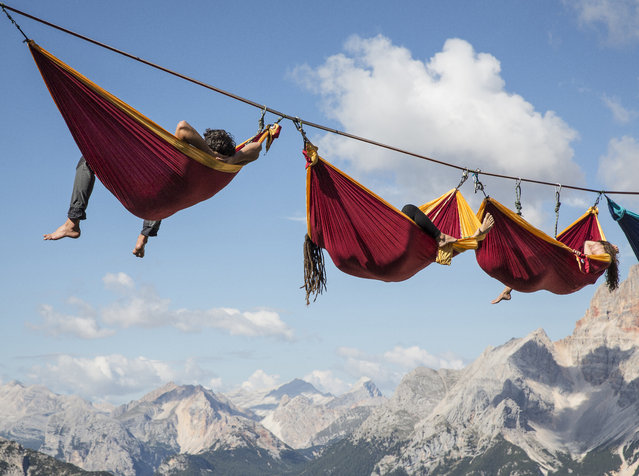
Doesn’t taking a nap in a hammock outdoors sound lovely? Perhaps not when you’re hanging in the air, thousands of feet above ground, between two mountains in the Italian Alps! Which is exactly what these adventurous folks did during the International Highline Meeting in Monte Piana, Italy. (Photo by Sebastian Wahlhuetter Photography)
West Bromwich Albion's Saido Berahino (front) is challenged by Manchester City's Fernandinho during their English Premier League soccer match at The Hawthorns in West Bromwich, central England December 4, 2013. (Photo by Eddie Keogh/Reuters)
On August 31, 2012, a long filament of solar material that had been hovering in the sun's atmosphere, the corona, erupted out into space at 4:36 p.m. EDT. The coronal mass ejection, or CME, traveled at over 900 miles per second. The CME did not travel directly toward Earth, but did connect with Earth's magnetic environment, or magnetosphere, causing aurora to appear on the night of Monday, September 3. (Photo by NASA/GSFC/SDO via The Atlantic)