Loading...
Done
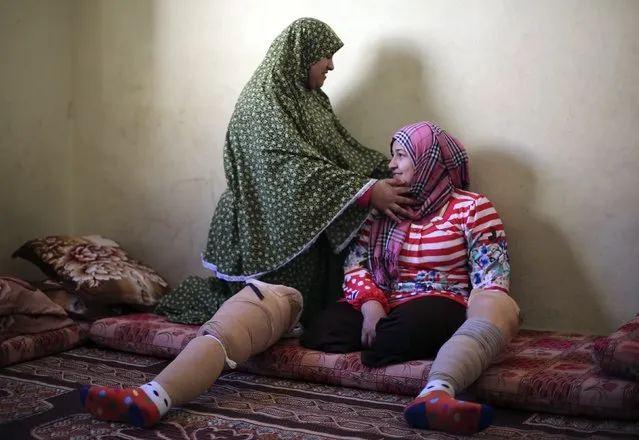
Palestinian girl Manar Al-Shinbari (R), 15, who lost her both legs by what medics said was Israeli shelling at a UN-run school where she was taking refuge during the 50-day war last summer, is helped by her sister to put on her headscarf in an apartment in Jabaliya refugee camp in the northern Gaza Strip January 13, 2015. (Photo by Mohammed Salem/Reuters)

Palestinian girl Manar Al-Shinbari (R), 15, who lost her both legs by what medics said was Israeli shelling at a UN-run school where she was taking refuge during the 50-day war last summer, is helped by her sister to put on her headscarf in an apartment in Jabaliya refugee camp in the northern Gaza Strip January 13, 2015. Manar's mother and three of her brothers were killed in the same incident. The girl's family house was destroyed by Israeli shelling during the war. (Photo by Mohammed Salem/Reuters)
Details
14 Jan 2015 12:34:00
A visitor looks down from a terrace at a Volkswagen Beetle owners' meeting in Sao Bernardo do Campo January 25, 2015. Around 1000 Volkswagen Beetle cars took part in this event as part of celebrations marking Brazil's annual National Volkswagen Beetle day, which falls on January 20. (Photo by Paulo Whitaker/Reuters)

A visitor looks down from a terrace at a Volkswagen Beetle owners' meeting in Sao Bernardo do Campo January 25, 2015. Around 1000 Volkswagen Beetle cars took part in this event as part of celebrations marking Brazil's annual National Volkswagen Beetle day, which falls on January 20. (Photo by Paulo Whitaker/Reuters)
Details
26 Jan 2015 11:36:00
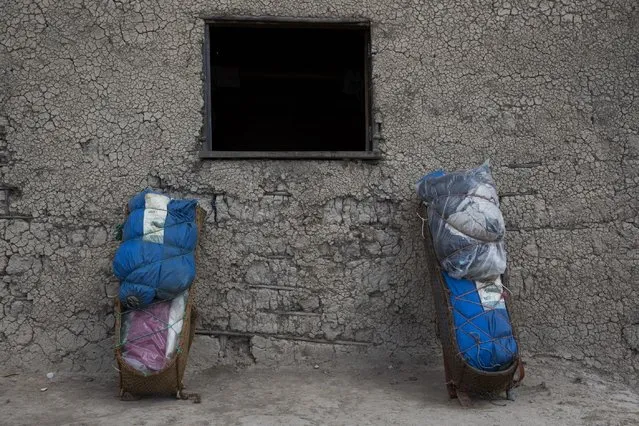
Indigenous woven backpacks called guayare are seen in front of a house in Paraitepui village, before a walking excursion to Mount Roraima, near Venezuela's border with Brazil January 13, 2015. A mysterious table-topped mountain on the Venezuela-Brazil border that perplexed 19th century explorers and inspired “The Lost World” novel is attracting ever more modern-day adventurers. (Photo by Carlos Garcia Rawlins/Reuters)

Indigenous woven backpacks called guayare are seen in front of a house in Paraitepui village, before a walking excursion to Mount Roraima, near Venezuela's border with Brazil January 13, 2015. A mysterious table-topped mountain on the Venezuela-Brazil border that perplexed 19th century explorers and inspired “The Lost World” novel is attracting ever more modern-day adventurers. (Photo by Carlos Garcia Rawlins/Reuters)
Details
04 Feb 2015 12:09:00
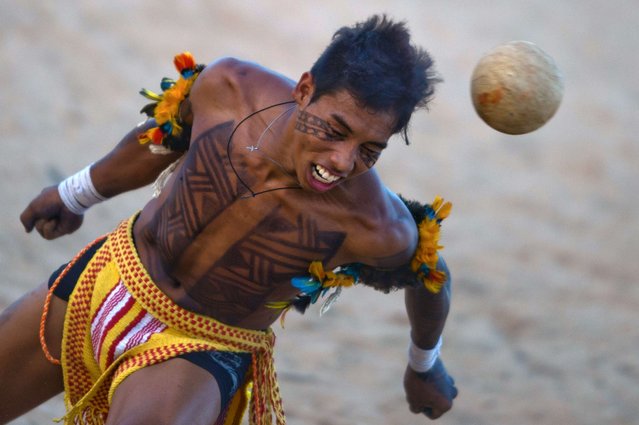
Brazilian natives of the Pareci tribe play head football with a hand-made ball for a demonstration, during the first day of the International Games of Indigenous Peoples, in Cuiaba, state of Mato Grosso, on November 10, 2013. 1500 natives from 49 Brazilian ethnic groups and from another 17 countries are gathering in Cuiaba until November 16 to compete in some 30 athletic disciplines, many of their own. (Photo by Christophe Simon/AFP Photo)

Brazilian natives of the Pareci tribe play head football with a hand-made ball for a demonstration, during the first day of the International Games of Indigenous Peoples, in Cuiaba, state of Mato Grosso, on November 10, 2013. 1500 natives from 49 Brazilian ethnic groups and from another 17 countries are gathering in Cuiaba until November 16 to compete in some 30 athletic disciplines, many of their own. (Photo by Christophe Simon/AFP Photo)
Details
13 Nov 2013 11:50:00
A person drags a suitcase as a boy clings to it on a square in front of a railway station ahead of the Chinese Lunar New Year in Qingdao, Shandong province, January 28, 2014. About 3.62 billion trips will be made during the 40-day Spring Festival travel rush, which started from January 16, reported Xinhua News Agency citing a government official. (Photo by Reuters/China Daily)

A person drags a suitcase as a boy clings to it on a square in front of a railway station ahead of the Chinese Lunar New Year in Qingdao, Shandong province, January 28, 2014. About 3.62 billion trips will be made during the 40-day Spring Festival travel rush, which started from January 16, reported Xinhua News Agency citing a government official. (Photo by Reuters/China Daily)
Details
04 Feb 2014 09:06:00
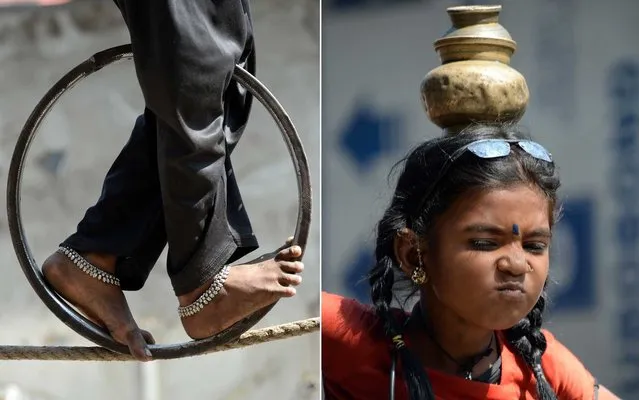
Nine year old girl Barsati reacts while walking on a tightrope in Mumbai on February 11, 2014. Barsati, and her younger brother Rajababu, (4) earn an average of around 2000 rupees (32 dollars) per day from pedestrians and tourists performing various acts on the tightrope near the city's iconic landmark Gateway of India. (Photo by Indranil Mukherjee/AFP Photo)

Nine year old girl Barsati reacts while walking on a tightrope in Mumbai on February 11, 2014. Barsati, and her younger brother Rajababu, (4) earn an average of around 2000 rupees (32 dollars) per day from pedestrians and tourists performing various acts on the tightrope near the city's iconic landmark Gateway of India. (Photo by Indranil Mukherjee/AFP Photo)
Details
15 Feb 2014 12:02:00
This picture taken on February 23, 2014 shows participants wearing dresses running half-naked in the annual 3.5 km Undie Run held in the Olympic Forest Park smog-covered Beijing. Some 200 participants took part in this event, many of them with gas masks,  as dangerous smog blighted swathes of northern China in recent days. (Photo by AFP Photo/STR)

This picture taken on February 23, 2014 shows participants wearing dresses running half-naked in the annual 3.5 km Undie Run held in the Olympic Forest Park smog-covered Beijing. Some 200 participants took part in this event, many of them with gas masks, as dangerous smog blighted swathes of northern China in recent days. (Photo by AFP Photo/STR)
Details
26 Feb 2014 10:26:00
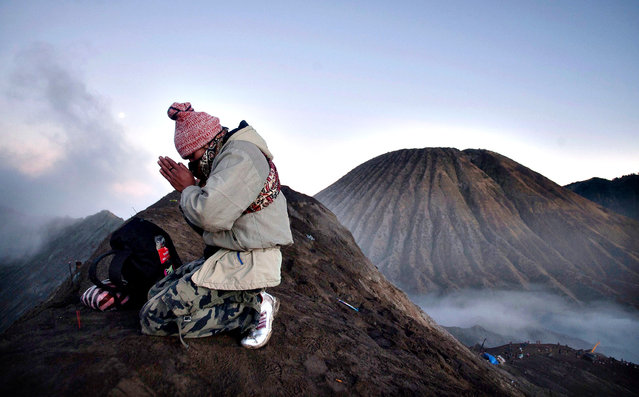
A Tengger tribesman prays at Mount Bromo during the annual Kasada ceremony in East Java on August 12, 2014. The Kasada ceremony is a festival held every 14th day of the Kasada month in the traditional Hindu lunar calender to honour Sang Hyang Widhi (God Almighty) and is based on the legend of Roro Anteng and Joko Seger from the Majapahit Kingdom, from which their Tengger tribe name originates. (Photo by Juni Kriswanto/AFP Photo)

A Tengger tribesman prays at Mount Bromo during the annual Kasada ceremony in East Java on August 12, 2014. The Kasada ceremony is a festival held every 14th day of the Kasada month in the traditional Hindu lunar calender to honour Sang Hyang Widhi (God Almighty) and is based on the legend of Roro Anteng and Joko Seger from the Majapahit Kingdom, from which their Tengger tribe name originates. Hundreds of worshippers from the Tengger tribe offer food and livestock as a symbolic sacrifice which they throw into the crater for the blessings of safety and prosperity to their familyies and community. (Photo by Juni Kriswanto/AFP Photo)
Details
16 Aug 2014 11:19:00