Loading...
Done
Tridacna Gigas, or Giant Clams

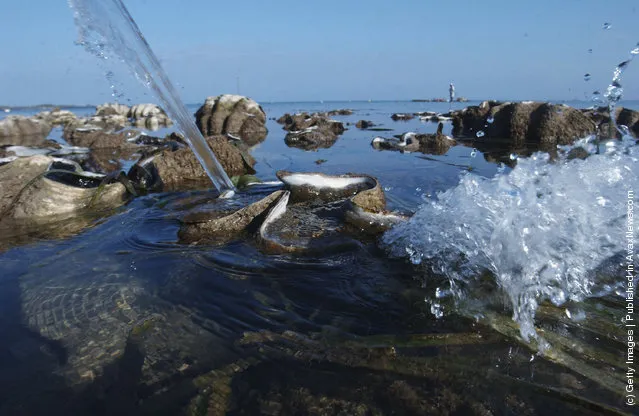
“The giant clam, Tridacna gigas (known as pā’ua in Cook Islands Māori), is the largest living bivalve mollusc. T. gigas is one of the most endangered clam species. It was mentioned as early as 1825 in scientific reports. One of a number of large clam species native to the shallow coral reefs of the South Pacific and Indian oceans, they can weigh more than 200 kilograms (440 lb) measure as much as 120 cm (47 in) across, and have an average lifespan in the wild of 100 years or more”. – Wikipedia

Photo: Tridacna Gigas, or Giant Clams spew water as a traditional fisherman passes by a small sanctuary on January 23, 2004 near Bolinao in the Northern Philippines. The clams, prime builders for coral reefs and providing shelter for spawning fish and other marine life, are exposed by low tides in the sanctuary. Overfishing and pollution throughout the country are not only threatening food security, but are also starting to choke one of the few working clam sanctuaries in the world. (Photo by David Greedy/Getty Images)
Details
01 Oct 2011 13:10:00


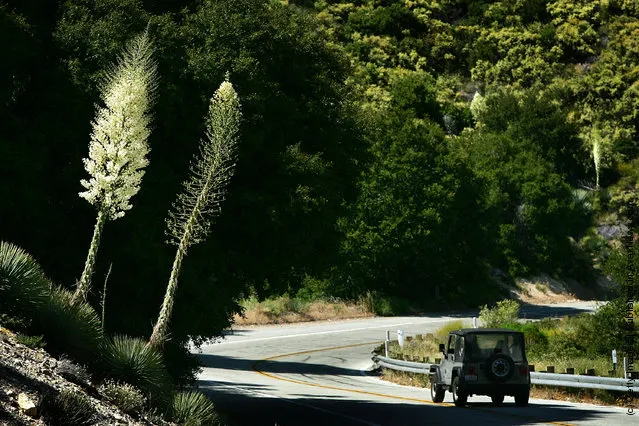
“Yucca is a genus of perennial shrubs and trees in the agave family, Agavaceae. Its 40-50 species are notable for their rosettes of evergreen, tough, sword-shaped leaves and large terminal panicles of white or whitish flowers. They are native to the hot and dry (arid) parts of North America, Central America, South America, and the Caribbean. Early reports of the species were confused with the cassava (Manihot esculenta). Consequently, Linnaeus mistakenly derived the generic name from the Carib word for the latter, yuca. It is also colloquially known in the midwest United States as “Ghosts in the graveyard”, as it is commonly found growing in rural graveyards and when in bloom the flowers appear as an apparition floating.” – Wikipedia

Photo: A yucca standing among flowers bursts forth a very large stalk of flowers as a heavy wildflower bloom on June 21, 2005 in the Angeles National Forest northwest of La Canada, California. (Photo by David McNew/Getty Images)
Details
29 Mar 2011 07:31:00
Miss Exotic World Pageant

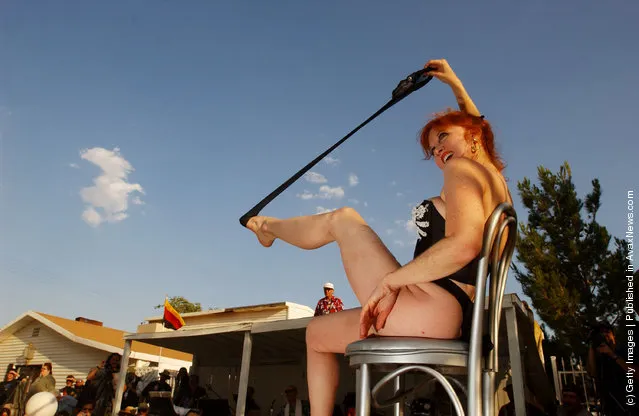
“The Miss Exotic World Pageant (officially, the Miss Exotic World Pageant and Striptease Reunion) is an annual neo-burlesque pageant and convention, and is the annual showcase event (and fundraiser for) the Burlesque Hall of Fame (formerly the Exotic World burlesque museum). The pageant, sometimes referred to as the “Miss America of Burlesque”, attracts former burlesque queens from past decades, as well as current participants of the neo-burlesque scene. The pageant consists of burlesque performances spanning a weekend, culminating with the competition to crown a single performer as Miss Exotic World. Because of the significance of the Exotic World Burlesque Museum to the burlesque community, winning the pageant is considered a top honor for a burlesque performer”. – Wikipedia

Here: Stephanie Blake removes a stocking at the Miss Exotic World Pageant at the Exotic World Burlesque Museum on June 7, 2003 in Helendale outside of Barstow, California. (Photo by David McNew/Getty Images)
Details
01 Aug 2011 12:07:00
Girls, who are part of Afghan Mobile Mini Circus for Children (MMCC), participate in a juggling competition in Kabul, Afghanistan August 12, 2015. (Photo by Ahmad Masood/Reuters)

Girls, who are part of Afghan Mobile Mini Circus for Children (MMCC), participate in a juggling competition in Kabul, Afghanistan August 12, 2015. The MMCC, founded by David Mason from Denmark, teaches cooperation and creativity to children scarred by years of war in Afghanistan. Despite the dangers, the project has grown so popular that it now runs centres in ten provinces and has hundreds of regular students. The circus makes visits to internally displaced persons' camps, schools, orphanages, and holds annual festivals. The children are taught the skills of juggling clubs, walking on stilts and acrobatics. (Photo by Ahmad Masood/Reuters)
Details
01 Sep 2015 12:47:00
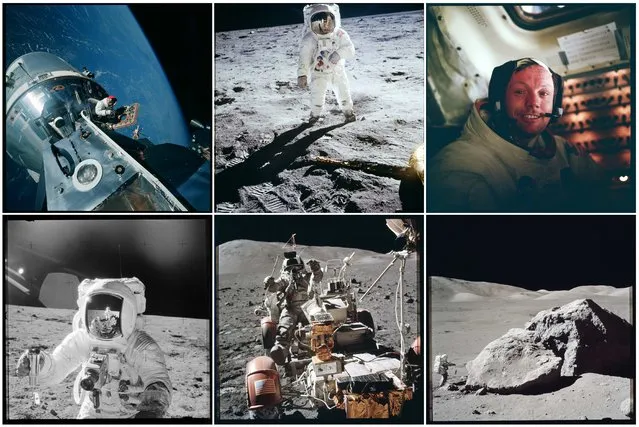
NASA handout photographs from the various Apollo missions are shown in this combination photograph. The photographs are some of more than 12,000 from NASA's archives recently aggregated on the Project Apollo Archive Flickr account. (Photo by Reuters/NASA)

NASA handout photographs from the various Apollo missions are shown in this combination photograph. The photographs are some of more than 12,000 from NASA's archives recently aggregated on the Project Apollo Archive Flickr account. (Top L) David R. Scott, command module pilot, stands in the open hatch of the Command Module during the Apollo 9 mission March 6, 1969. (Top centre) Edwin "Buzz" Aldrin Jr.walks on the surface of the moon during the Apollo 11 mission July 20, 1969. (Top R) Neil Armstrong, Apollo 11 commander, is pictured inside the Lunar Module during the Apollo 11 mission July 20, 1969. (Bottom L) Alan Bean holds a container filled with lunar soil collected during the Apollo 12 mission November 19, 1969. (Bottom centre) Scientist-astronaut Harrison Schmitt rides in the Lunar Roving Vehicle during the Apollo 17 mission December 13, 1972. (Bottom R) Harrison Schmitt stands next to a huge, split boulder during the Apollo 17 mission December 13, 1972. (Photo by Reuters/NASA)
Details
13 Oct 2015 08:02:00
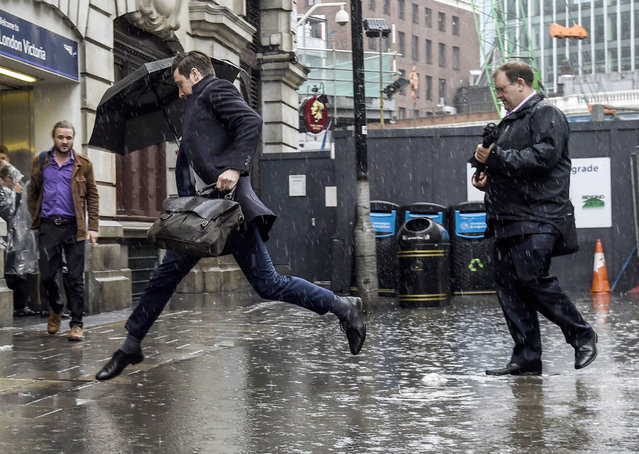
A man jumps over a puddle outside Victoria Station, as heavy rain falls,  in London, Monday June 20, 2016. Monday marks the Summer Solstice – the longest day of the year and the astronomical change of seasons when days are longest and nights are shortest in the Northern Hemisphere. (Photo by Lauren Hurley/PA Wire via AP Photo)

A man jumps over a puddle outside Victoria Station, as heavy rain falls, in London, Monday June 20, 2016. Monday marks the Summer Solstice – the longest day of the year and the astronomical change of seasons when days are longest and nights are shortest in the Northern Hemisphere. (Photo by Lauren Hurley/PA Wire via AP Photo)
Details
21 Jun 2016 07:25:00
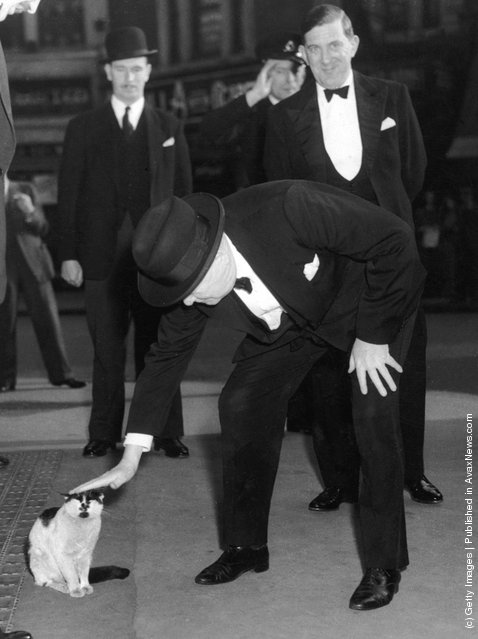
British prime minister Winston Churchill (1874 - 1965) stops to pet a cat at Liverpool Street Station, 24th May 1952

British prime minister Winston Churchill (1874–1965) stops to pet a cat at Liverpool Street Station, 24th May 1952. (Photo by Keystone/Hulton Archive/Getty Images)
Details
23 Nov 2011 12:17:00


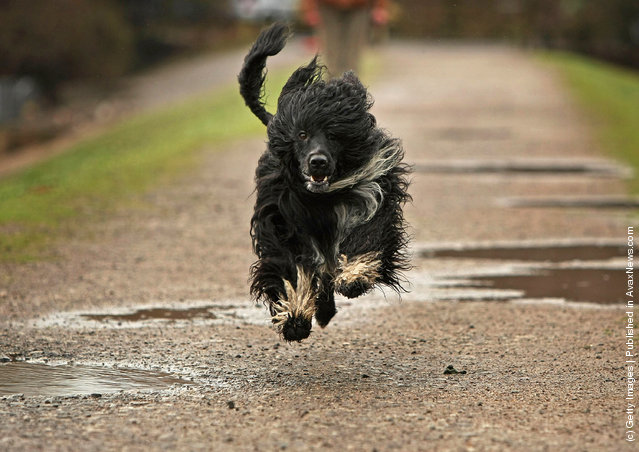
“The Portuguese Water Dog is a breed of working dog as classified by the American Kennel Club. Portuguese Water Dogs are originally from the Portuguese region of the Algarve, from where the breed expanded to all around Portugal's coast, where they were taught to herd fish into fishermen's nets, to retrieve lost tackle or broken nets, and to act as couriers from ship to ship, or ship to shore. Portuguese Water Dogs rode in bobbing fishing trawlers as they worked their way from the warm Atlantic waters of Portugal to the frigid fishing waters off the coast of Iceland where the fleets caught cod to bring home. Portuguese Water Dogs were often taken with sailors during the Portuguese discoveries”. – Wikipedia

Photo: Kix, a Portuguese Water Dog , enjoys a walk around the muddy fields near his home before the grooming and preparation starts for this years Crufts on March 3, 2009 in Telford, England. (Photo by Christopher Furlong/Getty Images)
Details
26 Jul 2011 11:27:00