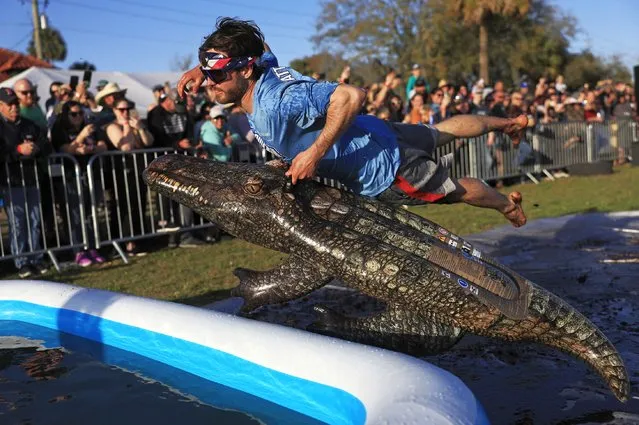
Ben Green, of St. Augustine, flies into the pool on his inflatable alligator to find the hidden lizard at the bottom of the pool in the “Evading Arrest Obstacle Course” during the inaugural Florida Man Games, Saturday, February 24, 2024, at Francis Field in St. Augustine, Fla. (Photo by Corey Perrine/The Florida Times-Union via AP Photo)
People gather outside Red Square and the Kremlin for the New Year celebrations in downtown Moscow late on December 31, 2023. (Photo by Tatyana Makeyeva/AFP Photo)
“One Third” – a project on food waste by an Austrian photography Klaus Pichler. According to a UN study one third of the world's food goes to waste – the largest part thereof in the industrialized nations of the global north. Equally, 925 million people around the world are threatened by starvation. The series “One Third” describes the connection between individual wastage of food and globalized food production.
Photo: Pineapple. Place of production: Guayaquil, Ecuador. Cultivation method: Outdoor plantation • Time of harvest: All- season. Transporting distance: 10.666 km (linear distance) • Means of transportation: Aircraft, truck. Carbon footprint (total) per kg: 11,94 kg • Water requirement (total) per kg: 360 l. Price: 2,10 € / kg. (Photo by Klaus Picher)
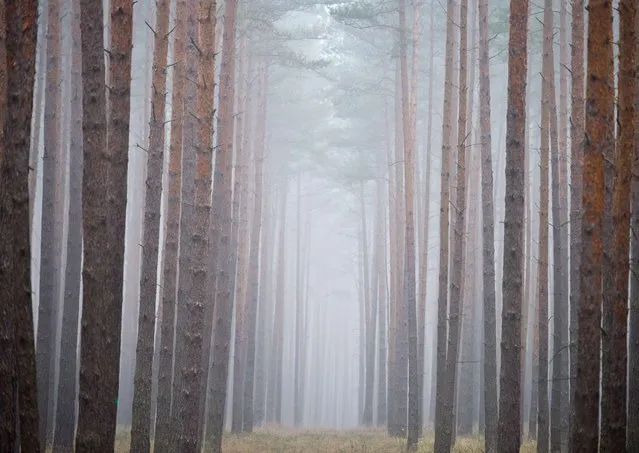
Fog hangs between pine trees in a forest near Neubrueck, eastern Germany, on November 20, 2012. Meteorologists forecast cloudy sky and temperatures around 5 degrees Celsius for the region. (Photo by Patrick Pleul/AFP Photo)
Soldiers of China's People's Liberation Army (PLA) jump as part of their winter training in temperature of negative 26 degrees Celsius at China's border with Russia in Heihe, Heilongjiang province, December 14, 2015. (Photo by Reuters/Stringer)
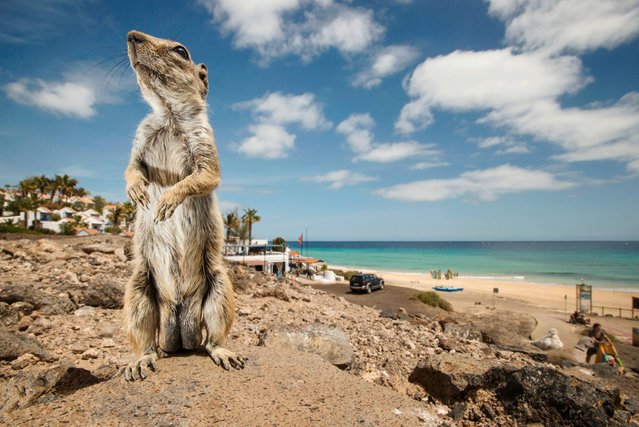
From towering elephants to tiny insects, photographers will be offering a rare insight into the natural world at this year’s Wildscreen Photography Festival 2014. The festival, formerly known as WildPhotos, is the UK’s largest wildlife photography show. The Wildscreen Photography Festival 2014 will be taking place between 24-26 October at London’s Royal Geographical Society. (Photo by Sam Hobson/Wildscreen Photography Festival 2014)
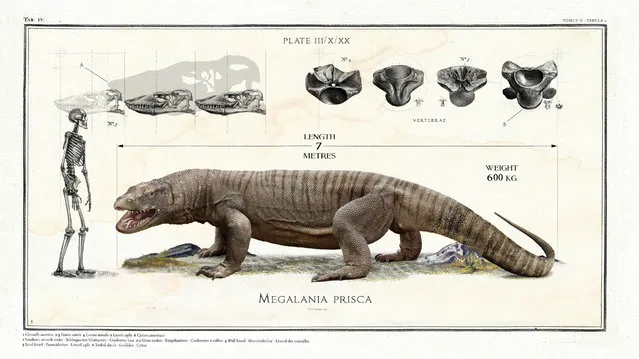
Fossil records indicate that this early lizard, Megalania (Megalania prisca or Varanus priscus), was a whopping seven metres in length. They were part of a megafaunal assemblage that inhabited southern Australia during the Pleistocene. The youngest fossil remains date to around 50,000 years ago. The first aboriginal settlers of Australia might have encountered them and been a factor in their extinction. (Photo by Sky TV/The Guardian)