Loading...
Done
A man shaves blocks of salt from the Danakil Depression on 28 March 2017, in Afar, Ethiopia. (Photo by Zacharias Abubeker/AFP Photo)

A man shaves blocks of salt from the Danakil Depression on 28 March 2017, in Afar, Ethiopia. Every morning, hundreds of men converge on a dry lakebed in a remote corner of Ethiopia, where they cleave the ground open with handaxes to extract salt, just as their fathers and grandfathers once did. (Photo by Zacharias Abubeker/AFP Photo)
Details
19 Apr 2017 08:57:00
An Afghan driver stands amid boxes of dry food next to his damaged truck at the site of an accident near the Pakistan-Afghanistan border crossing point in Chaman, Pakistan on August 20, 2021. (Photo by AFP Photo/Stringer Network)

An Afghan driver stands amid boxes of dry food next to his damaged truck at the site of an accident near the Pakistan-Afghanistan border crossing point in Chaman, Pakistan on August 20, 2021. (Photo by AFP Photo/Stringer Network)
Details
17 Sep 2021 09:18:00
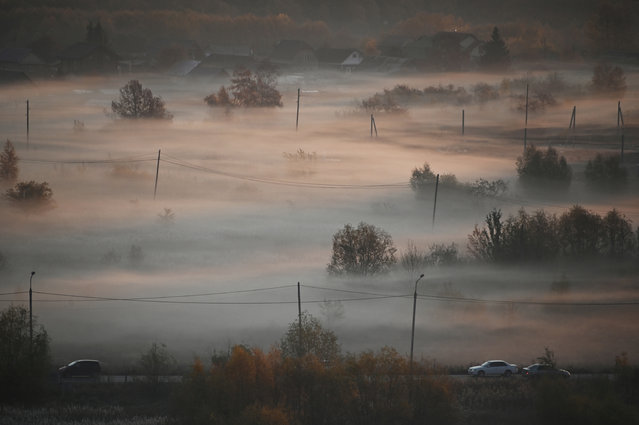
A morning fog is seen in the Siberian city of Omsk, Russia on October 8, 2019. (Photo by Alexey Malgavko/Reuters)

A morning fog is seen in the Siberian city of Omsk, Russia on October 8, 2019. (Photo by Alexey Malgavko/Reuters)
Details
19 Oct 2019 00:03:00
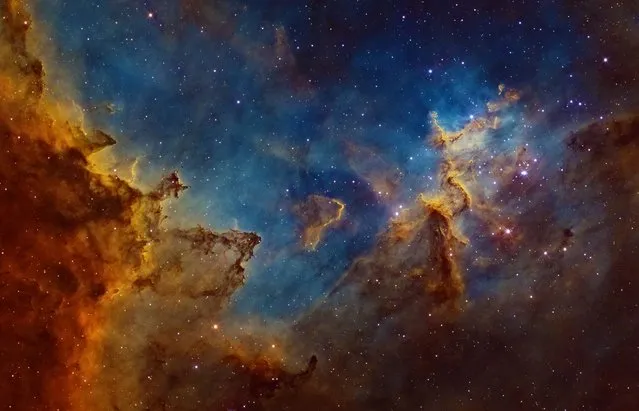
Centre of the Heart Nebula by Ivan Eder (Hungary). Situated 7500 light years away in the ‘W’-shaped constellation of Cassiopeia, the Heart Nebula is a vast region of glowing gas, energized by a cluster of young stars at its centre. The image depicts the central region, where dust clouds are being eroded and moulded into rugged shapes by the searing cosmic radiation. (Photo by Ivan Eder)

The competition, which is run by the Royal Observatory Greenwich in association with BBC Sky at Night Magazine, is now in its sixth year and has received over 2,500 entries. Photo: Centre of the Heart Nebula by Ivan Eder (Hungary). Situated 7500 light years away in the “W”-shaped constellation of Cassiopeia, the Heart Nebula is a vast region of glowing gas, energized by a cluster of young stars at its centre. The image depicts the central region, where dust clouds are being eroded and moulded into rugged shapes by the searing cosmic radiation. (Photo by Ivan Eder)
Details
03 Jul 2014 11:59:00
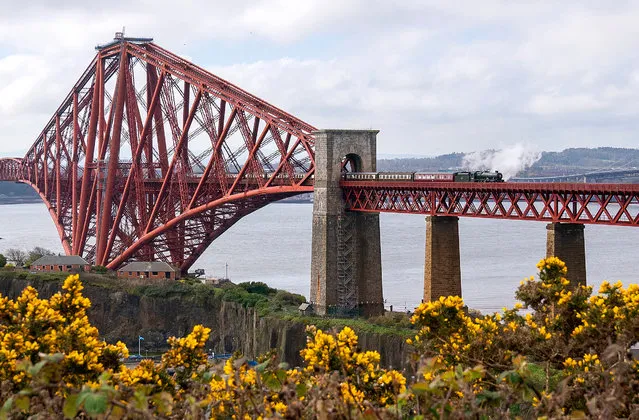
Jubilee Class steam locomotive 45596 Bahamas crosses the Forth Bridge on its way from Edinburgh Waverley to Aberdeen on a day trip operated by The Railway Touring Company on Wednesday, April 19, 2023. (Photo by Jane Barlow/PA Images via Getty Images)

Jubilee Class steam locomotive 45596 Bahamas crosses the Forth Bridge on its way from Edinburgh Waverley to Aberdeen on a day trip operated by The Railway Touring Company on Wednesday, April 19, 2023. (Photo by Jane Barlow/PA Images via Getty Images)
Details
03 Aug 2023 03:44:00
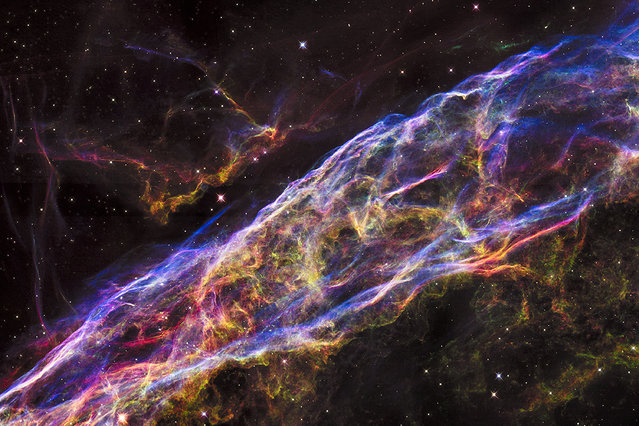
A small section of the expanding remains of the Veil Nebula, a massive star that exploded about 8,000 years ago. The entire nebula is 110 light-years across, covering six full moons on the sky as seen from Earth, and resides about 2,100 light-years away in the constellation Cygnus, the Swan. Image taken by NASA's Hubble Space Telescope. Released September 24, 2015. (Photo by Reuters/NASA/ESA/Hubble Heritage Team)

A small section of the expanding remains of the Veil Nebula, a massive star that exploded about 8,000 years ago. The entire nebula is 110 light-years across, covering six full moons on the sky as seen from Earth, and resides about 2,100 light-years away in the constellation Cygnus, the Swan. Image taken by NASA's Hubble Space Telescope. Released September 24, 2015. (Photo by Reuters/NASA/ESA/Hubble Heritage Team)
Details
10 Dec 2015 08:01:00
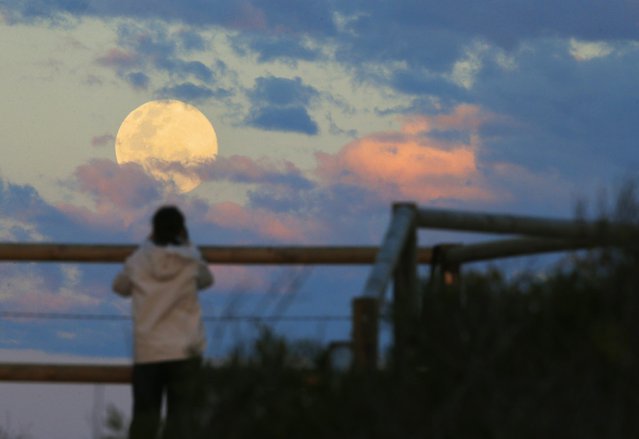
Sydney resident Virginia Maddock watches the supermoon rise off the Sydney beachside suburb of Wanda, August 10, 2014. The astronomical event occurs when the moon is closest to the Earth in its orbit, making it appear much larger and brighter than usual. (Photo by Jason Reed/Reuters)

Sydney resident Virginia Maddock watches the supermoon rise off the Sydney beachside suburb of Wanda, August 10, 2014. Sunday’s moon was at its closest approach to Earth, appearing bigger and brighter than any other moon this year. The moon was 221,765 miles away and looked 16 percent larger and 30 percent brighter than usual. (Photo by Jason Reed/Reuters)
Details
11 Aug 2014 11:50:00
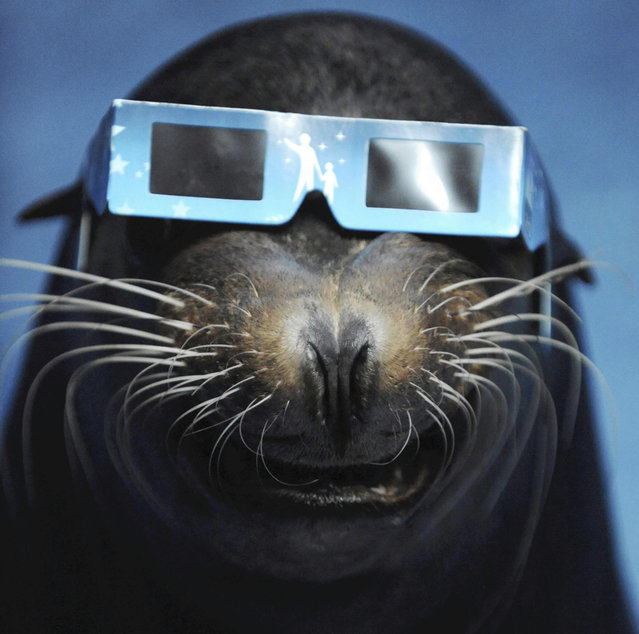
A sea lion

A sea lion wears a solar viewer during an annular solar eclipse at an aquarium in Tokyo, May 21, 2012. (Yomiuri Shimbun/Reuters)
Details
06 Jun 2012 02:28:00