Loading...
Done
Four orphan barn owl chicks were found weak from hunger and thirst after their mother's death, are under treatment at the Dicle Wildlife Rescue and Rehabilitation Center before being released back into their natural habitat on September 23, 2025, in Diyarbakir, Turkiye. (Photo by Bestami Bodruk/Anadolu via Getty Images)

Four orphan barn owl chicks were found weak from hunger and thirst after their mother's death, are under treatment at the Dicle Wildlife Rescue and Rehabilitation Center before being released back into their natural habitat on September 23, 2025, in Diyarbakir, Turkiye. (Photo by Bestami Bodruk/Anadolu via Getty Images)
Details
05 Oct 2025 03:51:00
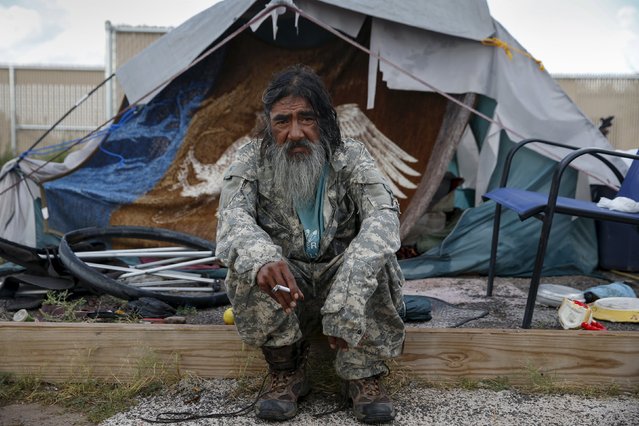
Daniel J. Wabsey, a 58-year-old war veteran, sits outside his tent at Camp Hope in Las Cruces, New Mexico October 6, 2015. “I've been traveling for 35 or 38 years. Getting inside would take a while to get used to. I just want to be able to eat, sleep and be safe. We all get along and understand in Camp Hope. We've all been there. With common sense you can survive out here”, Wabsey said. Camp Hope describe themselves as an “alternative transitional living project for the homeless”. Around 50 people live at the camp. (Photo by Shannon Stapleton/Reuters)

Daniel J. Wabsey, a 58-year-old war veteran, sits outside his tent at Camp Hope in Las Cruces, New Mexico October 6, 2015. “I've been traveling for 35 or 38 years. Getting inside would take a while to get used to. I just want to be able to eat, sleep and be safe. We all get along and understand in Camp Hope. We've all been there. With common sense you can survive out here”, Wabsey said. Camp Hope describe themselves as an “alternative transitional living project for the homeless”. Around 50 people live at the camp. (Photo by Shannon Stapleton/Reuters)
Details
19 Dec 2015 08:05:00
This Thursday, April 30, 2015 photo shows Lebanese citizens walking on the Corniche, or waterfront promenade in Beirut, Lebanon. (Photo by Hassan Ammar/AP Photo)

This Thursday, April 30, 2015 photo shows Lebanese citizens walking on the Corniche, or waterfront promenade in Beirut, Lebanon. This photo was shot through the lowered veil of a niqab, which is worn by some conservative Muslim women. The cloth allows women to follow a strict interpretation of their religious beliefs by preventing others from seeing their faces. (Photo by Hassan Ammar/AP Photo)
Details
18 May 2015 11:42:00
Boys play with a drainage culvert used for flood control in Las Pinas, Metro Manila February 28, 2016. (Photo by Erik De Castro/Reuters)

Boys play with a drainage culvert used for flood control in Las Pinas, Metro Manila February 28, 2016. (Photo by Erik De Castro/Reuters)
Details
13 Mar 2016 10:41:00
(L-R) Edmea Pereira, 69, Elsa Rodrigues, 61, and Osmidio Conde, 71, take part in their surf class in Santos, Sao Paulo state, Brazil, March 16, 2016. (Photo by Nacho Doce/Reuters)

(L-R) Edmea Pereira, 69, Elsa Rodrigues, 61, and Osmidio Conde, 71, take part in their surf class in Santos, Sao Paulo state, Brazil, March 16, 2016. When work is up, surf is up in Brazil, as a group of retired citizens take to the waves in keep-fit, keep-young sessions at a surf school in the city of Santos. The classes are run for free, three times a week at the Cisco Arana school, which aims to prove that age is just a number. (Photo by Nacho Doce/Reuters)
Details
19 Mar 2016 12:31:00
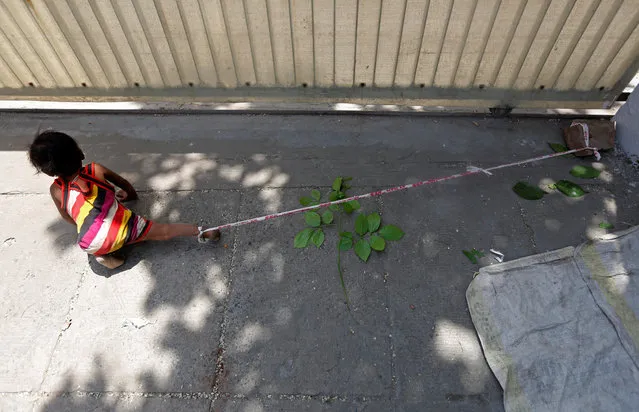
Barrier tape is tied around 15-month-old Shivani's ankle to prevent her from running away, while her mother Sarta Kalara works at a construction site nearby, in Ahmedabad, India, April 19, 2016. Kalara says she has no option but to tether her daughter Shivani to a stone despite her crying, while she and her husband work for 250 rupees ($3.8) each a shift digging holes for electricity cables in the city of Ahmedabad. There are about 40 million construction workers in India, at least one in five of them women, and the majority poor migrants who shift from site to site, building infrastructure for India's booming cities. Across the country it is not uncommon to see young children rolling in the sand and mud as their parents carry bricks or dig for new roads or luxury houses. (Photo by Amit Dave/Reuters)


Barrier tape is tied around 15-month-old Shivani's ankle to prevent her from running away, while her mother Sarta Kalara works at a construction site nearby, in Ahmedabad, India, April 19, 2016. Kalara says she has no option but to tether her daughter Shivani to a stone despite her crying, while she and her husband work for 250 rupees ($3.8) each a shift digging holes for electricity cables in the city of Ahmedabad. There are about 40 million construction workers in India, at least one in five of them women, and the majority poor migrants who shift from site to site, building infrastructure for India's booming cities. Across the country it is not uncommon to see young children rolling in the sand and mud as their parents carry bricks or dig for new roads or luxury houses. (Photo by Amit Dave/Reuters)
Details
14 Dec 2016 07:39:00
In this November 18, 2014 photo, Murshida, 12, sits on the lap of her mother Marjina as the train leaves for their village in West Bengal, at a railway station in New Delhi, India. Six months ago, Marjina stepped off a train in New Delhi with her two children, hoping to find a better life after her husband abandoned them without so much as a goodbye. (Photo by Altaf Qadri/AP Photo)

In this November 18, 2014 photo, Murshida, 12, sits on the lap of her mother Marjina as the train leaves for their village in West Bengal, at a railway station in New Delhi, India. Six months ago, Marjina stepped off a train in New Delhi with her two children, hoping to find a better life after her husband abandoned them without so much as a goodbye. The family spent their days at a landfill picking through other people’s garbage to find salvageable bits to resell or recycle. After six months of poverty, illness and shame, they returned to that train station in New Delhi, headed back to an uncertain future to their hometown in West Bengal. (Photo by Altaf Qadri/AP Photo)
Details
09 Dec 2014 09:47:00
In this February 11, 2105 photo, 72-year-old Aurea Murillo prepares to make a pass during a handball match among elderly Aymara indigenous women in El Alto, Bolivia. Dozens of traditional Aymara grandmothers ease many of the aches and pains of aging by practicing a sport that is decidedly untraditional in Bolivia: team handball. (Photo by Juan Karita/AP Photo)

In this February 11, 2105 photo, 72-year-old Aurea Murillo prepares to make a pass during a handball match among elderly Aymara indigenous women in El Alto, Bolivia. Dozens of traditional Aymara grandmothers ease many of the aches and pains of aging by practicing a sport that is decidedly untraditional in Bolivia: team handball. (Photo by Juan Karita/AP Photo)
Details
27 Feb 2015 19:34:00