Loading...
Done
Aurorae category runner-up: Lone Tree under a Scandinavian Aurora by Tom Archer (UK). The photographer decided to explore the area around the hotel on a very crisp -35C evening in Finnish Lapland. When he found this tree, he decided to wait for the misty conditions to change and could not believe his luck when the sky cleared and the aurora came out in the perfect spot. Archer spent about an hour photographing it before his camera started to lock up because of the harsh conditions, but by then he was happy to call it a night. (Photo by Tom Archer/2020 Astronomy Photographer of the Year)

Aurorae category runner-up: Lone Tree under a Scandinavian Aurora by Tom Archer (UK). The photographer decided to explore the area around the hotel on a very crisp -35C evening in Finnish Lapland. When he found this tree, he decided to wait for the misty conditions to change and could not believe his luck when the sky cleared and the aurora came out in the perfect spot. Archer spent about an hour photographing it before his camera started to lock up because of the harsh conditions, but by then he was happy to call it a night. (Photo by Tom Archer/2020 Astronomy Photographer of the Year)
Details
17 Sep 2020 00:03:00
Syrian government troops patrol the newly captured al- Sakhour neighbourhood in the eastern part of the northern city of Aleppo on December 7, 2016 Rebels in Aleppo called for a five- day truce and the evacuation of civilians Wednesday after losing more than three quarters of their territory including the Old City to a Syrian army offensive. (Photo by George Ourfalian/AFP Photo)

Syrian government troops patrol the newly captured al- Sakhour neighbourhood in the eastern part of the northern city of Aleppo on December 7, 2016 Rebels in Aleppo called for a five- day truce and the evacuation of civilians Wednesday after losing more than three quarters of their territory including the Old City to a Syrian army offensive. (Photo by George Ourfalian/AFP Photo)
Details
08 Dec 2016 12:35:00
NASA's rover Opportunity visits Victoria Crater, viewed from orbit by the High Resolution Imaging Science Experiment on NASA's Mars Reconnaissance Orbiter in october of 2006. Opportunity is a small dot on the crater's lip, at top right. Opportunity first reached the crater's rim on September 27, 2006. (Photo by NASA/JPL-Caltech/University of Arizona/The Atlantic)

“NASA's Mars rover Opportunity just celebrated its ninth anniversary on Mars – a mission that was originally meant to last just 90 days...” – The Atlantic. Photo: NASA's rover Opportunity visits Victoria Crater, viewed from orbit by the High Resolution Imaging Science Experiment on NASA's Mars Reconnaissance Orbiter in october of 2006. Opportunity is a small dot on the crater's lip, at top right. Opportunity first reached the crater's rim on September 27, 2006. (Photo by NASA/JPL-Caltech/University of Arizona via The Atlantic)


Details
14 Feb 2013 10:58:00
“Zeybeks”. That's Dance, Sunward and Zeybeks. (Photo by Hasan Baglar/2014 Sony World Photography Awards)

“Zeybeks”. That's Dance, Sunward and Zeybeks. (Photo by Hasan Baglar/2014 Sony World Photography Awards)
Details
07 Feb 2014 08:57:00
A woman greets a street artist at the San Fermin festival in Pamplona, northern Spain July 8, 2016. (Photo by Eloy Alonso/Reuters)

A woman greets a street artist at the San Fermin festival in Pamplona, northern Spain July 8, 2016. (Photo by Eloy Alonso/Reuters)
Details
09 Jul 2016 10:06:00
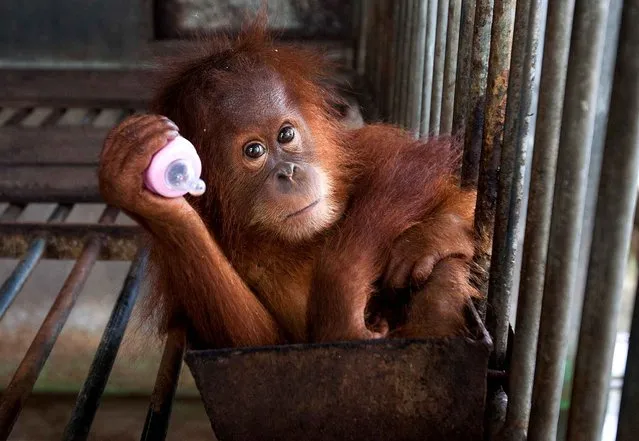
This picture shows a two-year old orangutan seized from a residents house at the provincial Nature Conservation and Agency (BKSDSA) office in Banda Aceh on September 16, 2014. The critically-endangered primates population are dwindling rapidly due to poaching and rapid destruction of their forest habitat that is being converted into palm oil plantations. (Photo by Chaideer Mahyuddin/AFP Photo)

This picture shows a two-year old orangutan seized from a residents house at the provincial Nature Conservation and Agency (BKSDSA) office in Banda Aceh on September 16, 2014. The critically-endangered primates population are dwindling rapidly due to poaching and rapid destruction of their forest habitat that is being converted into palm oil plantations. (Photo by Chaideer Mahyuddin/AFP Photo)
Details
20 Sep 2014 11:09:00
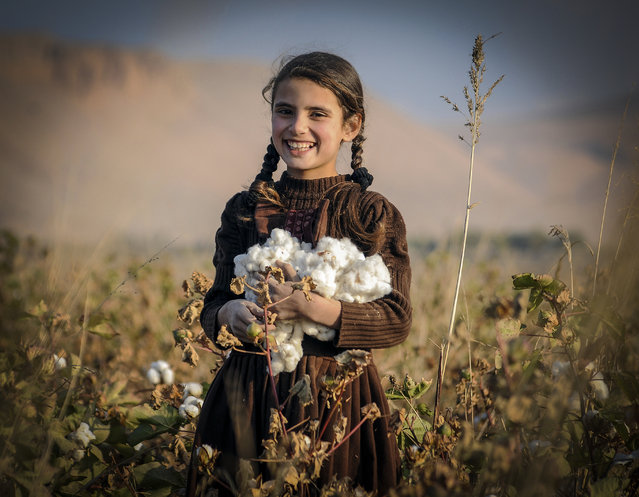
An Afghan girl harvests Cotton buds at a field on the outskirts of Balkh province, Afghanistan, November 15, 2014. (Photo by Sayed Mustafa/EPA)

An Afghan girl harvests Cotton buds at a field on the outskirts of Balkh province, Afghanistan, November 15, 2014. (Photo by Sayed Mustafa/EPA)
Details
22 Nov 2014 13:08:00
An aerial view shows a sinkhole 3.5 km (2 miles) to the east of Solikamsk-2 mine in Perm region, November 20, 2014. Shares in Russia's Uralkali, the world's top potash producer, fell sharply for a second day on Wednesday after a mine accident that could reduce global supplies and push up prices of the crop nutrient worldwide. (Photo by Reuters/Press service of Uralkali company)

An aerial view shows a sinkhole 3.5 km (2 miles) to the east of Solikamsk-2 mine in Perm region, November 20, 2014. Shares in Russia's Uralkali, the world's top potash producer, fell sharply for a second day on Wednesday after a mine accident that could reduce global supplies and push up prices of the crop nutrient worldwide. Uralkali shares have fallen 28 percent since Tuesday when it suspended work at its Solikamsk-2 mine, which accounts for a fifth of the company's output and 3.5 percent of global capacity, following an inflow of water. A sinkhole, stretching 30 by 40 metres (yards), found at an abandoned mine 3.5 km (2 miles) to the east, increased concern about the future of the mine because an inflow of water and the resulting sinkhole in 2006 forced another Uralkali operation to shut permanently. (Photo by Reuters/Press service of Uralkali company)
Details
22 Nov 2014 13:51:00