Loading...
Done
These black-and-white photos are taken from the new book “Armoured Warfare in the First World War 1916 – 1918” by Anthony Tucker-Jones and published by Pen & Sword Military. “Interestingly the British, French and Germans took completely different approaches with varying results”. The British military produced “Little Willie” in Autumn 1915 weighing 18 tonnes, which had a crew of two plus four gunners. “Inspired by a tracked artillery tractor “Little Willie” was referred to as a water tank – hence the name tank – to ensure secrecy”, said Anthony. “This led to the strange looking Mark I with its peculiar rhomboid shape, designed to cross trenches with guns in sponsons on either side. The Germans saw the tank as unchivalrous and were slow to grasp its utility. They favoured the Stormtrooper (specialist soldiers used to infiltrate enemy trenches) and artillery, not the tank”, said Anthony. “However, they didn’t hesitate to make use of captured British tanks. Although the tank helped secure victory and German soldiers dubbed it “Germany’s Downfall” the country was ultimately brought to its knees by the Allies blockade”. Here: British troops hitch a ride on a Mark IV after the massed tank fleet spearheading attack at Cambrai on November 20, 1917. (Photo by Anthony Tucker-Jones/Mediadrumworld.com)

These black-and-white photos are taken from the new book “Armoured Warfare in the First World War 1916 – 1918” by Anthony Tucker-Jones and published by Pen & Sword Military. Here: British troops hitch a ride on a Mark IV after the massed tank fleet spearheading attack at Cambrai on November 20, 1917. (Photo by Anthony Tucker-Jones/Mediadrumworld.com)
Details
23 Feb 2017 00:02:00
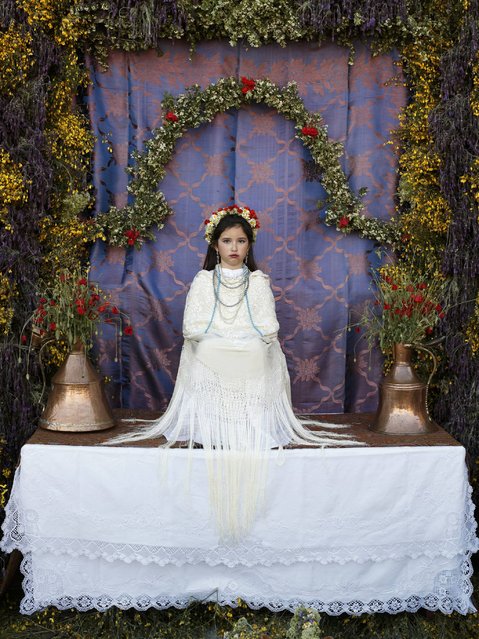
A “Maya” girl sits in an altar during the traditional celebration of “Las Mayas” on the streets in Colmenar Viejo, near Madrid, Spain, Friday, May 2, 2014. (Photo by Daniel Ochoa de Olza/AP Photo)

A “Maya” girl sits in an altar during the traditional celebration of “Las Mayas” on the streets in Colmenar Viejo, near Madrid, Spain, Friday, May 2, 2014. The festivity of the Maya comes from pagan rites and dates from the medieval age, appearing in ancient documents, it takes place every year in the beginning of May and celebrates the beginning off the spring. A girl between 7 and 11years is chosen as “Maya” and should sit still, serious, and quiet for a couple of hours in an altar on the street decorated with flowers and plants, afterwards they walk to the church with their family where they attend a ceremony. (Photo by Daniel Ochoa de Olza/AP Photo)
Details
13 May 2014 10:17:00
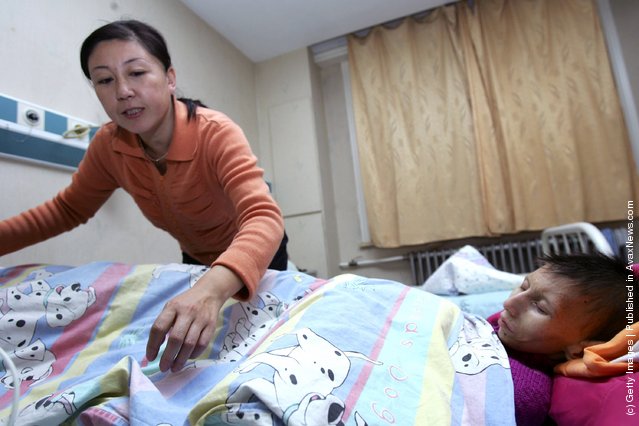
12-year-old Chinese girl Sun Yangyang suffering from Cockayne syndrome

“Cockayne syndrome (also called Weber-Cockayne syndrome, or Neill-Dingwall Syndrome) is a rare autosomal recessive congenital disorder characterized by growth failure, impaired development of the nervous system, abnormal sensitivity to sunlight (photosensitivity), and premature aging. Hearing loss and eye abnormalities (pigmentary retinopathy) are other common features, but problems with any or all of the internal organs are possible. It is associated with a group of disorders called leukodystrophies. The underlying disorder is a defect in a DNA repair mechanism. It is named after English physician Edward Alfred Cockayne (1880–1956)”. – Wikipedia

Photo: Mother of 12-year-old Chinese girl Sun Yangyang suffering from Cockayne syndrome, tends her at the First Affiliated Hospital of Jilin University on November 11, 2006 in Changchun of Jilin Province, China. The disease results in the senile appearance of Yangyang and also causes eyesight, hearing weakness and other problems. Doctors failed to cure the girl... (Photo by China Photos/Getty Images)
Details
08 Aug 2011 11:17:00
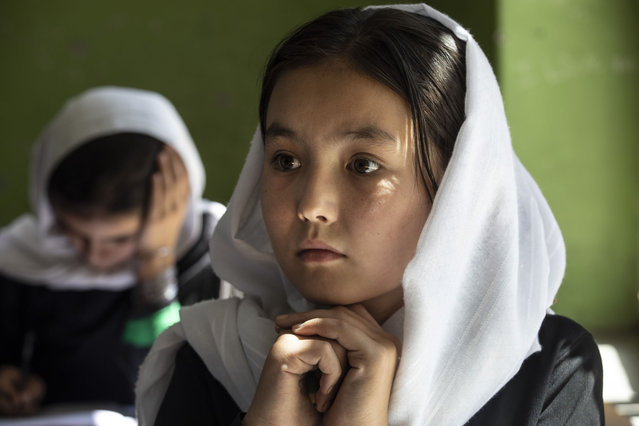
Behishta,11, listens during 4th grade class at the Zarghoona high school on July 25 2021 in Kabul, Afghanistan. The Zarghoona girls high school is the largest in Kabul with 8,500 female students attending classes. The school opened after a nearly two-month break due to the coronavirus (COVID-19) pandemic. Currently there is widespread fear that the Taliban who already control around half the country will reintroduce its notorious system barring girls and women from almost all work, and access to education. The Ministry of Education has announced the opening of schools, but there are  mixed reports in many areas where the Taliban have taken control or where fighting is ongoing. (Photo by Paula Bronstein/Getty Images)

Behishta,11, listens during 4th grade class at the Zarghoona high school on July 25 2021 in Kabul, Afghanistan. The Zarghoona girls high school is the largest in Kabul with 8,500 female students attending classes. The school opened after a nearly two-month break due to the coronavirus (COVID-19) pandemic. (Photo by Paula Bronstein/Getty Images)
Details
12 Aug 2021 08:41:00
An Indian girl dressed in traditional attire reacts to camera as she watches a cultural performance during Lohri festival in Jammu, India, Monday, January 13, 2014. Lohri is a celebration of the winter solstice observed by Hindus and Sikhs in northern India. (Photo by Channi Anand/AP Photo)

An Indian girl dressed in traditional attire reacts to camera as she watches a cultural performance during Lohri festival in Jammu, India, Monday, January 13, 2014. Lohri is a celebration of the winter solstice observed by Hindus and Sikhs in northern India. (Photo by Channi Anand/AP Photo)
Details
18 Jan 2014 13:28:00
A rainbow arcs over a girl on the platform of Stadion station. (Photo by Conor MacNeill/The Observer)

Beneath the Swedish capital lies an intricate web of underground train lines. More than 90 of the 100 stations in the 110km tunnel system, sometimes referred to as “the world’s longest art gallery”, have been decorated with paintings, installations, mosaics and sculptures by 150 artists since the 1950s. After spending a couple of weeks exploring arctic Norway and Sweden, London-based travel photographer Conor MacNeill headed underground to capture images of the metro stations. Here: A rainbow arcs over a girl on the platform of Stadion station. (Photo by Conor MacNeill/The Observer)
Details
05 Jun 2016 13:21:00
A girl washes the body paint off her arm on the shore of Lake Balaton during the coinciding Strand Festival and B.My.Lake Festival in Zamardi, 110 kms southwest of Budapest, Hungary, 24 August 2016. (Photo by Zoltan Balogh/EPA)

A girl washes the body paint off her arm on the shore of Lake Balaton during the coinciding Strand Festival and B.My.Lake Festival in Zamardi, 110 kms southwest of Budapest, Hungary, 24 August 2016. (Photo by Zoltan Balogh/EPA)
Details
26 Aug 2016 11:18:00
A girl poses at an entrance of her house next to a bomb dropped by the U.S. Air Force planes during the Vietnam War, in the village of Ban Napia in Xieng Khouang province, Laos September 3, 2016. (Photo by Jorge Silva/Reuters)

A girl poses at an entrance of her house next to a bomb dropped by the U.S. Air Force planes during the Vietnam War, in the village of Ban Napia in Xieng Khouang province, Laos September 3, 2016. From 1964 to 1973, U.S. warplanes dropped more than 270 million cluster munitions on Laos, one-third of which did not explode, according to the Lao National Regulatory Authority. (Photo by Jorge Silva/Reuters)
Details
06 Sep 2016 10:30:00