Loading...
Done
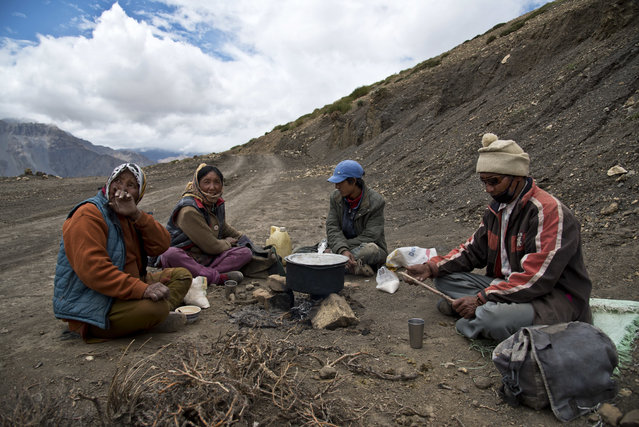
In this August 17, 2016, photo, from left to right, Chhering Chodom, 60, Tashi Yangzom, 50, Lobsang Chhering, 27, and Dorje Tandup, 58, drink milk tea on the side of the road. For centuries, the sleepy valley nestled in the Indian Himalayas remained a hidden Buddhist enclave forbidden to outsiders. Enduring the harsh year-round conditions of the high mountain desert, the people of Spiti Valley lived by a simple communal code – share the Earth's bounty, be hospitable to neighbors, and eschew greed and temptation at all turns. That's all starting to change, for better or worse. Since India began allowing its own citizens as well as outsiders to visit the valley in the early 1990s, tourism and trade have boomed. And the marks of modernization, such as solar panels, asphalt roads and concrete buildings, have begun to appear around some of the villages that dot the remote landscape at altitudes above 4,000 meters (13,000 feet). (Photo by Thomas Cytrynowicz/AP Photo)

In this August 17, 2016, photo, from left to right, Chhering Chodom, 60, Tashi Yangzom, 50, Lobsang Chhering, 27, and Dorje Tandup, 58, drink milk tea on the side of the road. For centuries, the sleepy valley nestled in the Indian Himalayas remained a hidden Buddhist enclave forbidden to outsiders. Enduring the harsh year-round conditions of the high mountain desert, the people of Spiti Valley lived by a simple communal code – share the Earth's bounty, be hospitable to neighbors, and eschew greed and temptation at all turns. That's all starting to change, for better or worse. (Photo by Thomas Cytrynowicz/AP Photo)
Details
15 Sep 2016 09:22:00
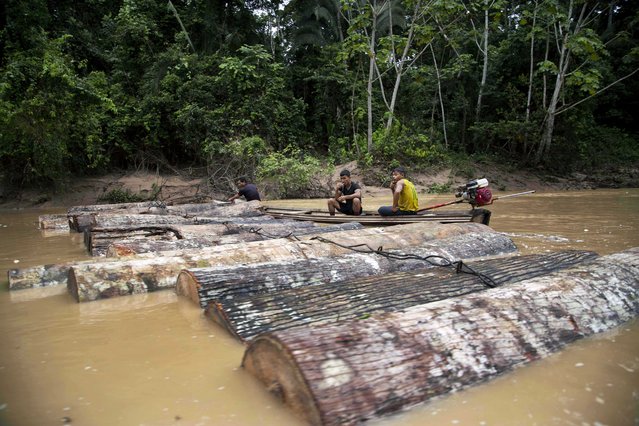
In this March 17, 2015 photo, Ashaninka Indian men, identified by locals as illegal loggers, tie tree trunks together to move them along the Putaya River near the hamlet of Saweto, Peru. Illegal logging persists unabated in this remote Amazon community where four indigenous leaders who resisted it were slain in September. The Putaya River is the waterway that transports felled trees, cut both legally and illegally, to the city of Pucallpa. (Photo by Martin Mejia/AP Photo)

In this March 17, 2015 photo, Ashaninka Indian men, identified by locals as illegal loggers, tie tree trunks together to move them along the Putaya River near the hamlet of Saweto, Peru. Illegal logging persists unabated in this remote Amazon community where four indigenous leaders who resisted it were slain in September. The Putaya River is the waterway that transports felled trees, cut both legally and illegally, to the city of Pucallpa. (Photo by Martin Mejia/AP Photo)
Details
27 Mar 2015 12:40:00
A woman and a girl dressed in historical Red Army uniform, wait before watching the Victory Day parade, marking the 71st anniversary of the victory over Nazi Germany in World War Two, at Red Square in Moscow, Russia, May 9, 2016. (Photo by Grigory Dukor/Reuters)

A woman and a girl dressed in historical Red Army uniform, wait before watching the Victory Day parade, marking the 71st anniversary of the victory over Nazi Germany in World War Two, at Red Square in Moscow, Russia, May 9, 2016. (Photo by Grigory Dukor/Reuters)
Details
10 May 2016 13:19:00
A woman shoots her rifle at a forest shooting range near the village of Visnova, Czech Republic, June 9, 2016. (Photo by David W. Cerny/Reuters)

A woman shoots her rifle at a forest shooting range near the village of Visnova, Czech Republic, June 9, 2016. (Photo by David W. Cerny/Reuters)
Details
11 Jun 2016 12:17:00
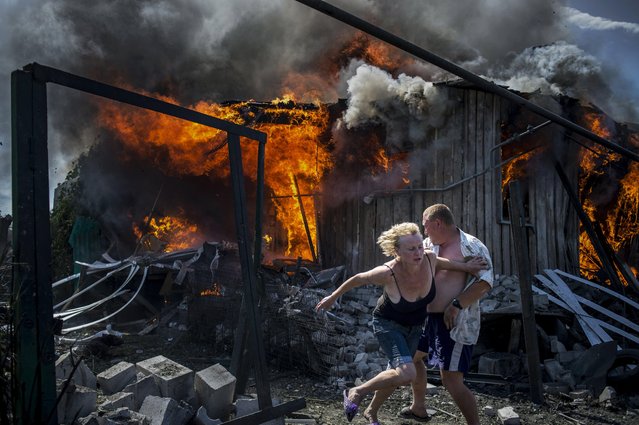
A handout photo made available by the World Press Photo (WPP) organization on 13 February 2017 shows a picture by Rossiya Segodnya photographer Valery Melnikov that won the Long-Term Projects – First Prize award of the 60th annual World Press Photo Contest, it was announced by the WPP Foundation in Amsterdam, The Netherlands on 13 February 2017. Caption: Civilians escape from a fire at a house destroyed by an air attack in the Luhanskaya village. Story: Ordinary people became victims of the conflict between self-proclaimed republics and the official Ukrainian authorities from 2014 onwards in the region of Donbass. Disaster came into their lives unexpectedly. These people were involved in the military confrontation against their will. They experienced the most terrible things: the death of their friends and relatives, destroyed homes and the ruined lives of thousands of people. (Photo by Valery Melnikov/EPA/Rossiya Segodnya/World Press Photo)

A handout photo made available by the World Press Photo (WPP) organization on 13 February 2017 shows a picture by Rossiya Segodnya photographer Valery Melnikov that won the Long-Term Projects – First Prize award of the 60th annual World Press Photo Contest, it was announced by the WPP Foundation in Amsterdam, The Netherlands on 13 February 2017. Caption: Civilians escape from a fire at a house destroyed by an air attack in the Luhanskaya village. (Photo by Valery Melnikov/EPA/Rossiya Segodnya/World Press Photo)
Details
15 Feb 2017 00:06:00
Spanish actor Antonio Banderas embraces a robot used in the film Automata during a photocall on the third day of the 62nd San Sebastian Film Festival, September 21, 2014. Banderas stars in and produced the science fiction film, which is part of the festival's official section. (Photo by Vincent West/Reuters)

Spanish actor Antonio Banderas embraces a robot used in the film Automata during a photocall on the third day of the 62nd San Sebastian Film Festival, September 21, 2014. Banderas stars in and produced the science fiction film, which is part of the festival's official section. (Photo by Vincent West/Reuters)
Details
27 Sep 2014 11:38:00
A competitor shows her tattoos at the MBK Tattoo Contest in a shopping mall in Bangkok October 23, 2014. (Photo by Athit Perawongmetha/Reuters)

A competitor shows her tattoos at the MBK Tattoo Contest in a shopping mall in Bangkok October 23, 2014. (Photo by Athit Perawongmetha/Reuters)
Details
25 Oct 2014 13:34:00
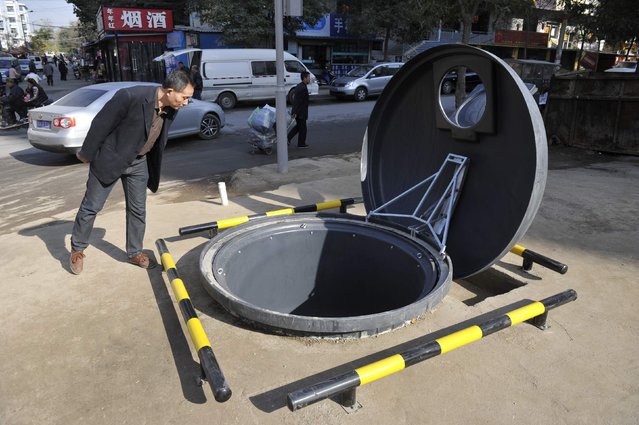
A resident looks into a newly-built giant trash can, partially buried underground, next to a street in Taiyuan, Shanxi province November 6, 2014. The trash can, which has a diameter of 1.9 meters and a depth of 2.8 meters, could contain approximately 10 cubic metres of garbage. It was built to replace an open-air garbage dump site, local media reported. (Photo by Reuters/Stringer)

A resident looks into a newly-built giant trash can, partially buried underground, next to a street in Taiyuan, Shanxi province November 6, 2014. The trash can, which has a diameter of 1.9 meters and a depth of 2.8 meters, could contain approximately 10 cubic metres of garbage. It was built to replace an open-air garbage dump site, local media reported. (Photo by Reuters/Stringer)
Details
08 Nov 2014 12:40:00