Loading...
Done


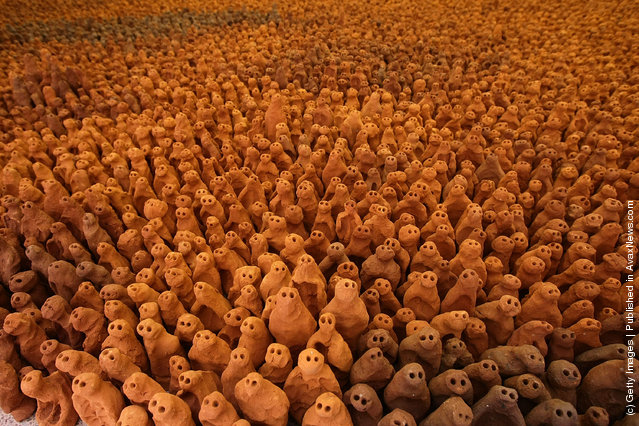
Figures from Antony Gormley's “Field For The British Isles” adorns an exhibition space in St Helen's College in the town of it's creation 15 years ago, June 23, 2008, St Helens, England. The installation of over 40,000 clay figures has returned to the place where it was made by local people from local clay. Artist Antony Gormley describes his creation as “25 tons of clay energised by fire, sensitised by touch and made conscious by being given eyes ... a field of gazes which looks at the observer making him or her its subject”. (Photo by Christopher Furlong/Getty Images)
Details
10 May 2011 09:20:00


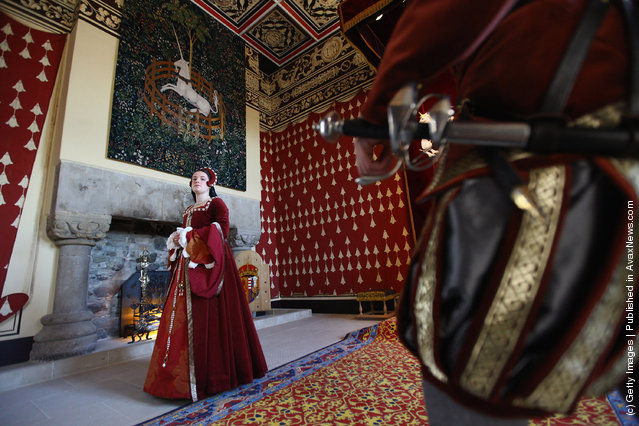
Laura Titch, dressed as Mary of Guise, and Duncan Maclachlan, dressed as Alexander of Stewart, rehearse for Stirling Castle's grand renaissance palace opening on June 3, 2011 in Stirling, Scotland. The palace has been closed for two years, while a Ј12 million pound project was undertaken to return the palace to how it might have looked back in the 1540s, when it was home to Mary of Guise, the widow of James V. Their daughter, Mary Queen of Scots, was raised there before living in France. (Photo by Jeff J Mitchell/Getty Images)
Details
04 Jun 2011 06:24:00


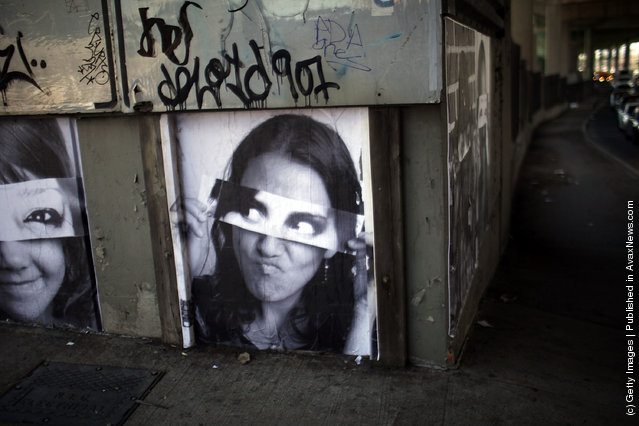
A picture composed by the French street artist JR is plastered to a wall under a highway as part of a community project called “Through A Mother's Eyes”, which involves members of the economically distressed neighborhood of Hunts Point in images taken by and of themselves on June 30, 2011 in New York City. JR, a recent TED prize winner, has staged similar projects around the world that look to transform high crime and impoverished neighborhoods into spaces for street art combined with the celebration of community. (Photo by Spencer Platt/Getty Images)
Details
01 Jul 2011 11:43:00
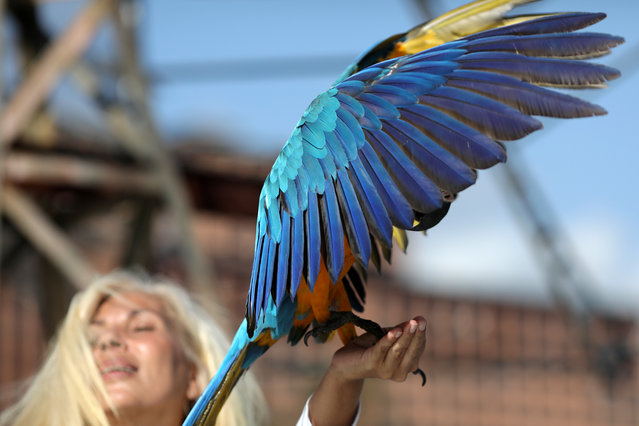
A macaw lands in Carmen Borges' hand while she stays at a rooftop of a building in Caracas, Venezuela, June 12, 2019. (Photo by Manaure Quintero/Reuters)

Looking for an escape from the daily realities of crisis-ridden Venezuela, Carmen Gomez finds solace receiving visitors on the roof of her Caracas apartment building every morning: groups of blue and gold macaws that arrive at daybreak. Here: A macaw lands in Carmen Borges' hand while she stays at a rooftop of a building in Caracas, Venezuela, June 12, 2019. (Photo by Manaure Quintero/Reuters)
Details
24 Jul 2019 00:03:00
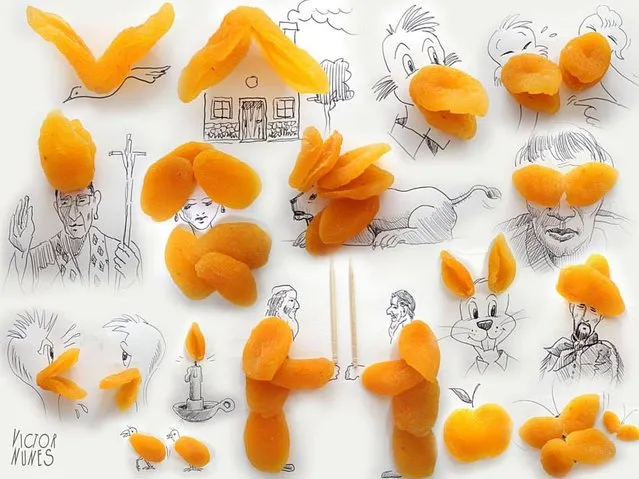
Food In Faces By Victor Nunes

Artist Victor Nunes combines every-day objects with simple illustrations to turn them into pictures of faces, animals and other playful scenes. His images invite us to look at the world differently and find creative images in our surroundings. Nunes’ art is a great example of pareidolia, which is our propensity to give meaning to random objects (like in this post about seeing faces in random objects). It’s the reason why we associate a smiley face with a human face and why some of Nunes’ pieces of popcorn or bread resemble faces to us.
Details
02 Feb 2014 11:58:00
Dog Chews  Aston Martin

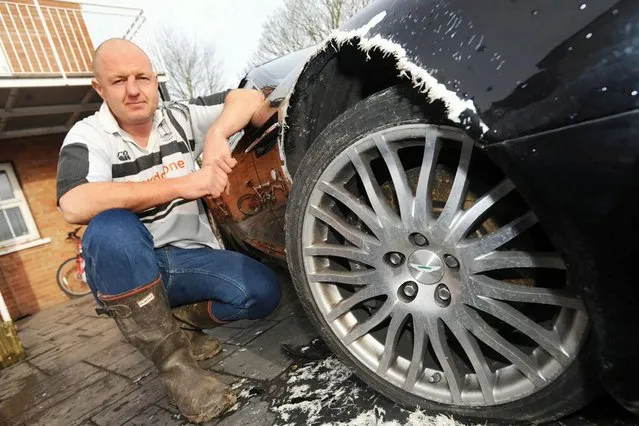
A car buff came home to find his prized motor looking a like a dog's dinner after his pet pooch chewed through the £80,000 Aston Martin.
Luce, a four-year-old border collie spaniel cross, waited until builder Royston Grimstead had left for work before she started chomping her way through the DB9 Volante's wheel arch, doing £3,000 worth of damage.
Details
09 Feb 2014 14:49:00
Arctic Hare

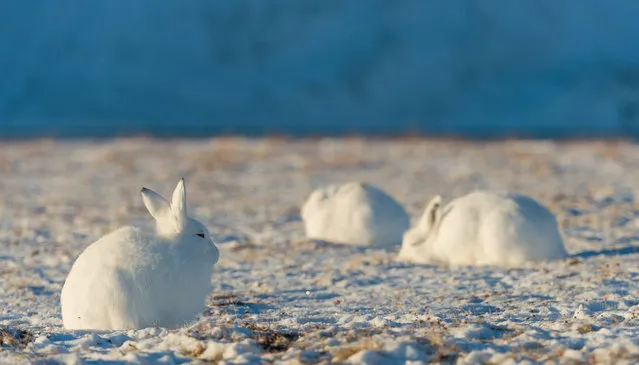
The arctic hare, or polar rabbit, is a species of hare which is adapted largely to polar and mountainous habitats. The arctic hare survives with a thick coat of fur and usually digs holes in the ground or under snow to keep warm and sleep. Arctic hares look like rabbits but have shorter ears, are taller when standing, and, unlike rabbits, can thrive in cold climates. They can travel together with many other hares, sometimes huddling with dozens or more, but are usually found alone, taking, in some cases, more than one partner. The arctic hare can run up to 60 kilometres per hour (40 mph). Its predators include the arctic wolf, arctic fox, and ermine.
Details
17 Mar 2014 13:56:00
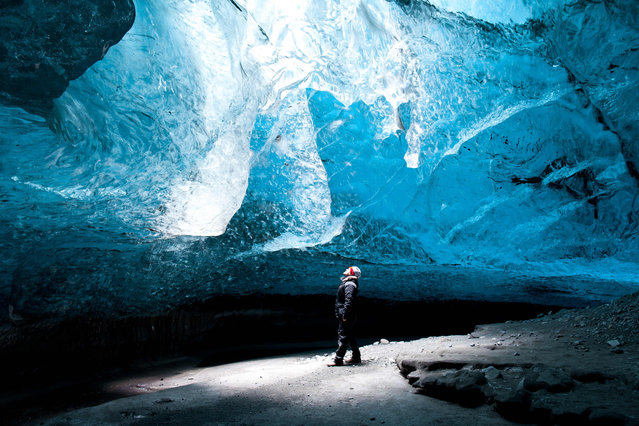
A wide view of Rob Lott  in the crystal ice cave in the Vatnajokull Glacier, Iceland. (Photo by Rob Lott/Barcroft Media)

Shimmering clearest blue and stretching as far as the eye can see, this is one of Iceland's famed crystal ice caves. The giant solid waves look frozen in time but they are slowly moving along as part of the Vatnajokull Glacier – which stretches across eight per cent of the island. The images were captured in February 2014 by British photographer Rob Lott, 49. Photo: A wide view of Rob Lott in the crystal ice cave in the Vatnajokull Glacier, Iceland. (Photo by Rob Lott/Barcroft Media)
Details
17 Mar 2014 08:26:00