Loading...
Done
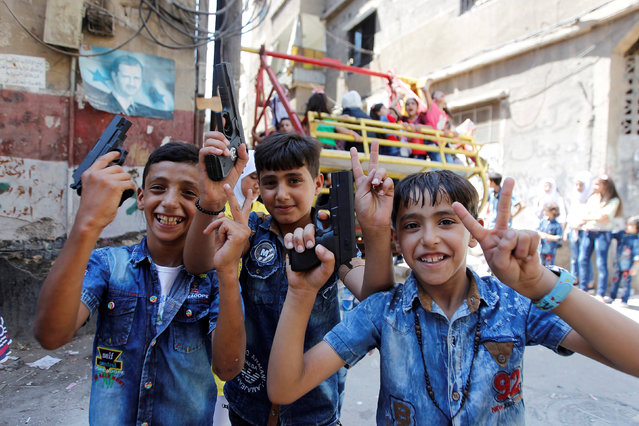
Boys pose with their toy guns as others play on swings, on the first day of the Muslim holiday of Eid al-Fitr, which marks the end of the holy month of Ramadan, in the government-controlled district of Dwelaa in Damascus, Syria July 6, 2016. (Photo by Omar Sanadiki/Reuters)

Boys pose with their toy guns as others play on swings, on the first day of the Muslim holiday of Eid al-Fitr, which marks the end of the holy month of Ramadan, in the government-controlled district of Dwelaa in Damascus, Syria July 6, 2016. (Photo by Omar Sanadiki/Reuters)
Details
09 Jul 2016 08:52:00
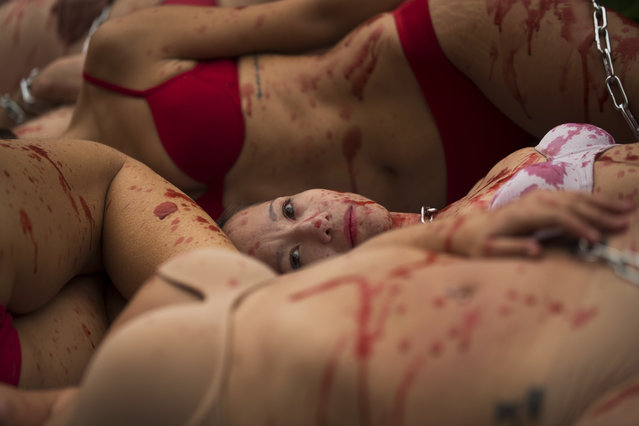
Animal rights activist, stained with fake blood, perform during a protest against the use of animal skins in the clothes and fashion industry, in Madrid, Sunday, December 10, 2017. (Photo by Francisco Seco/AP Photo)

Animal rights activist, stained with fake blood, perform during a protest against the use of animal skins in the clothes and fashion industry, in Madrid, Sunday, December 10, 2017. (Photo by Francisco Seco/AP Photo)
Details
11 Dec 2017 09:50:00
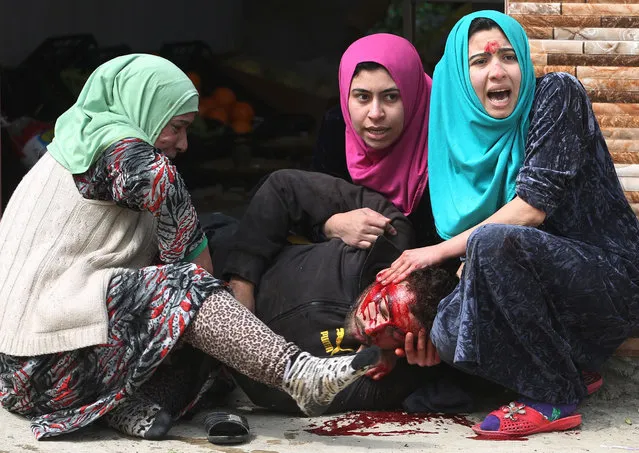
Iraqi women cry over their brother's body, who was killed by a mortar shell fired by Islamic State (IS) group jihadists on civilians who were gathered to receive aid, in Al-Risala neighbourhood on March 22, 2017, as an ongoing offensive by Iraqi forces to retake the city from the group continues. Iraqi forces launched a major operation to recapture west Mosul – the most-populated urban area still held by IS – on February 19, and have retaken a series of neighbourhoods from the jihadists. (Photo by Ahmad Al-Rubaye/AFP Photo)

Iraqi women cry over their brother's body, who was killed by a mortar shell fired by Islamic State (IS) group jihadists on civilians who were gathered to receive aid, in Al-Risala neighbourhood on March 22, 2017, as an ongoing offensive by Iraqi forces to retake the city from the group continues. Iraqi forces launched a major operation to recapture west Mosul – the most-populated urban area still held by IS – on February 19, and have retaken a series of neighbourhoods from the jihadists. (Photo by Ahmad Al-Rubaye/AFP Photo)
Details
27 Mar 2017 08:30:00
A woman reacts as rescuers search for survivors through the rubble of collapsed buildings in Adana, on February 6, 2023 after a 7,8 magnitude earthquake struck the country's south-east. The combined death toll has risen to over 1,900 for Turkey and Syria after the region's strongest quake in nearly a century. Turkey's emergency services said at least 1,121 people died in the earthquake, with another 783 confirmed fatalities in Syria. (Photo by Can Erok/AFP Photo)

A woman reacts as rescuers search for survivors through the rubble of collapsed buildings in Adana, on February 6, 2023 after a 7,8 magnitude earthquake struck the country's south-east. The combined death toll has risen to over 1,900 for Turkey and Syria after the region's strongest quake in nearly a century. Turkey's emergency services said at least 1,121 people died in the earthquake, with another 783 confirmed fatalities in Syria. (Photo by Can Erok/AFP Photo)
Details
08 Feb 2023 05:57:00
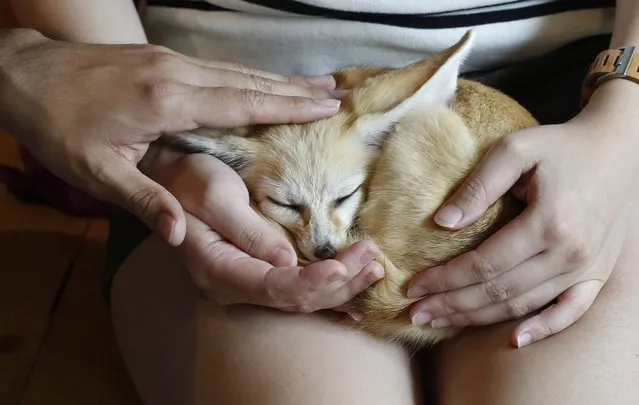
A picture made available on 07 March 2016 shows visitors petting and holding a Fennec fox, native to the Sahara, in the petting room at the Little Zoo Cafe, a business built to capitalize on Thais' love for exotic animals, and food, on the outskirts of Bangkok, Thailand, 05 March 2016. (Photo by Barbara Walton/EPA)

A picture made available on 07 March 2016 shows visitors petting and holding a Fennec fox, native to the Sahara, in the petting room at the Little Zoo Cafe, a business built to capitalize on Thais' love for exotic animals, and food, on the outskirts of Bangkok, Thailand, 05 March 2016. The cafe boasts Fennec foxes, Meerkat, native to parts of Africa, Silver Fox, Raccoon and Chinchillas, along with a menu of Thai food and Cheesecake, among other sweet deserts. Nature is a faraway fantasy in the bustling exhaust-filled cement city of Bangkok, fuelling a demand to own and be close to exotic pets. The trend to be near to a species that was once wild, in a city environment, far from the natural setting, has drawn criticism but continues to grow. (Photo by Barbara Walton/EPA)

Details
13 Mar 2016 09:38:00
Thomas Thwaites of the United Kingdom accepts the 2016 Ig Nobel Prize in Biology for “creating prosthetic extensions of his limbs that allowed him to move in the manner of, and spend time roaming the hills in the company of, goats” during the 26th First Annual Ig Nobel Prize ceremony at Harvard University in Cambridge, Massachusetts, U.S. September 22, 2016. (Photo by Brian Snyder/Reuters)

Thomas Thwaites of the United Kingdom accepts the 2016 Ig Nobel Prize in Biology for “creating prosthetic extensions of his limbs that allowed him to move in the manner of, and spend time roaming the hills in the company of, goats” during the 26th First Annual Ig Nobel Prize ceremony at Harvard University in Cambridge, Massachusetts, U.S. September 22, 2016. (Photo by Brian Snyder/Reuters)
Details
24 Sep 2016 10:46:00
Tiharu Ram, 70, a follower of Ramnami Samaj, who has tattooed the name of the Hindu god Ram on his face, poses for a picture outside his house in the village of Chandlidi, in the eastern state of Chhattisgarh, India, November 16, 2015. (Photo by Adnan Abidi/Reuters)

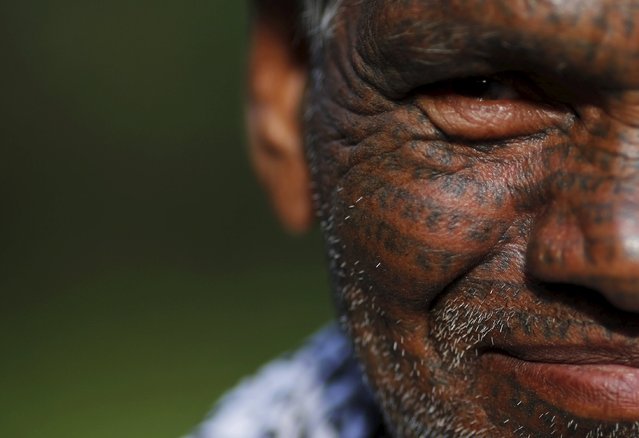
Tiharu Ram, 70, a follower of Ramnami Samaj, who has tattooed the name of the Hindu god Ram on his face, poses for a picture outside his house in the village of Chandlidi, in the eastern state of Chhattisgarh, India, November 16, 2015. Denied entry to temples and forced to use separate wells, low-caste Hindus in the eastern state of Chhattisgarh first tattooed their bodies and faces more than 100 years ago as an act of defiance and devotion. (Photo by Adnan Abidi/Reuters)
Details
14 Jan 2016 08:05:00
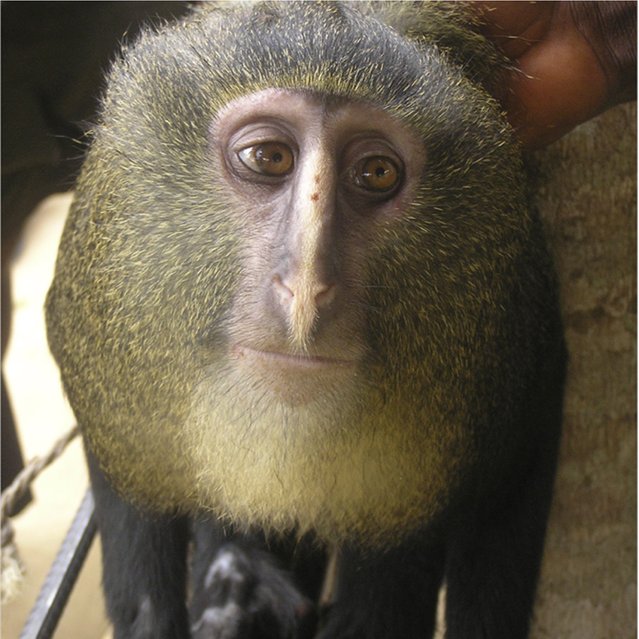
A new species of monkey found in the Democratic Republic of the Congo and identified as Lesula (Cercopithecus lomamiensis) is seen in this undated photograph from an article published September 12, 2012 in the science journal PLOS One. (Photo by Hart J. A., Detwiler K. M., Gilbert C. C./Reuters)

A new species of monkey found in the Democratic Republic of the Congo and identified as Lesula (Cercopithecus lomamiensis) is seen in this undated photograph from an article published September 12, 2012 in the science journal PLOS One. The monkey was first seen in 2007 by researchers John and Terese Hart of the Peabody Museum of Natural History at Yale Research Project. The finding of C. lomamiensis represents only the second new species of African monkey to be discovered in the past 28 years, according to the research article. (Photo by Hart J. A., Detwiler K. M., Gilbert C. C./Reuters)
Details
27 Sep 2012 08:17:00