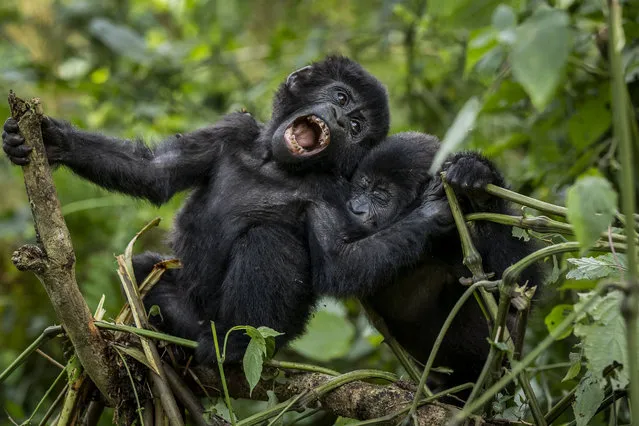
Two one-year old baby mountain gorillas play together in the forest of Bwindi Impenetrable National Park in southwestern Uganda on Saturday, April 3, 2021. (Photo by AP Photo/Stringer)
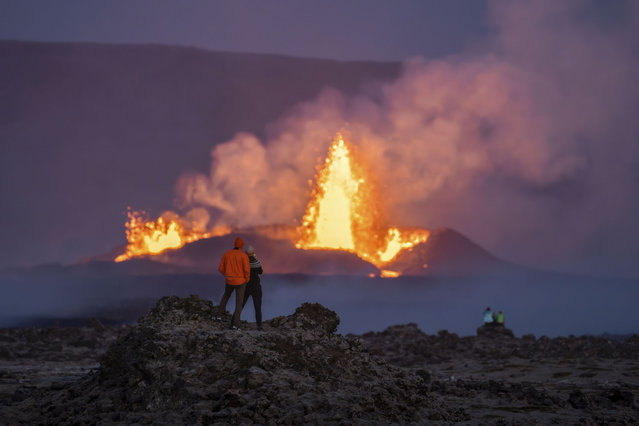
People watch the erupting craters and the lava fountains from the old lava fields around the eruption site on the Reykjanes Peninsula, in Iceland, Wednesday, August 28, 2024. (Photo by Marco di Marco/AP Photo)
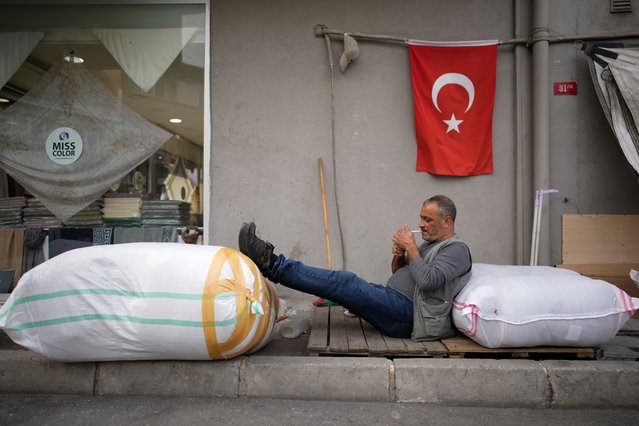
Suat Demir, a 52-year-old parter, smokes a cigarette after finishing his work day in Istanbul, Turkey, Thursday, October 2, 2025. (Photo by Emrah Gurel/AP Photo)
An Indian girl dressed in traditional attire reacts to camera as she watches a cultural performance during Lohri festival in Jammu, India, Monday, January 13, 2014. Lohri is a celebration of the winter solstice observed by Hindus and Sikhs in northern India. (Photo by Channi Anand/AP Photo)
Two working girls entertaining themselves in the absence of customers at the Moonlite Bunny Ranch, a legal brothel owned by Dennis Hof, in Lyon County, one of the fews counties in the USA which permits legalized prostitution. (Photo by Stephan Gladieu/Getty Images)
Beneath the Swedish capital lies an intricate web of underground train lines. More than 90 of the 100 stations in the 110km tunnel system, sometimes referred to as “the world’s longest art gallery”, have been decorated with paintings, installations, mosaics and sculptures by 150 artists since the 1950s. After spending a couple of weeks exploring arctic Norway and Sweden, London-based travel photographer Conor MacNeill headed underground to capture images of the metro stations. Here: A rainbow arcs over a girl on the platform of Stadion station. (Photo by Conor MacNeill/The Observer)
A girl washes the body paint off her arm on the shore of Lake Balaton during the coinciding Strand Festival and B.My.Lake Festival in Zamardi, 110 kms southwest of Budapest, Hungary, 24 August 2016. (Photo by Zoltan Balogh/EPA)
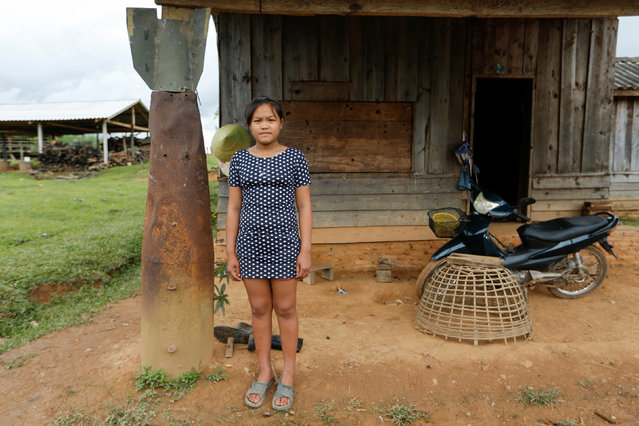
A girl poses at an entrance of her house next to a bomb dropped by the U.S. Air Force planes during the Vietnam War, in the village of Ban Napia in Xieng Khouang province, Laos September 3, 2016. From 1964 to 1973, U.S. warplanes dropped more than 270 million cluster munitions on Laos, one-third of which did not explode, according to the Lao National Regulatory Authority. (Photo by Jorge Silva/Reuters)