Loading...
Done
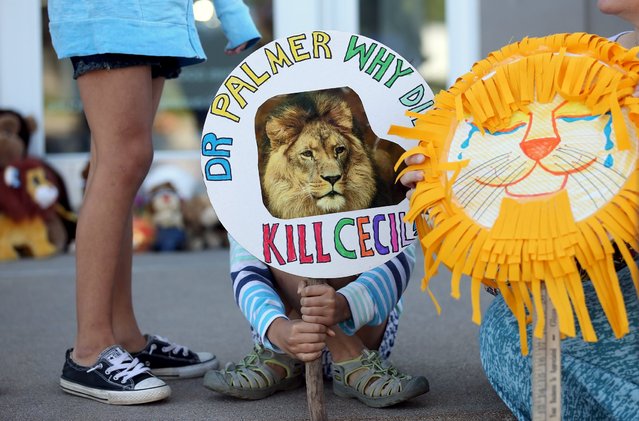
Piper Hoppe, 10, from Minnetonka, Minnesota, holds a sign at the doorway of River Bluff Dental clinic in protest against the killing of a famous lion in Zimbabwe, in Bloomington, Minnesota July 29, 2015. (Photo by Eric Miller/Reuters)

Piper Hoppe, 10, from Minnetonka, Minnesota, holds a sign at the doorway of River Bluff Dental clinic in protest against the killing of a famous lion in Zimbabwe, in Bloomington, Minnesota July 29, 2015. A Zimbabwean court on Wednesday charged a professional local hunter Theo Bronkhorst with failing to prevent an American from unlawfully killing “Cecil”, the southern African country's best-known lion. The American, Walter James Palmer, a Minnesota dentist who paid $50,000 to kill the lion, has left Zimbabwe. He says he did kill the animal but believed the hunt was legal and that the necessary permits had been issued. (Photo by Eric Miller/Reuters)
Details
30 Jul 2015 12:01:00
Tourists walk behind a faded sign warning of tsunami hazard in Khao Lak, Phang Nga province December 15, 2014. Ahead of the anniversary of the 2004 tsunami, experts and officials say key weaknesses remain across the region in the system designed to warn people of the next disaster, and get them to safety. (Photo by Damir Sagolj/Reuters)

Tourists walk behind a faded sign warning of tsunami hazard in Khao Lak, Phang Nga province December 15, 2014. Ahead of the anniversary of the 2004 tsunami, experts and officials say key weaknesses remain across the region in the system designed to warn people of the next disaster, and get them to safety. Thailand prepares to mark the tenth anniversary of the 2004 tsunami, the deadliest on the record, that killed at least 226,000 people in 13 Asian and African countries. (Photo by Damir Sagolj/Reuters)
Details
21 Dec 2014 11:01:00


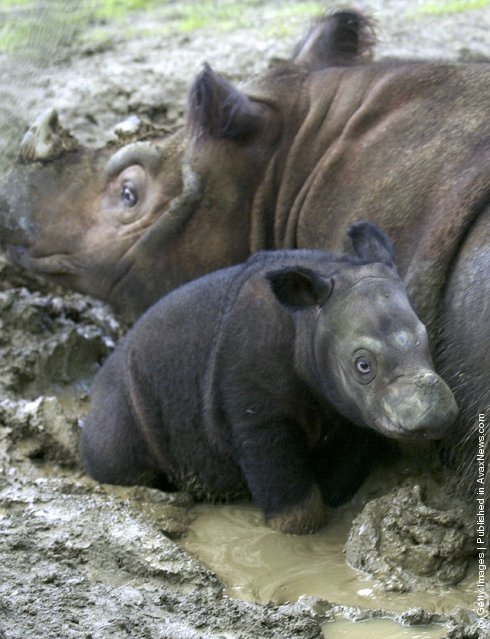
“The Sumatran Rhinoceros (Dicerorhinus sumatrensis) is a member of the family Rhinocerotidae and one of five extant rhinoceroses. It is the only extant species of the genus Dicerorhinus. It is the smallest rhinoceros, standing about 120–145 centimetres (3.9–4.76 ft) high at the shoulder, with a body length of 250 centimetres (8.2 ft) and weight of 500–800 kilograms (1,100–1,800 lb). Like the African species, it has two horns; the larger is the nasal horn, typically 15–25 centimetres (5.9–9.8 in), while the other horn is typically a stub. A coat of reddish-brown hair covers most of the Sumatran Rhino's body”. – Wikipedia

Photo: Emi, a Sumatran rhinoceros lies in the mud with her three-week-old female calf at the Cincinnati Zoo and Botanical Garden August 19, 2004 in Cincinnati, Ohio. Emi made history by becoming the first Sumatran rhino to produce two calves in captivity. (Photo by Mike Simons/Getty Images)
Details
22 Jun 2011 12:37:00
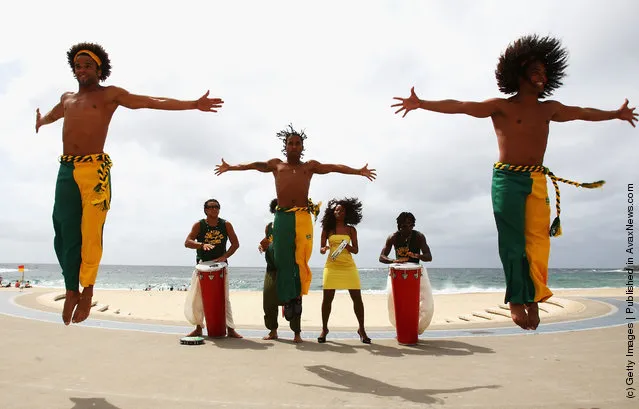
Warriors Of Brazil: Capoeira Spectacular

“Capoeira is a Brazilian art form that combines elements of martial arts, sports, and music. It was created in Brazil mainly by descendants of African slaves with Brazilian native influences, probably beginning in the 16th century. It is known by quick and complex moves, using mainly power kicks and quick leg sweeps, with some ground and aerial acrobatics, knee strikes, take-downs, elbow strikes, punches and headbutts. The word capoeira comes from Tupi, referring to the areas of low vegetation in the Brazilian interior”. – Wikipedia

Photo: The Warriors of Brazil perform on Coogee Beach on November 23, 2009 in Sydney, Australia. The Warriors of Brazil show is a spectacular stage show which combines the extraordinary martial art of Capoeira with the uplifting music and dance of Carnival. (Photo by Ryan Pierse/Getty Images)
Details
19 Sep 2011 14:13:00
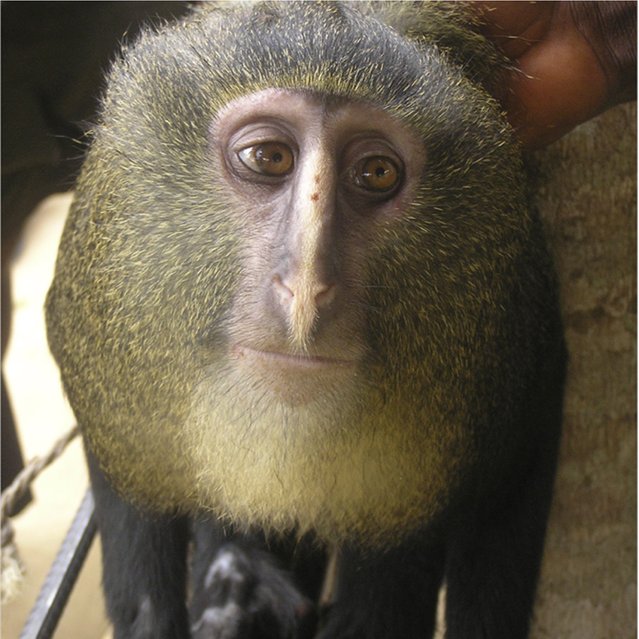
A new species of monkey found in the Democratic Republic of the Congo and identified as Lesula (Cercopithecus lomamiensis) is seen in this undated photograph from an article published September 12, 2012 in the science journal PLOS One. (Photo by Hart J. A., Detwiler K. M., Gilbert C. C./Reuters)

A new species of monkey found in the Democratic Republic of the Congo and identified as Lesula (Cercopithecus lomamiensis) is seen in this undated photograph from an article published September 12, 2012 in the science journal PLOS One. The monkey was first seen in 2007 by researchers John and Terese Hart of the Peabody Museum of Natural History at Yale Research Project. The finding of C. lomamiensis represents only the second new species of African monkey to be discovered in the past 28 years, according to the research article. (Photo by Hart J. A., Detwiler K. M., Gilbert C. C./Reuters)
Details
27 Sep 2012 08:17:00
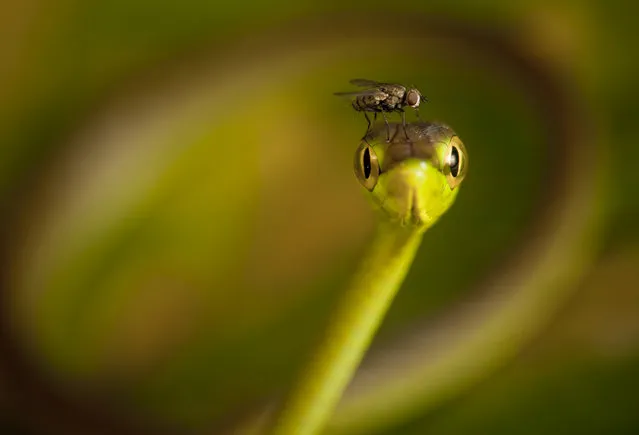
“Fly cap for a vine snake”. A fly lands on the head of a vine snake in the Choco of Colombia. (Photo and caption by Robin Moore/National Geographic Traveler Photo Contest)

“Fly cap for a vine snake”. A fly lands on the head of a vine snake in the Choco of Colombia. (Photo and caption by Robin Moore/National Geographic Traveler Photo Contest)

ATTENTION! All pictures are presented in high resolution. To see Hi-Res images – just TWICE click on any picture. In other words, click small picture – opens the BIG picture. Click BIG picture – opens VERY BIG picture.
Details
24 Jun 2013 11:36:00
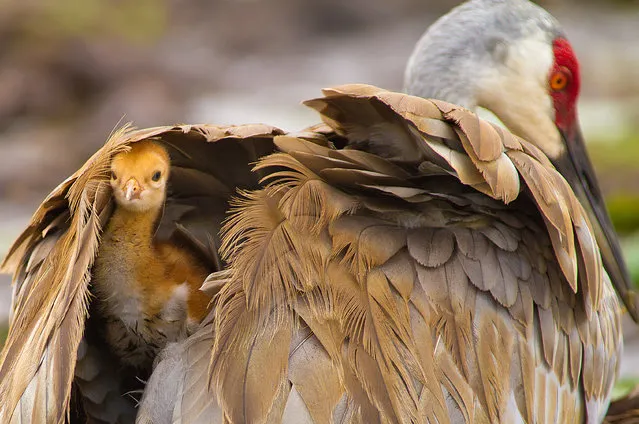
“Hiding In The Shadows”. This Baby Sandhill taking refuge under Moms wings while sitting on her second egg. I witnessed this baby being born earlier that day,and the next morning saw the other one hatch,what a sight to see. Photo location: Deland, Florida. (Photo and caption by Scott Helfrich/National Geographic Photo Contest)

“Hiding In The Shadows”. This Baby Sandhill taking refuge under Moms wings while sitting on her second egg. I witnessed this baby being born earlier that day,and the next morning saw the other one hatch,what a sight to see. Photo location: Deland, Florida. (Photo and caption by Scott Helfrich/National Geographic Photo Contest)
Details
08 Dec 2013 11:51:00
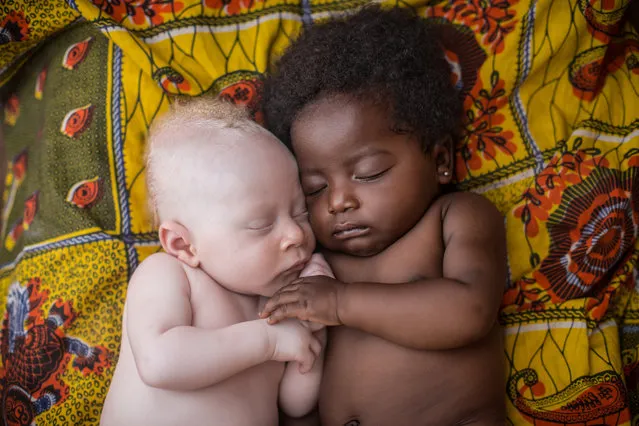
“Basunga”. Basunga (3 weeks-old newborn with albinism) is happily sleeping with his cousin. For now, he does not yet realize the difficulties he will face to integrate into the Congolese society as a PWA. The success of his integration will greatly depends of how he accepts himself and his skin condition a and how educated he will be. Photo location: Kinshasa, Congo RDC. (Photo and caption by Patricia Willocq/National Geographic Photo Contest)

“Basunga”. Basunga (3 weeks-old newborn with albinism) is happily sleeping with his cousin. For now, he does not yet realize the difficulties he will face to integrate into the Congolese society as a PWA. The success of his integration will greatly depends of how he accepts himself and his skin condition a and how educated he will be. Photo location: Kinshasa, Congo RDC. (Photo and caption by Patricia Willocq/National Geographic Photo Contest)
Details
09 Dec 2013 06:38:00