Loading...
Done
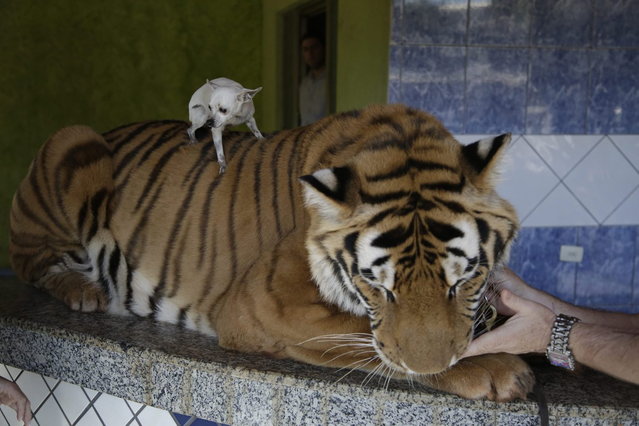
The Borges' family pet dog, Little, is placed on the back of Tom, their tiger, for a photo to be taken, in Maringa, Brazil, Friday, September 27, 2013. The Brazilian family is now locked in a legal dispute for the big cats, they have eight tigers and two lions, with federal wildlife officials working to take them away. While Borges does have a license to raise the animals, Brazilian wildlife officials say he illegally bred the cats, creating a public danger. (Photo by Renata Brito/AP Photo)

“Ary Borges and his family live in southern Brazil like most families the Borges' love animals and have an array of cats living in their home. The only difference between the cats owned by the Borges family and the cat that is cuddled up on your lap as you read this is the Borges' cats weigh over 700 pounds and could kill you just as soon as look at you. The Borges family shares their home with nine tigers, two lionesses, a chimp and a Chihuahua”. – Amanda Schiavo via Latin Times. Photo: The Borges' family pet dog, Little, is placed on the back of Tom, their tiger, for a photo to be taken, in Maringa, Brazil, Friday, September 27, 2013. (Photo by Renata Brito/AP Photo)
Details
04 Oct 2013 11:51:00
A fire-eater of the “Diables de Terrassa” performs during Sitges' little “Festa Major”, “Santa Tecla” in Sitges, Spain on September 19, 2016. This celebration brings together some of Catalonia’s most emblematic festive traditions. The central axis of the celebrations is the traditional parade, made up of “big-head” carnival figures and characters who dance to music played on different traditional instruments. One of the most popular events is the Correfoc or fire-running, which is also the closing event of the fiesta. The people run and jump over characters dressed up as devils and dragons, carrying fire. (Photo by Matthias Oesterle/ZUMA Press/Splash News)

A fire-eater of the “Diables de Terrassa” performs during Sitges' little “Festa Major”, “Santa Tecla” in Sitges, Spain on September 19, 2016. This celebration brings together some of Catalonia’s most emblematic festive traditions. The central axis of the celebrations is the traditional parade, made up of “big-head” carnival figures and characters who dance to music played on different traditional instruments. One of the most popular events is the Correfoc or fire-running, which is also the closing event of the fiesta. The people run and jump over characters dressed up as devils and dragons, carrying fire. (Photo by Matthias Oesterle/ZUMA Press/Splash News)
Details
20 Sep 2016 09:28:00
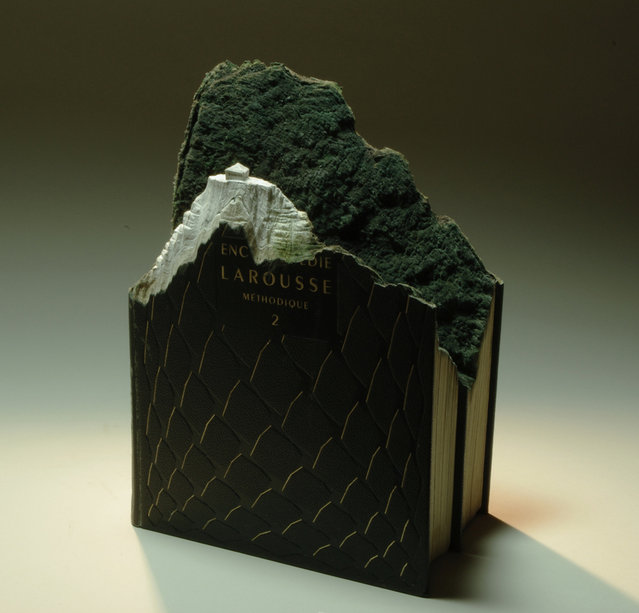
 Landscapes Carved Out of Books by Guy Laramee

“So I carve landscapes out of books and I paint Romantic landscapes”, says interdisciplinary artist Guy Laramee who, in the course of his 30 years of practice, found his way through such varied and numerous disciplines as : stage writing, stage directing, contemporary music writing, musical instrument design and building, singing, video, scenography, sculpture, installation, painting and literature. Laramee uses books that are slowly falling apart, such as old encyclopedias and dictionaries to create dramatic landscapes.
Details
05 Jan 2013 18:13:00
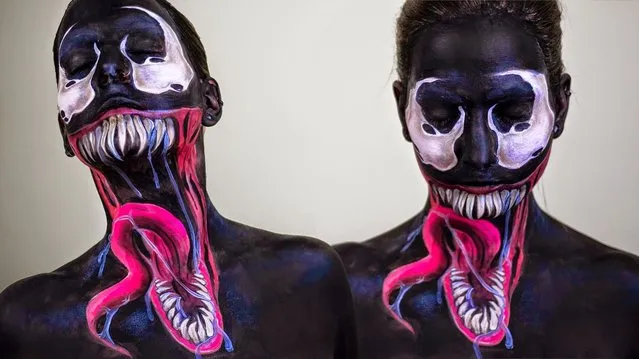
Face Painting By Elsa Rhae

Elsa Rhae Pageler, otherwise known as just Elsa Rhae, has the unbelievable knack for transforming her beautiful face into something incredibly scary. Although she began her career in video editing, and still works as one to this day, she has become infamous for her amazing makeup transformations. She took a stage makeup class as an elective to graduate from her film degree in college and soon realized that it was a passion she didn’t even know she had at first.
Details
27 Aug 2014 13:53:00
Meet Lil Bub

Lil Bub is a female “perma-kitten” house cat born with several genetic mutations causing dwarfism, polydactylism and disformed lower jaw. Bub rose to fame online after her owner Mike Bridavsky began uploading videos of her to YouTube in November 2011.

See also: Foo-Chan
See also: Grumpy Cat
Details
04 Sep 2013 09:25:00
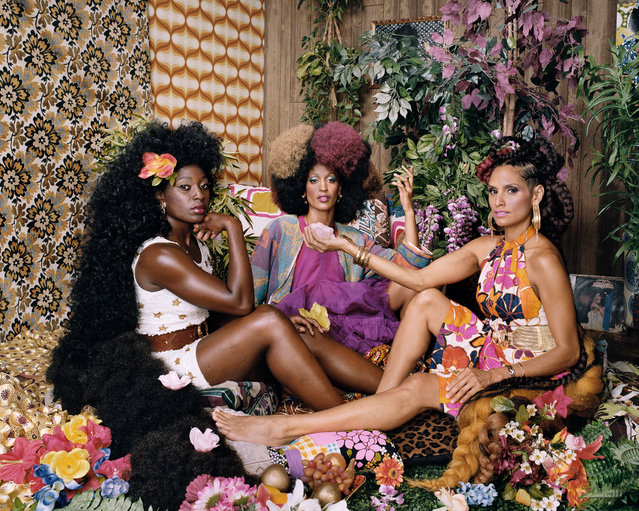
Les Trois Femmes Deux, 2018. (Photo by Mickalene Thomas/Courtesy of Yancey Richardson Gallery, New York)

Vast collection of fine art photography about to open at Pier 24 in Manhattan. One of the world's most prestigious annual photography events, The Photography Show is the longest-running and foremost exhibition dedicated to the photographic medium, offering a wide range of museum-quality work, including contemporary, modern, and 19th-century photographs as well as photo-based art, video, and new media. Here: Les Trois Femmes Deux, 2018. (Photo by Mickalene Thomas/Courtesy of Yancey Richardson Gallery, New York)
Details
04 Apr 2019 00:01:00


It looks like 2024 has ended and we are still alive (although of course it's not evening yet). Well, let's wish ourselves the same in the future. If someone wants to put USDT TRC20 under the tree: TDWPvSi7RY4wNZPukDRyKghhLGTGsRNRBe (nobody will put anything, of course – but you understand, it's a ritual). Happy New Year! And now disco.
Details
31 Dec 2024 04:28:00
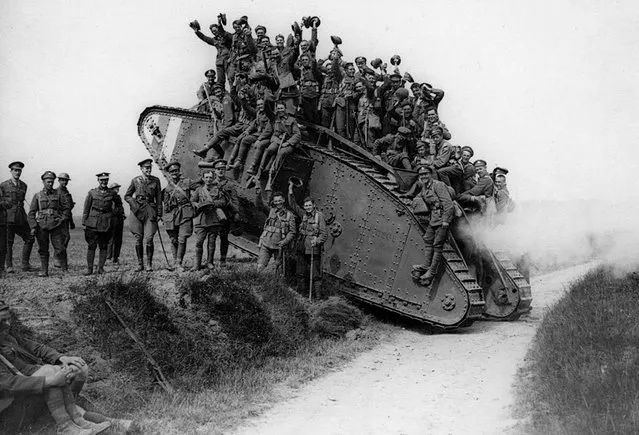
These black-and-white photos are taken from the new book “Armoured Warfare in the First World War 1916 – 1918” by Anthony Tucker-Jones and published by Pen & Sword Military. “Interestingly the British, French and Germans took completely different approaches with varying results”. The British military produced “Little Willie” in Autumn 1915 weighing 18 tonnes, which had a crew of two plus four gunners. “Inspired by a tracked artillery tractor “Little Willie” was referred to as a water tank – hence the name tank – to ensure secrecy”, said Anthony. “This led to the strange looking Mark I with its peculiar rhomboid shape, designed to cross trenches with guns in sponsons on either side. The Germans saw the tank as unchivalrous and were slow to grasp its utility. They favoured the Stormtrooper (specialist soldiers used to infiltrate enemy trenches) and artillery, not the tank”, said Anthony. “However, they didn’t hesitate to make use of captured British tanks. Although the tank helped secure victory and German soldiers dubbed it “Germany’s Downfall” the country was ultimately brought to its knees by the Allies blockade”. Here: British troops hitch a ride on a Mark IV after the massed tank fleet spearheading attack at Cambrai on November 20, 1917. (Photo by Anthony Tucker-Jones/Mediadrumworld.com)

These black-and-white photos are taken from the new book “Armoured Warfare in the First World War 1916 – 1918” by Anthony Tucker-Jones and published by Pen & Sword Military. Here: British troops hitch a ride on a Mark IV after the massed tank fleet spearheading attack at Cambrai on November 20, 1917. (Photo by Anthony Tucker-Jones/Mediadrumworld.com)
Details
23 Feb 2017 00:02:00