Loading...
Done
Revellers dressed as zombies take part in an enactment of the running of the bulls a day before the start of the San Fermin festival in Pamplona, northern Spain, July 5, 2016. (Photo by Eloy Alonso/Reuters)

Revellers dressed as zombies take part in an enactment of the running of the bulls a day before the start of the San Fermin festival in Pamplona, northern Spain, July 5, 2016. (Photo by Eloy Alonso/Reuters)
Details
06 Jul 2016 16:15:00
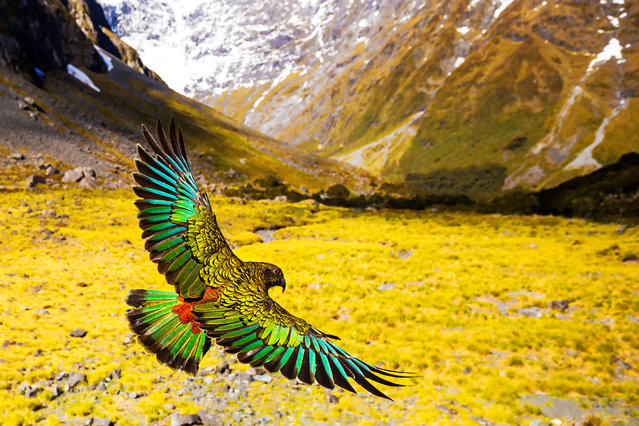
Kea are the only true alpine parrots in the world and thrive as cunning opportunists in the freezing conditions of the Southern Alps. Kea are thought to have developed their wide array of food-finding strategies during the last great ice age, where they learned to adapt using their unusual powers of curiosity. (Photo by Tom Walker/BBC Pictures/The Guardian)

Kea are the only true alpine parrots in the world and thrive as cunning opportunists in the freezing conditions of the Southern Alps. Kea are thought to have developed their wide array of food-finding strategies during the last great ice age, where they learned to adapt using their unusual powers of curiosity. (Photo by Tom Walker/BBC Pictures/The Guardian)
Details
19 Jul 2016 13:03:00
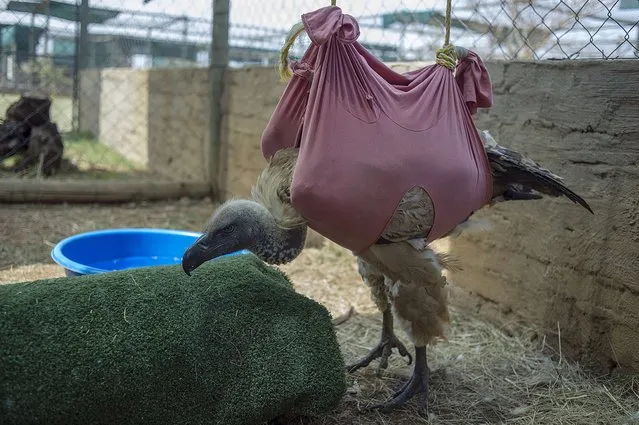
An injured vulture is treated at the VulPro Vulture Rehabilitation Centre in Hartebeepoortdam in the Magalisburg region on September 15, 2015. Confined to southern Africa, just under 4,000 breeding pairs of Cape Vultures remain in the wild, mostly in South Africa, Lesotho and Botswana. Unless conservation efforts are successful, Africa's largest vulture species may be facing eventual extinction. (Photo by Mujahid Safodien/AFP Photo)

An injured vulture is treated at the VulPro Vulture Rehabilitation Centre in Hartebeepoortdam in the Magalisburg region on September 15, 2015. Confined to southern Africa, just under 4,000 breeding pairs of Cape Vultures remain in the wild, mostly in South Africa, Lesotho and Botswana. Unless conservation efforts are successful, Africa's largest vulture species may be facing eventual extinction. (Photo by Mujahid Safodien/AFP Photo)
Details
19 Sep 2015 12:27:00
A Palestinian woman paints a mural, depicting a masked Palestinian holding a knife, in support of Palestinians committing stabbing attacks against Israelis, in Rafah in the southern Gaza Strip November 3, 2015. (Photo by Ibraheem Abu Mustafa/Reuters)

A Palestinian woman paints a mural, depicting a masked Palestinian holding a knife, in support of Palestinians committing stabbing attacks against Israelis, in Rafah in the southern Gaza Strip November 3, 2015. (Photo by Ibraheem Abu Mustafa/Reuters)
Details
06 Nov 2015 08:00:00
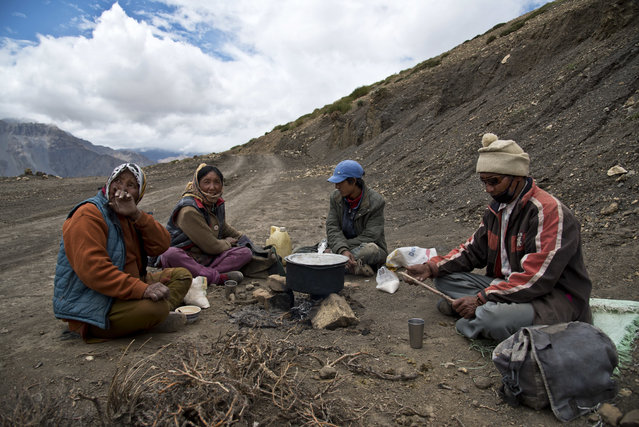
In this August 17, 2016, photo, from left to right, Chhering Chodom, 60, Tashi Yangzom, 50, Lobsang Chhering, 27, and Dorje Tandup, 58, drink milk tea on the side of the road. For centuries, the sleepy valley nestled in the Indian Himalayas remained a hidden Buddhist enclave forbidden to outsiders. Enduring the harsh year-round conditions of the high mountain desert, the people of Spiti Valley lived by a simple communal code – share the Earth's bounty, be hospitable to neighbors, and eschew greed and temptation at all turns. That's all starting to change, for better or worse. Since India began allowing its own citizens as well as outsiders to visit the valley in the early 1990s, tourism and trade have boomed. And the marks of modernization, such as solar panels, asphalt roads and concrete buildings, have begun to appear around some of the villages that dot the remote landscape at altitudes above 4,000 meters (13,000 feet). (Photo by Thomas Cytrynowicz/AP Photo)

In this August 17, 2016, photo, from left to right, Chhering Chodom, 60, Tashi Yangzom, 50, Lobsang Chhering, 27, and Dorje Tandup, 58, drink milk tea on the side of the road. For centuries, the sleepy valley nestled in the Indian Himalayas remained a hidden Buddhist enclave forbidden to outsiders. Enduring the harsh year-round conditions of the high mountain desert, the people of Spiti Valley lived by a simple communal code – share the Earth's bounty, be hospitable to neighbors, and eschew greed and temptation at all turns. That's all starting to change, for better or worse. (Photo by Thomas Cytrynowicz/AP Photo)

Details
15 Sep 2016 09:22:00
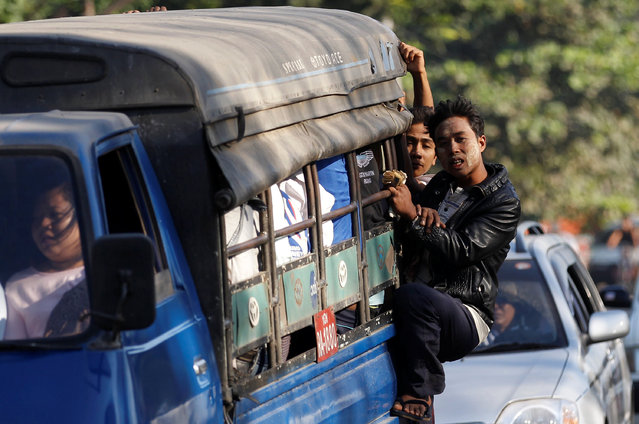
People ride a bus as they travel in Yangon, Myanmar January 14, 2017. Picture taken January 14, 2017. (Photo by Soe Zeya Tun/Reuters)

People ride a bus as they travel in Yangon, Myanmar January 14, 2017. Picture taken January 14, 2017. (Photo by Soe Zeya Tun/Reuters)
Details
11 Apr 2017 09:46:00
A miniature model of Chichen Itza in Mexico, part of Gulliver's Gate, a miniature world being recreated in a 49,000-square-foot exhibit space in Times Square, is seen during a preview April 10, 2017 in New York City. (Photo by Timothy A. Clary/AFP Photo)

A miniature model of Chichen Itza in Mexico, part of Gulliver's Gate, a miniature world being recreated in a 49,000-square-foot exhibit space in Times Square, is seen during a preview April 10, 2017 in New York City. (Photo by Timothy A. Clary/AFP Photo)
Details
15 Apr 2017 08:36:00
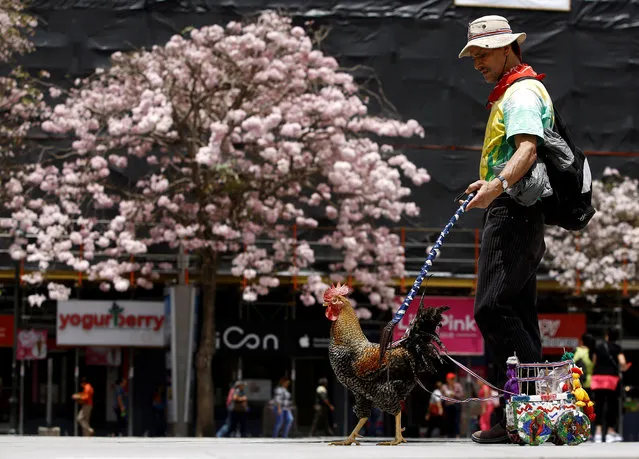
Martin Herrera, 58, who has had a love for roosters since his childhood, and has spent the last 20 years domesticating and training them, walks with his favorite rooster “Paquito” in San Jose, Costa Rica April 27, 2017. (Photo by Juan Carlos Ulate/Reuters)

Martin Herrera, 58, who has had a love for roosters since his childhood, and has spent the last 20 years domesticating and training them, walks with his favorite rooster “Paquito” in San Jose, Costa Rica April 27, 2017. (Photo by Juan Carlos Ulate/Reuters)
Details
05 May 2017 07:34:00