Loading...
Done
Number 10. BELL H-13 SIOUX was a two-bladed, single engine, light helicopter built by Bell Helicopter. Westland Aircraft manufactured the Sioux under license for the British military as the Sioux AH.1 and HT. (Photo by AP Photo)

Number 10. BELL H-13 SIOUX was a two-bladed, single engine, light helicopter built by Bell Helicopter. Westland Aircraft manufactured the Sioux under license for the British military as the Sioux AH.1 and HT. In 1947, the United States Air Force ordered the improved Bell Model 47A. Most were designated YR-13 and three winterized versions were designated YR-13A. The United States Army first ordered Bell 47s in 1948 under the designation H-13. These would later receive the name Sioux. The Bell-built H-13 B is seen airborne in this April 29, 1951 photo. The helicopter is equipped with a 173 horsepower engine, cruises at 85 miles per hour, climbs 900 feet in a minute and has a service ceiling of 11,500 feet. (Photo by AP Photo)
Details
08 Aug 2014 11:59:00
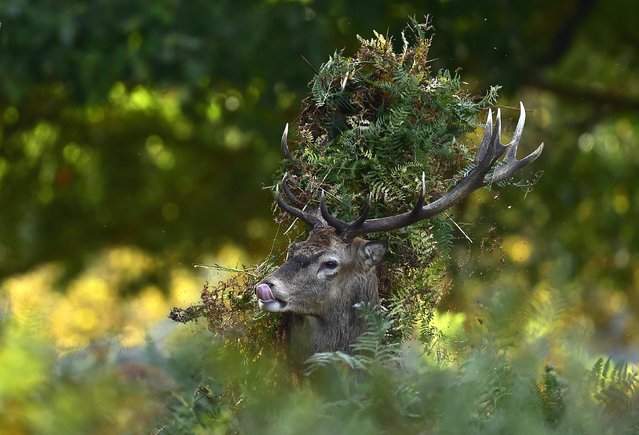
A male red deer with antlers covered in bracken, walks through undergrowth in Richmond Park in south west London, October 3, 2014. Over 600 red and fallow deer roam in the largest of London's Royal Parks, and have their numbers managed in an annual cull each November and February. (Photo by Toby Melville/Reuters)

A male red deer with antlers covered in bracken, walks through undergrowth in Richmond Park in south west London, October 3, 2014. Over 600 red and fallow deer roam in the largest of London's Royal Parks, and have their numbers managed in an annual cull each November and February. (Photo by Toby Melville/Reuters)
Details
04 Oct 2014 12:17:00
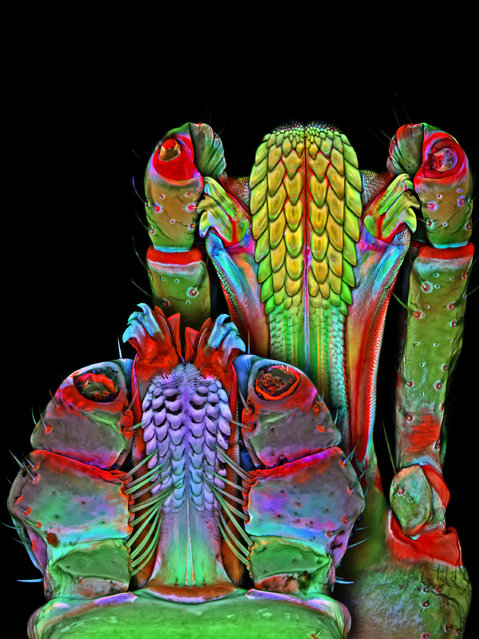
Underside of the Brown dog tick and Lonestar tick mouthparts; Confocal, 100X. Janelia Farm Research Campus, Howard Hughes Medical Institute (HHMI), Ashburn, Virginia, USA. (Photo by Dr. Igor Robert Siwanowicz/Nikon Small World 2014)

Now celebrating its 40th year, Nikon Small World is widely regarded as the leading forum to recognize proficiency and photographic excellence of photography taken under the microscope. To select the winners, competition judges analyzed entries from all over the world covering subjects ranging from chemical compounds to up-close-and-personal looks at biological specimens. The 2014 winners will be revealed on October 30th. In 2014, the competition received over 1,200 entries from more than 79 countries around the world. (Photo by Dr. Igor Robert Siwanowicz/Nikon Small World 2014)
Details
17 Oct 2014 13:10:00
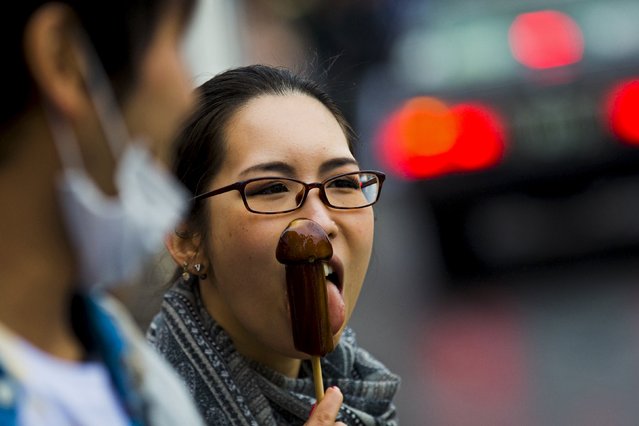
A woman eats candy in the shape of a phallus during the Kanamara Matsuri, or Iron Phallus Festival through a street near the Kanamara shrine in Kawasaki outside of Tokyo April 5, 2015. The festival celebrates fertility and is used to raise awareness and money for the prevention of sexually transmitted diseases. (Photo by Thomas Peter/Reuters)

A woman eats candy in the shape of a phallus during the Kanamara Matsuri, or Iron Phallus Festival through a street near the Kanamara shrine in Kawasaki outside of Tokyo April 5, 2015. The festival celebrates fertility and is used to raise awareness and money for the prevention of sexually transmitted diseases. (Photo by Thomas Peter/Reuters)
Details
11 Apr 2015 10:13:00
Russian honor guard soldiers warm up prior a rehearsal for the Victory Day military parade in St. Petersburg, Russia, Wednesday, May 3, 2017. The parade will take place at Dvortsovaya (Palace) Square on May 9, to celebrate 72 years after the victory in WWII. (Photo by Dmitri Lovetsky/AP Photo)

Russian honor guard soldiers warm up prior a rehearsal for the Victory Day military parade in St. Petersburg, Russia, Wednesday, May 3, 2017. The parade will take place at Dvortsovaya (Palace) Square on May 9, to celebrate 72 years after the victory in WWII. (Photo by Dmitri Lovetsky/AP Photo)
Details
05 May 2017 07:39:00
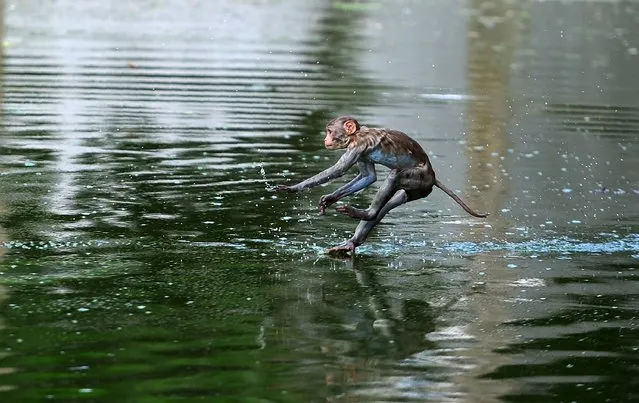
A monkey leaps into a pond on a hot day in Allahabad on May 19, 2017. According to local reports temperatures have soared in the northern Indian city to 47.28 Celsius. (Photo by Sanjay Kanojia/AFP Photo)

A monkey leaps into a pond on a hot day in Allahabad on May 19, 2017. According to local reports temperatures have soared in the northern Indian city to 47.28 Celsius. (Photo by Sanjay Kanojia/AFP Photo)
Details
21 May 2017 08:31:00
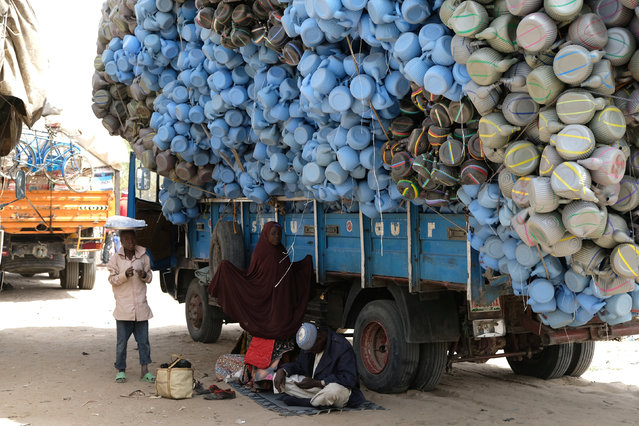
A family of refugees shelters under a truck carrying plastic lota, kettles used to perform Muslim ablutions in Muna Garage, Maiduguri, Nigeria February 16, 2017. (Photo by Paul Carsten/Reuters)

A family of refugees shelters under a truck carrying plastic lota, kettles used to perform Muslim ablutions in Muna Garage, Maiduguri, Nigeria February 16, 2017. (Photo by Paul Carsten/Reuters)
Details
25 May 2017 08:38:00
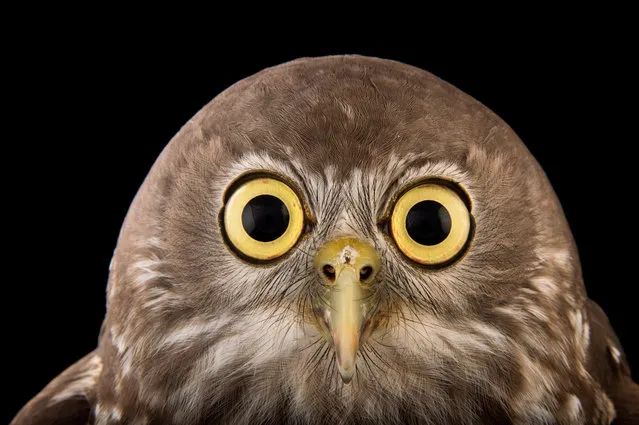
The National Geographic Photo Ark is a travelling exhibition of photographer Joel Sartore’s quest to create a photo archive of biodiversity around the world. So far, Sartore has captured studio portraits of more than 6,000 species – a number that he hopes to double. On 1 July, the ark will open at Melbourne zoo – the first time it has been exhibited in the southern hemisphere. More than 50 portraits will be on display, including many of Australian endangered animals being protected by programs at the zoo itself. These captions have been edited from text supplied by Melbourne zoo. Here: Barking owl. So-named because its call sounds like a barking dog, these birds are native to Australia, Indonesia and Papua New Guinea. In Victoria they are listed as an endangered species, and in 2003 there were estimated to be fewer than 50 breeding pairs. The main threat to the species in Victoria is loss of habitat, especially large trees with hollows in which they can nest and on which many of their prey depend. Apart from a bark, they may utter a chilling scream when they feel threatened. (Photo by Joel Sartore/National Geographic Photo Ark/The Guardian)

The National Geographic Photo Ark is a travelling exhibition of photographer Joel Sartore’s quest to create a photo archive of biodiversity around the world. So far, Sartore has captured studio portraits of more than 6,000 species – a number that he hopes to double. On 1 July, the ark will open at Melbourne zoo – the first time it has been exhibited in the southern hemisphere. More than 50 portraits will be on display, including many of Australian endangered animals being protected by programs at the zoo itself. These captions have been edited from text supplied by Melbourne zoo. Here: Barking owl. (Photo by Joel Sartore/National Geographic Photo Ark/The Guardian)
Details
01 Jul 2017 07:45:00