Loading...
Done
Mount Roraima

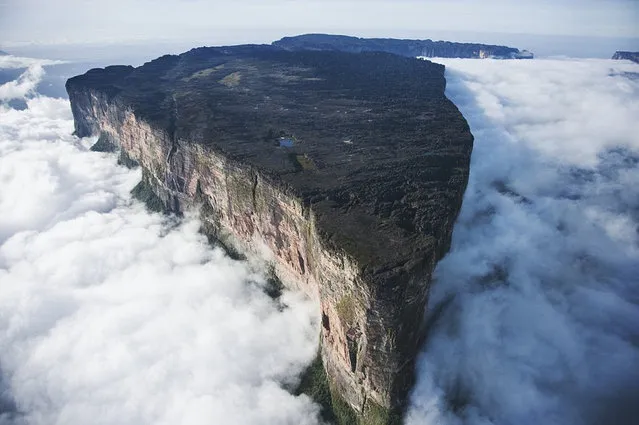
Mount Roraima (Spanish: Monte Roraima, also known as Tepuy Roraima and Cerro Roraima; Portuguese: Monte Roraima [ˈmõtʃi ʁoˈɾajmɐ]) is the highest of the Pakaraima chain of tepui plateau in South America. First described by the English explorer Sir Walter Raleigh in 1596, its 31 km2 summit area is defended by 400-metre-tall cliffs on all sides. The mountain includes the triple border point of Venezuela, Brazil and Guyana.
Details
11 Sep 2012 08:04:00
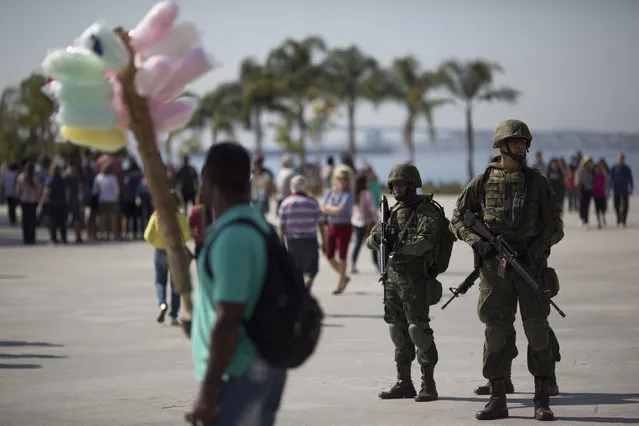
Soldiers stand guard in Maua square where a cotton candy vendor passes by in Rio de Janeiro, Brazil, Saturday, July 9, 2016, as security is deployed to get to know the areas they'll be patrolling during the Olympics. Roughly twice the security contingent at the London Olympics will be deployed during the August games in Rio, which are expected to draw thousands of foreigners to a city where armed muggings, stray bullets and turf wars between heavily armed drug gangs are routine. (Photo by Leo Correa/AP Photo)

Soldiers stand guard in Maua square where a cotton candy vendor passes by in Rio de Janeiro, Brazil, Saturday, July 9, 2016, as security is deployed to get to know the areas they'll be patrolling during the Olympics. Roughly twice the security contingent at the London Olympics will be deployed during the August games in Rio, which are expected to draw thousands of foreigners to a city where armed muggings, stray bullets and turf wars between heavily armed drug gangs are routine. (Photo by Leo Correa/AP Photo)
Details
10 Jul 2016 09:35:00
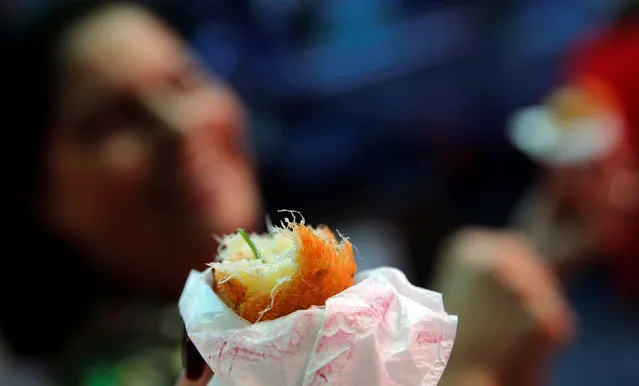
A view of traditional bolinhos de bacalhau (fried codfish balls) in Rio de Janeiro, Brazil, May 7, 2016. (Photo by Sergio Moraes/Reuters)

If the most popular foods of Rio de Janeiro have one thing in common, it is their informality. You can find fine restaurants in the city, but they do not set Rio apart from other places. What does set it apart, and what invariably brings its residents, known as "Cariocas," together is the unpretentious food they eat in bright, loud, crowded bars and restaurants, on busy street corners, or after a day at the beach. Here: A view of traditional bolinhos de bacalhau (fried codfish balls) in Rio de Janeiro, Brazil, May 7, 2016. (Photo by Sergio Moraes/Reuters)
Details
05 Aug 2016 13:20:00
A woman shouts asking for help during an eviction in Rio de Janeiro, Brazil, Friday, April 11, 2014. Squatters in Rio de Janeiro are clashing with police after a Brazilian court ordered that 5,000 people be evicted from abandoned buildings of a telecommunications company. Officers have used tear gas and stun grenades to try to disperse the families. (Photo by Silvia Izquierdo/AP Photo)

A woman shouts asking for help during an eviction in Rio de Janeiro, Brazil, Friday, April 11, 2014. Squatters in Rio de Janeiro are clashing with police after a Brazilian court ordered that 5,000 people be evicted from abandoned buildings of a telecommunications company. Officers have used tear gas and stun grenades to try to disperse the families. (Photo by Silvia Izquierdo/AP Photo)
Details
13 Apr 2014 07:22:00
Carolaine Reis and her son Miguel Alves, residents of the Aglomerado da Serra favela, wear a protective mask against the spread of the new Coronavirus (COVID-19) made by the seamstresses of the Remexe Favelinha studio, in the Aglomerado da Serra favela, on April 13, 2020 in Belo Horizonte, Brazil. Facial masks follow the protocol and guidelines defined by the Ministry of Health. Around 6,000 masks have already been produced. The masks are being distributed to a part of the population and sold throughout the country, in the amount of 5 reais per unit. (Photo by Pedro Vilela/Getty Images)

Carolaine Reis and her son Miguel Alves, residents of the Aglomerado da Serra favela, wear a protective mask against the spread of the new Coronavirus (COVID-19) made by the seamstresses of the Remexe Favelinha studio, in the Aglomerado da Serra favela, on April 13, 2020 in Belo Horizonte, Brazil. Facial masks follow the protocol and guidelines defined by the Ministry of Health. Around 6,000 masks have already been produced. The masks are being distributed to a part of the population and sold throughout the country, in the amount of 5 reais per unit. (Photo by Pedro Vilela/Getty Images)
Details
16 Apr 2020 00:03:00
Contestant Nathalie De Oliveira of Brazil prepares backstage before the final show of the Miss International Queen 2016 transgender/transsexual beauty pageant in Pattaya, Thailand, March 10, 2017. Thai contestant Jiratchaya Sirimongkolnawin was crowned Miss International Queen 2016 on Friday at a contest billed as the world's largest and most popular transgender pageant. (Photo by Athit Perawongmetha/Reuters)

Contestant Nathalie De Oliveira of Brazil prepares backstage before the final show of the Miss International Queen 2016 transgender/transsexual beauty pageant in Pattaya, Thailand, March 10, 2017. Thai contestant Jiratchaya Sirimongkolnawin was crowned Miss International Queen 2016. The 2016 show was postponed from November last year due to Thailand's mourning period of its late King Bhumibol Adulyadej who died at age 88 on October 13, 2016. (Photo by Athit Perawongmetha/Reuters)
Details
12 Mar 2017 09:57:00
Kawakanih Yawalapiti, 9, Upper Xingu region of Mato Grosso, Brazil, 2018: Kawakanih lives with her tribe, the Yawalapiti, in Xingu national park, a preserve in the Amazon basin of Brazil. The Yawalapiti collect seeds to preserve species unique to their ecosystem, which lies between the rain forest and savannah. Kawakanih’s diet is simple, consisting mainly of fish, cassava, porridge, fruit and nuts. “It takes five minutes to catch dinner”, says Kawakanih. “When you’re hungry, you just go to the river with your net”. (Photo by Gregg Segal/The Guardian)

Photographer Gregg Segal travelled the world to document children and the food they eat in a week. Partly inspired by the increasing problems of childhood obesity, he tracked traditional regional diets as yet unaffected by globalisation, and ironically, found that the healthiest diets were often eaten by the least well off. (Photo by Gregg Segal/The Guardian)
Details
03 Jul 2019 00:03:00
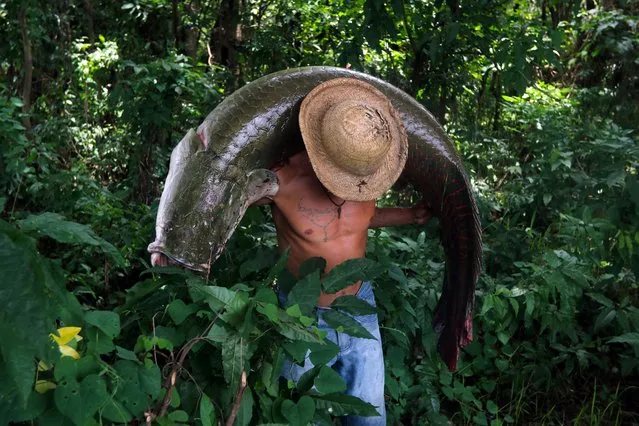
A fisherman carries a large Pirarucu (Arapaima gigas) at the Piagacu-Purus Sustainable Development Reserve in Amazonas state, Brazil, on October 24, 2019. The pirarucu -a giant fish of the Amazon, that had been on the verge of extinction- can measure up to three meters and weigh more than 200 kilos. The soft and tasty white meat fish is nowadays served in renowned restaurants in Rio de Janeiro. (Photo by Ricardo Oliveira/AFP Photo)

A fisherman carries a large Pirarucu (Arapaima gigas) at the Piagacu-Purus Sustainable Development Reserve in Amazonas state, Brazil, on October 24, 2019. The pirarucu -a giant fish of the Amazon, that had been on the verge of extinction- can measure up to three meters and weigh more than 200 kilos. The soft and tasty white meat fish is nowadays served in renowned restaurants in Rio de Janeiro. (Photo by Ricardo Oliveira/AFP Photo)
Details
31 Oct 2019 00:07:00