Loading...
Done
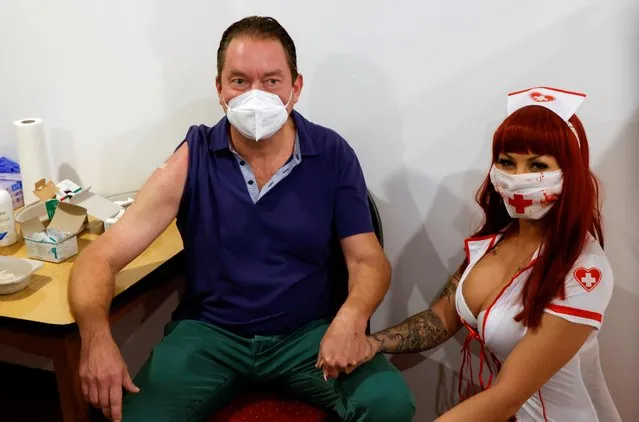
A woman dressed as a nurse sits next to Gerhard after a coronavirus disease (COVID-19) vaccination in a brothel in Vienna, Austria on November 8, 2021. (Photo by Leonhard Foeger/Reuters)

A woman dressed as a nurse sits next to Gerhard after a coronavirus disease (COVID-19) vaccination in a brothel in Vienna, Austria on November 8, 2021. (Photo by Leonhard Foeger/Reuters)
Details
11 Nov 2021 08:38:00
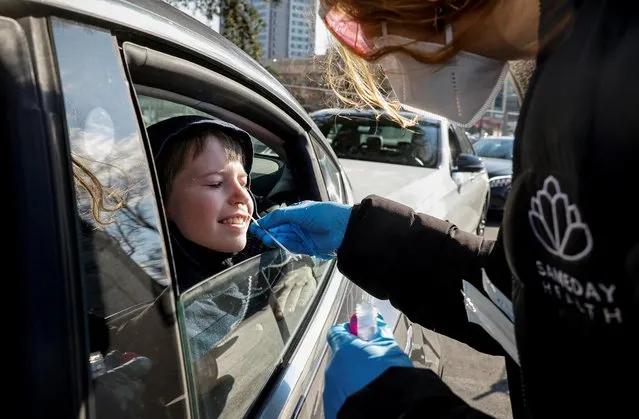
Levi Dinmore, 8, gets a COVID-19 test at a Sameday Health drive-through testing site in Bethesda, Maryland, U.S., December 22, 2021. (Photo by Evelyn Hockstein/Reuters)

Levi Dinmore, 8, gets a COVID-19 test at a Sameday Health drive-through testing site in Bethesda, Maryland, U.S., December 22, 2021. (Photo by Evelyn Hockstein/Reuters)
Details
28 Dec 2021 08:59:00
British singer Rita Ora ready to record in the studio in North West London, United Kingdom on October 13, 2020. (Photo by Click News and Media)

British singer Rita Ora ready to record in the studio in North West London, United Kingdom on October 13, 2020. (Photo by Click News and Media)
Details
18 Oct 2020 00:05:00
The Sheep watch the sunset from the top of Cleeve Hill, Cheltenham, United Kingdom on June 22, 2020. (Photo by Jack Boskett/The Telegraph)

The Sheep watch the sunset from the top of Cleeve Hill, Cheltenham, United Kingdom on June 22, 2020. (Photo by Jack Boskett/The Telegraph)
Details
21 Jul 2020 00:05:00
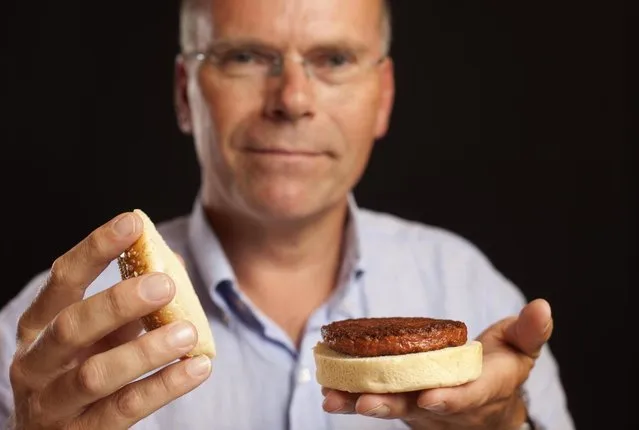
In this handout image provided by Ogilvy, a burger made from cultured beef, which has been developed by Professor Mark Post of Maastricht University in the Netherlands (pictured) is shown to the media during a press conference on August 5, 2013 in London, England. Cultured Beef could help solve the coming food crisis and combat climate change with commercial production of Cultured Beef beginning within ten to twenty years. (Photo by David Parry via Getty Images)

In this handout image provided by Ogilvy, a burger made from cultured beef, which has been developed by Professor Mark Post of Maastricht University in the Netherlands (pictured) is shown to the media during a press conference on August 5, 2013 in London, England. The in-vitro burger, cultured from cattle stem cells, the first example of what its creator says could provide an answer to global food shortages and help combat climate change, was fried in a pan and tasted by two volunteers. The burger is the result of years of research by Dutch scientist Mark Post, a vascular biologist at the University of Maastricht, who is working to show how meat grown in petri dishes might one day be a true alternative to meat from livestock.The meat in the burger has been made by knitting together around 20,000 strands of protein that has been cultured from cattle stem cells in Post's lab. (Photo by David Parry)
Details
06 Aug 2013 08:48:00
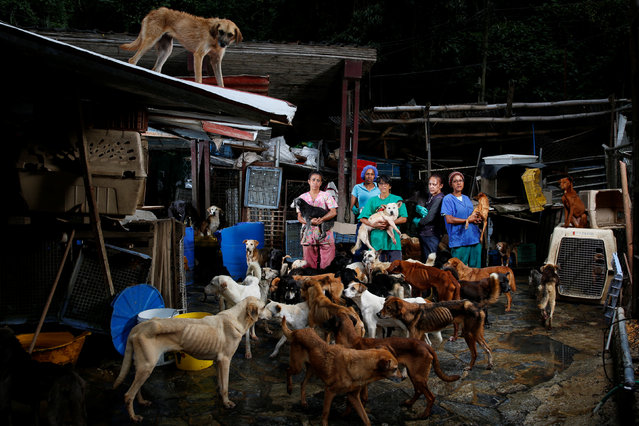
(L-R) Maria Silva, Milena Cortes, Maria Arteaga, Jackeline Bastidas and Gissy Abello pose for a picture at the Famproa dogs shelter where they work, in Los Teques, Venezuela, August 25, 2016. Venezuelans struggling to feed their families let alone their pets are dumping animals on the streets, in parks and at makeshift homes overrun with scrawny animals amid an economic crisis. An hour from Caracas in Los Teques, hundreds of dogs bark and run around the streets scavenging for food outside a makeshift shelter. People come by every few hours to hand over scrawny dogs which are fed by volunteers every day. Venezuela is undergoing a major economic and social crisis, with shortages of basic foods and medicines. Triple digit inflation is hitting everybody hard, including those who own pets. (Photo by Carlos Garcia Rawlins/Reuters)

(L-R) Maria Silva, Milena Cortes, Maria Arteaga, Jackeline Bastidas and Gissy Abello pose for a picture at the Famproa dogs shelter where they work, in Los Teques, Venezuela, August 25, 2016. Venezuelans struggling to feed their families let alone their pets are dumping animals on the streets, in parks and at makeshift homes overrun with scrawny animals amid an economic crisis. An hour from Caracas in Los Teques, hundreds of dogs bark and run around the streets scavenging for food outside a makeshift shelter. (Photo by Carlos Garcia Rawlins/Reuters)
Details
08 Sep 2016 10:01:00


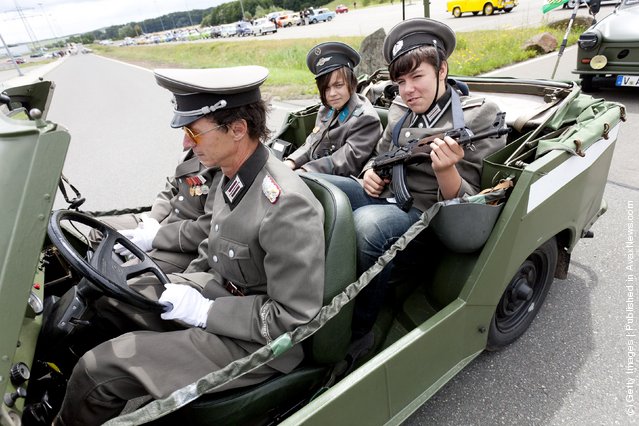
“The Trabant is a car that was produced by former East German auto maker VEB Sachsenring Automobilwerke Zwickau in Zwickau, Sachsen. It was the most common vehicle in East Germany, and was also exported to countries both inside and outside the communist bloc. The main selling points was that it had room for four adults and luggage in a compact, light and durable shell and that it was fast (when introduced) and durable. With its mediocre performance, smoky two-stroke engine, and production shortages, the Trabant is often cited as an example of the disadvantages of centralized planning; on the other hand, it is regarded with derisive affection as a symbol of the failed former East Germany and of the fall of communism (in former West Germany, as many East Germans streamed into West Berlin and West Germany in their Trabants after the opening of the Berlin Wall in 1989). It was in production without any significant changes for nearly 30 years with 3,096,099 Trabants produced in total”. – Wikipedia

Photo: Enthusiasts weared in uniforms of the former eastern german army trive in a military Trabant car as fans and owners of East German-era Trabant cars gather at the 2011 International Trabantfahrer Treffen (International Trabant Drivers Meeting) on June 26, 2011 in Zwickau, Germany. The Trabant, also known as the Trabi, was among the main cars produced in communist East Germany and built by VEB Sachsenring Automobilwerke in Zwickau for 30 years until 1989. Today the car has cult status for many followers and one company, IndiKar, is even seeking to revive the brand in a modern, electric version. (Photo by Carsten Koall/Getty Images)
Details
27 Jun 2011 12:21:00
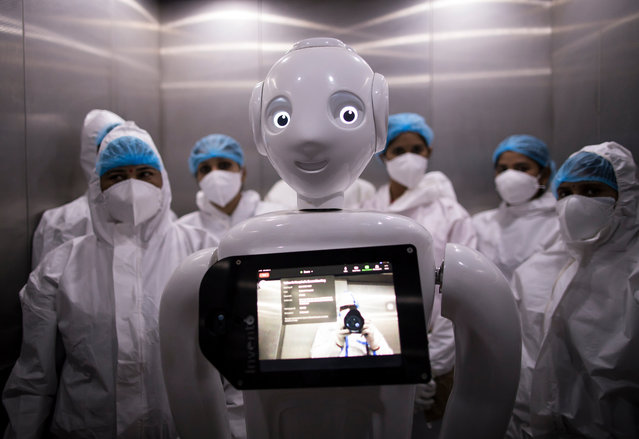
A robot used to assist Covid-19 patients is seen in an elevator on December 5, 2020 in New Delhi, India. The “Mitra” robot can connect patients with their loved ones, and can assist healthcare workers on the frontlines of the pandemic by minimisng the risk of infections caused by close contact. The Yatharth Hospital, which is treating Covid-19 patients in Noida, on the outskirts of New Delhi, is one of a handful of hospitals in India that has started to use robots. (Photo by Anindito Mukherjee/Getty Images)

A robot used to assist Covid-19 patients is seen in an elevator on December 5, 2020 in New Delhi, India. The “Mitra” robot can connect patients with their loved ones, and can assist healthcare workers on the frontlines of the pandemic by minimisng the risk of infections caused by close contact. The Yatharth Hospital, which is treating Covid-19 patients in Noida, on the outskirts of New Delhi, is one of a handful of hospitals in India that has started to use robots. (Photo by Anindito Mukherjee/Getty Images)
Details
21 Dec 2020 00:05:00