Loading...
Done
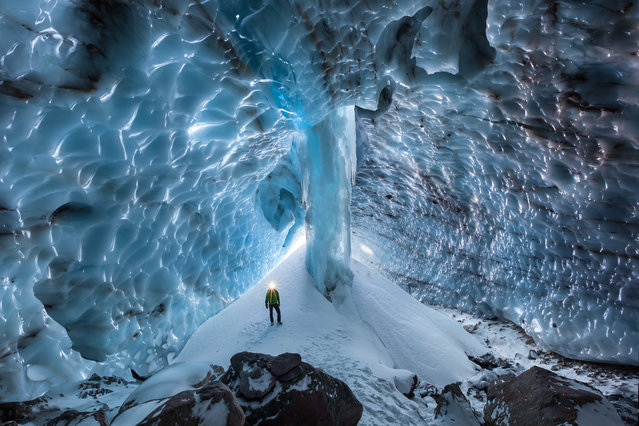
On the western side of Mount Hood lies the longest glacier cave system in the contiguous United States. In 2012, these caves were mapped to a combined length of 7,166.8 feet by cave explorers Brent McGregor and Eddy Cartaya. Currently, the total passage length is hundreds of feet less. Glaciers are frozen rivers; they are always moving and changing. In the past five years, we have seen the caves melt, shrink and collapse in a dramatic way. The caves are formed by water carving away at the ice. (Photo and caption by Josh Hydeman)

On the western side of Mount Hood lies the longest glacier cave system in the contiguous United States. In 2012, these caves were mapped to a combined length of 7,166.8 feet by cave explorers Brent McGregor and Eddy Cartaya. Currently, the total passage length is hundreds of feet less. Glaciers are frozen rivers; they are always moving and changing... (Photo and caption by Josh Hydeman)
Details
22 Mar 2015 11:05:00
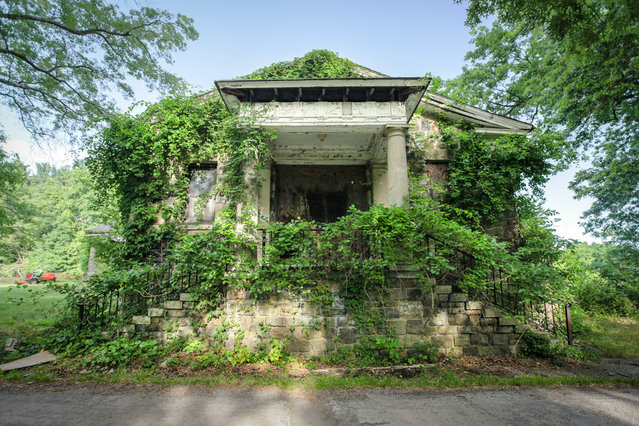
Letchworth Village is located just an hour's drive from NYC in Thiells, NY.  It was founded in 1912 to house the city's developmentally disabled as a ”state institution for the epileptic and feeble-minded”. (Photo by Will Ellis)

From Manhattan and Brooklyn's trendiest neighborhoods to the far-flung edges of theouter boroughs, Will Ellis has spent the last three years photographing and researching the lost and lonely corners of the United States' most populous city. His photo book Abandoned NYC is packed with 150 color images of sixteen of New York's most beautiful and mysterious abandoned spaces, paired with detailed essays on the fascinating history of these forgotten sites. Here: Letchworth Village is located just an hour's drive from NYC in Thiells, NY. It was founded in 1912 to house the city's developmentally disabled as a ”state institution for the epileptic and feeble-minded”. (Photo by Will Ellis)
Details
31 Mar 2015 12:31:00
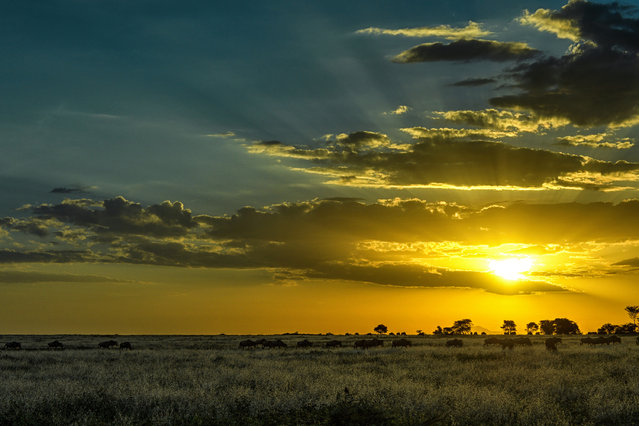
Using his camera skills, Marc meters the background sky in order to achieve the beautiful black silhouettes of the wildlife, Africa, 2010-2016. A photographer has travelled around Africa for six years to capture striking silhouettes of lions, giraffes and birds. Australian wildlife photographer, Marc Mol took the series of pictures in various areas of Africa; including Botswana and Kenya to Tanzania and Zambia. Whether grazing, hunting or resting, the animals' daily activities are transformed into something majestic when cast against golden evenings and pink dawns. (Photo by Marc Mol/Barcroft Images)

Using his camera skills, Marc meters the background sky in order to achieve the beautiful black silhouettes of the wildlife, Africa, 2010-2016. (Photo by Marc Mol/Barcroft Images)
Details
10 Jan 2017 13:36:00
A Syrian boy looks through a gate as others wait to cross into Syria at Oncupinar border crossing in the southeastern city of Kilis, Turkey February 11, 2016.. (Photo by Osman Orsal/Reuters)

A Syrian boy looks through a gate as others wait to cross into Syria at Oncupinar border crossing in the southeastern city of Kilis, Turkey February 11, 2016.. (Photo by Osman Orsal/Reuters)
Details
13 Feb 2016 09:42:00


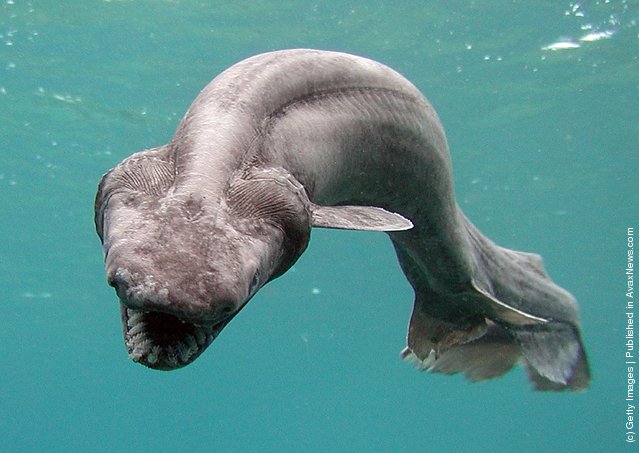
“The frilled shark (Chlamydoselachus anguineus) is one of two extant species of shark in the family Chlamydoselachidae, with a wide but patchy distribution in the Atlantic and Pacific Oceans. This uncommon species is found over the outer continental shelf and upper continental slope, generally near the bottom though there is evidence of substantial upward movements. It has been caught as deep as 1,570 m (5,150 ft), whereas in Suruga Bay, Japan it is most common at depths of 50–200 m (160–660 ft). Exhibiting several “primitive” features, the frilled shark has often been termed a «living fossil»”. – Wikipedia

Photo: A 1.6 meter long Frill shark swims in a tank after being found by a fisherman at a bay in Numazu, on January 21, 2007 in Numazu, Japan. The frill shark, also known as a Frilled shark usually lives in waters of a depth of 600 meters and so it is very rare that this shark is found alive at sea-level. It's body shape and the number of gill are similar to fossils of sharks which lived 350,000,000 years ago. (Photo by Awashima Marine Park/Getty Images)

Details
05 May 2011 10:01:00


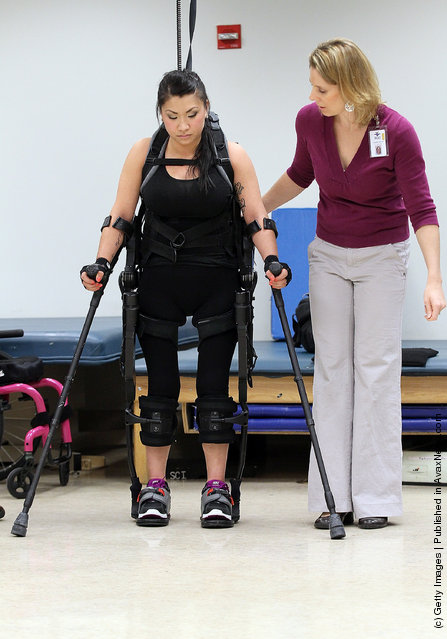
“eLEGS is a wearable, artificially intelligent, bionic device that enables people with paralysis to stand up and walk again. The exoskeleton is battery-powered and rechargeable, fitting comfortably and securely over clothing. Initially, eLEGS will be used under medical supervision for rehabilitation and training”. – BerkeleyBionics.com

Photo: Paralysis victim Stephanie Sablan (L) is helped by physical therapist Shonna Moran as she walks using eLEGS robotic legs at Santa Clara Valley Medical Center on May 25, 2011 in San Jose, California. Sablan, 24, was paralyzed from the waist down earlier this year when she was in a car accident and has begun using the newly developed eLEGS made by Berkeley Bionics. The robot-like battery powered eLEGS fit over clothing and enables people with paralysis to stand up and walk again. (Photo by Justin Sullivan/Getty Images)
Details
26 May 2011 09:56:00


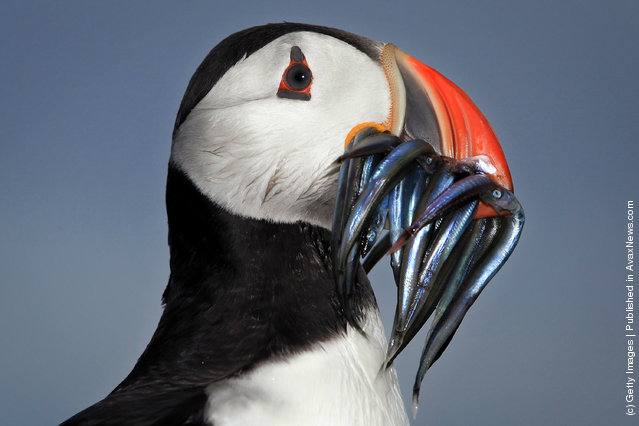
A Puffin returns to it's nest with a beak full of sand eels on June 25, 2011 on Inner Farne, England. The Farne Islands, which are run by the National Trust, are situated two to three miles off the Northumberland coastline. The archipeligo of 16-28 separate islands (depending on the tide) make the summer home to approximately 100,000 pairs of breeding seabirds including around 36,000 Puffins, 32,000 Guillemots and 2,000 pairs of Arctic Terns. The species of birds which nest in internationally important numbers include Shag, Sandwich Tern and Arctic Tern. The coastline around The Farnes are also the breeding ground to one of Europe's largest Grey Seal colonies with around 4,000 adults giving birth to 1500 pups every year. (Photo by Dan Kitwood/Getty Images)
Details
27 Jun 2011 12:58:00
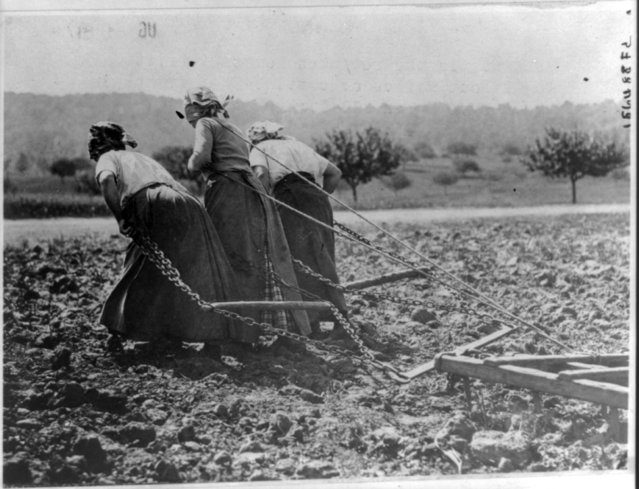
Peasants in the re-taken Somme District work in the fields, circa 1916- 1917, in this Library of Congress handout photo. (Photo by Reuters/Bain Collection/Library of Congress)

Peasants in the re-taken Somme District work in the fields, circa 1916- 1917, in this Library of Congress handout photo. For women 100 years ago, opportunities to work beyond the home and take part in political life were very limited. As the 20th century progressed, hard-won progress included gradually improved voting rights, while the upheaval of war pushed doors ajar as women worked as part of the war effort. U.S. Library of Congress archive photos show women's workplaces ranging from a flour mill in England to a coal mine in Belgium or Lincoln Motor Co.'s welding department in Detroit. International Women's Day is celebrated on March 8. (Photo by Reuters/Bain Collection/Library of Congress)
Details
03 Mar 2016 11:39:00