Loading...
Done
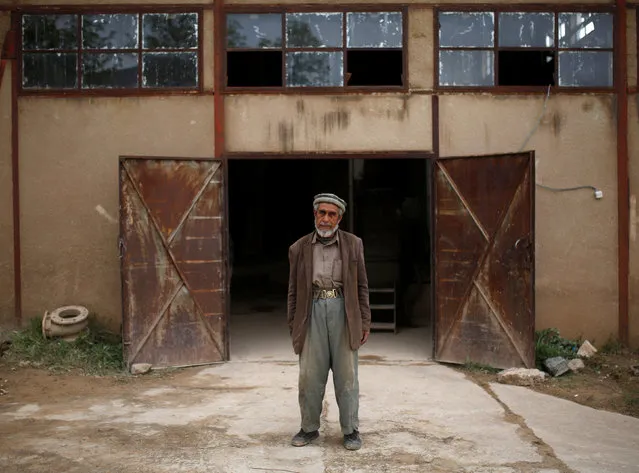
A worker at the Jabal Saraj cement factory poses for a photograph in Jabal Saraj, north of Kabul, Afghanistan April 19, 2016. (Photo by Ahmad Masood/Reuters)

A worker at the Jabal Saraj cement factory poses for a photograph in Jabal Saraj, north of Kabul, Afghanistan April 19, 2016. In an area desperately short of industry and jobs, local workers hope that the relaunch of the plant in Jabal Saraj, built by Czech engineers in 1957 and closed down by the Taliban in 1995, can show that Afghanistan's shattered industry can climb back to its feet after decades of war and destruction. But the outdated state-owned plant some 75 kilometres outside Kabul also shows how far it has to go before that promise can be achieved and there are serious questions over whether it has a viable future unless a new, modern facility is built to replace it. (Photo by Ahmad Masood/Reuters)
Details
31 May 2016 11:29:00
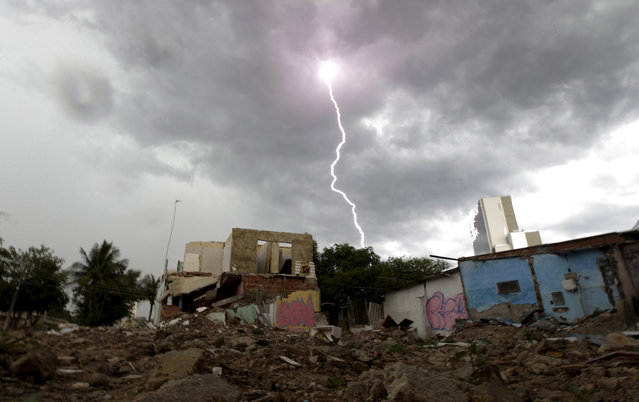
Partially demolished houses stand in the Vila Autodromo slum with the Rio 2016 Olympic Park in the background in Rio de Janeiro, Brazil, February 25, 2016. (Photo by Ricardo Moraes/Reuters)

Partially demolished houses stand in the Vila Autodromo slum with the Rio 2016 Olympic Park in the background in Rio de Janeiro, Brazil, February 25, 2016. (Photo by Ricardo Moraes/Reuters)
Details
05 Aug 2016 13:07:00
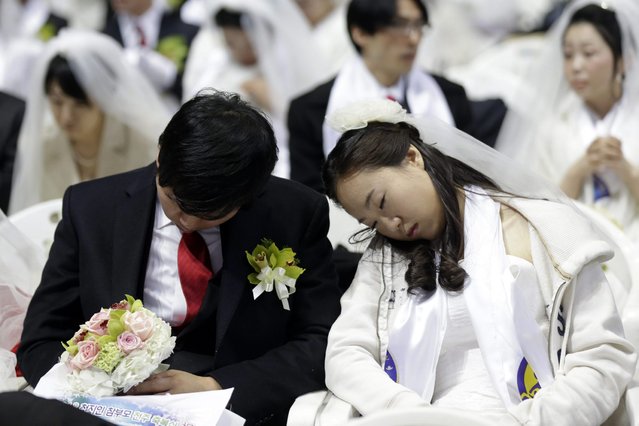
A newly-married couple takes a nap before their mass wedding ceremony at the CheongShim Peace World Center in Gapyeong, South Korea, Sunday, February 17, 2013. Some 3,500 South Korean and foreign couples exchanged or reaffirmed marriage vows in the Unification Church's mass wedding arranged by Hak Ja Han Moon, a wife of the late Rev. Sun Myung Moon, the controversial founder of the Unification Church. (Photo by Lee Jin-man/AP Photo)

A newly-married couple takes a nap before their mass wedding ceremony at the CheongShim Peace World Center in Gapyeong, South Korea, Sunday, February 17, 2013. Some 3,500 South Korean and foreign couples exchanged or reaffirmed marriage vows in the Unification Church's mass wedding arranged by Hak Ja Han Moon, a wife of the late Rev. Sun Myung Moon, the controversial founder of the Unification Church. (Photo by Lee Jin-man/AP Photo)
Details
18 Feb 2013 11:15:00
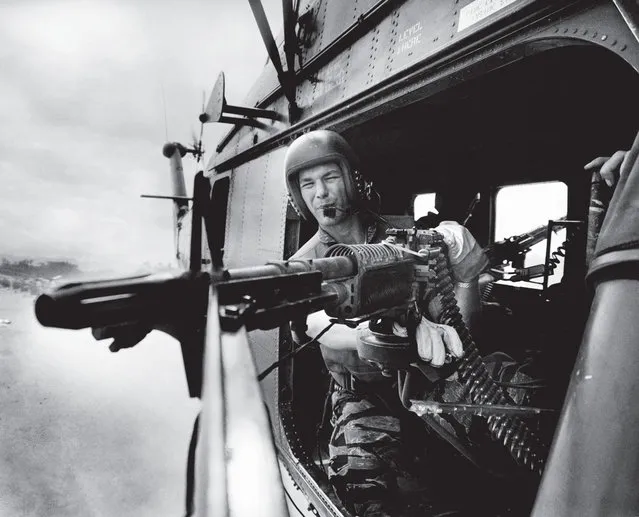
Man your battle stations: The crew chief of helicopter Yankee Papa 13, lance corporal James C. Farley, mans an M-60 machine gun during a mission near Da Nang, Vietnam on March 31, 1965. (Photo by Larry Burrows/Time & Life Pictures)

In the spring of 1965, within weeks of 3,500 American Marines arriving in Vietnam, a 39-year-old Briton named Larry Burrows began work on a feature for LIFE magazine, chronicling the day-to-day experience of U.S. troops on the ground – and in the air – in the midst of the rapidly widening war. The photographs in this gallery focus on a calamitous March 31, 1965, helicopter mission; Burrows’ “report from Da Nang”, featuring his pictures and his personal account of the harrowing operation, was published two weeks later as a now-famous cover story in the April 16, 1965, issue of LIFE.

Photo: Man your battle stations: The crew chief of helicopter Yankee Papa 13, lance corporal James C. Farley, mans an M-60 machine gun during a mission near Da Nang, Vietnam on March 31, 1965. (Photo by Larry Burrows/Time & Life Pictures)
Details
07 Apr 2013 07:08:00
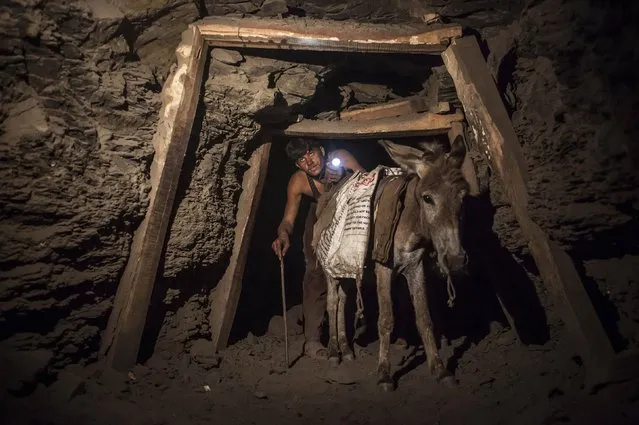
A miner with a donkey makes his way through the low and narrow tunnel leading out of a coal mine in Choa Saidan Shah in Punjab province, April 29, 2014. Workers at this mine in Choa Saidan Shah dig coal with pick axes, break it up and load it onto donkeys to be transported to the surface. (Photo by Sara Farid/Reuters)

A miner with a donkey makes his way through the low and narrow tunnel leading out of a coal mine in Choa Saidan Shah in Punjab province, April 29, 2014. Workers at this mine in Choa Saidan Shah dig coal with pick axes, break it up and load it onto donkeys to be transported to the surface. Employed by private contractors, a team of four workers can dig about a ton of coal a day, for which they earn around $10 to be split between them. The coalmine is in the heart of Punjab, Pakistan's most populous and richest province, but the labourers mostly come from the poorer neighbouring region of Khyber Pakhtunkhwa. (Photo by Sara Farid/Reuters)
Details
03 Aug 2014 07:35:00
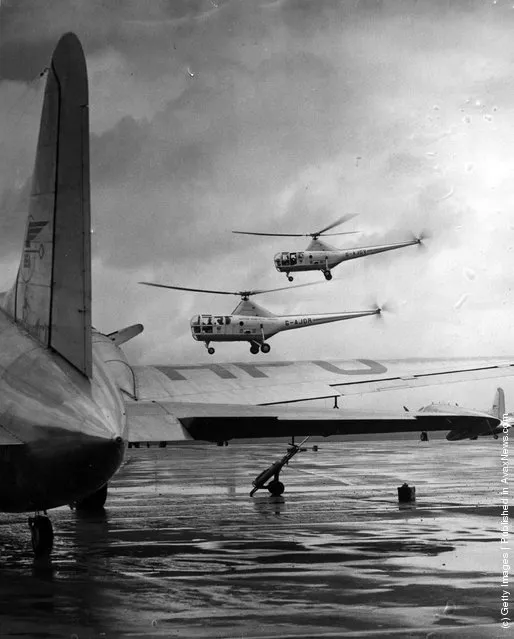
Sikorsky H-5 helicopters

“Igor Sikorsky (May 25, 1889 – October 26, 1972), born Igor Ivanovich Sikorsky was a Russian American pioneer of aviation in both helicopters and fixed-wing aircraft. He designed and flew the world's first multi-engine fixed-wing aircraft, the Russky Vityaz in 1913, and the first airliner, Ilya Muromets, in 1914. After immigrating to the United States in 1919, Sikorsky founded the Sikorsky Aircraft Corporation in 1923, and developed the first of Pan American Airways' ocean-conquering flying boats in the 1930s. In 1939 Sikorsky designed and flew the Vought-Sikorsky VS-300, the first viable American helicopter, which pioneered the rotor configuration used by most helicopters today. Sikorsky would modify the design into the Sikorsky R-4, which became the world's first mass-produced helicopter in 1942”. – Wikipedia

Photo: Westland Sikorsky H-5's, used by British European Airways Helicopters, which fly between London and Birmingham. The Sikorsky H-5, (aka R-5, S-51, HO3S-1, or Horse) (R-5 until 1948; company designation VS-327) is a helicopter built by Sikorsky Aircraft Corporation, formerly used by the United States Air Force, and its predecessor, the United States Army Air Forces, as well as the United States Navy and United States Coast Guard (with the designations HO2S and HO3S). (Photo by Harrison /Topical Press Agency/Getty Images). 22nd May 1951
Details
06 Sep 2011 10:18:00
Takeoka Chisaka, Hiroshima, Japan. “One morning in August 1945, I was walking home from the night shift at a factory in Hiroshima. As I reached my door, there was a huge explosion. When I came to, my head was bleeding and I had been blasted 30m away”. (Photo and caption by Sasha Maslov)

Takeoka Chisaka, Hiroshima, Japan. “One morning in August 1945, I was walking home from the night shift at a factory in Hiroshima. As I reached my door, there was a huge explosion. When I came to, my head was bleeding and I had been blasted 30m away. The atomic bomb had detonated. When I found my mother, her eyes were badly burned. A doctor said they had to come out, but he didn’t have the proper tools so used a knife instead. It was hellish. I became a peace-worker after the war. In the 1960s, at a meeting at the UN, I met one of the people who created the atomic bomb. He apologised”. (Photo and caption by Sasha Maslov)
Details
11 May 2015 11:56:00
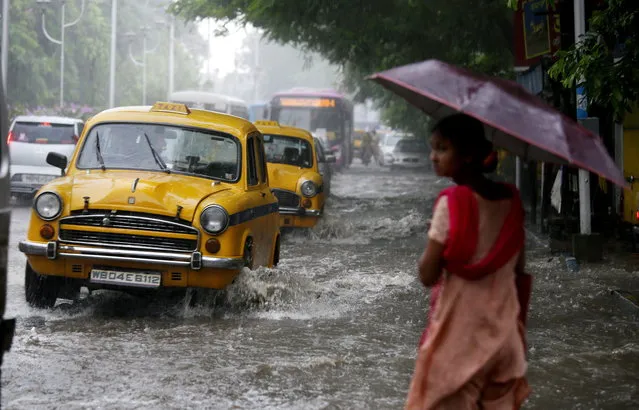
Indian commuters wade through floodwaters during the continuous rain shower in Calcutta, India, July 10, 2015. A monsoon shower hit the city and disrupted daily life. The Indian monsoon, takes place between May and September. (Photo by Piyal Adhikary/EPA)

Indian commuters wade through floodwaters during the continuous rain shower in Calcutta, India, July 10, 2015. A monsoon shower hit the city and disrupted daily life. The Indian monsoon, takes place between May and September. (Photo by Piyal Adhikary/EPA)
Details
11 Jul 2015 14:18:00