2016 Rio Olympics, Weightlifting, Final, Women's 63kg, Riocentro, Pavilion 2, Rio de Janeiro, Brazil on August 9, 2016. Marina Rodriguez (CUB) of Cuba competes. (Photo by Stoyan Nenov/Reuters)
A stunning photographic collection featuring portraits of people from 30 countries and the food they eat in one day. In this fascinating study of people and their diets, 80 profiles are organized by the total number of calories each person puts away in a day. Featuring a Japanese sumo wrestler, a Massai herdswoman, world-renowned Spanish chef Ferran Adria, an American competitive eater, and more, these compulsively readable personal stories also include demographic particulars, including age, activity level, height, and weight. Essays from Harvard primatologist Richard Wrangham, journalist Michael Pollan, and others discuss the implications of our modern diets for our health and for the planet. This compelling blend of photography and investigative reportage expands our understanding of the complex relationships among individuals, culture, and food.
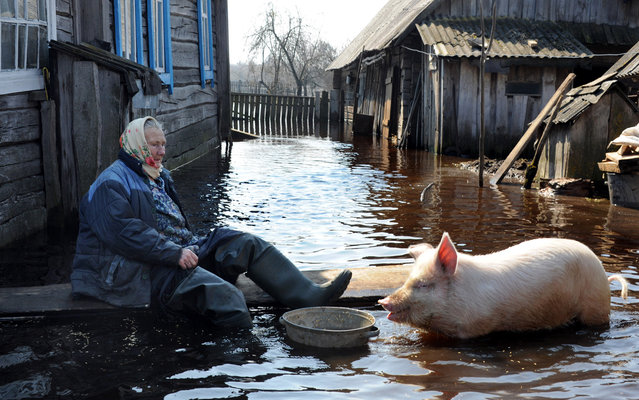
A woman feeds a pig in her yard during spring flood in the Belarus village of Snyadin near Pripyat river, some 300 km south of Minsk, on April 16, 2013. (Photo by Viktor Drachev/AFP Photo)
2016 Rio Olympics, Rhythmic Gymnastics, Final, Individual All-Around Final, Rotation 1, Rio Olympic Arena, Rio de Janeiro, Brazil on August 20, 2016. Melitina Staniouta (BLR) of Belarus competes using the hoop. (Photo by Ruben Sprich/Reuters)
A woman smokes a mask bong on the final day of Hempfest, Seattle's annual gathering to promote the legalization of marijuana, on August 17, 2014. (Photo by Jordan Stead/Seattlepi.com)
Children attend a war safety awareness class conducted by civil defence members, in the rebel-controlled area of Maaret al-Numan town in Idlib province, Syria May 14, 2016. (Photo by Khalil Ashawi/Reuters)
Luling, Louisiana, US. New evidence contradicts previous claims of the relative safety of glyphosate, the world’s most widely used herbicide, which is manufactured here. It is often used in conjunction with seeds that have been genetically modified to tolerate its application, meaning that anyone consuming these crops is eating a genetically modified plant, and whatever residue of the pesticide that remains. (Photo by J. Henry Fair/Industrial Scars/Papadakis Publisher)