Loading...
Done
A man holds a child after rescuing him from a kindergarten affected by a fire at a commercial building, in Ningde, Fujian province, China, September 16, 2015. According to local media, more than 260 people were evacuated due to the fire, which broke out Wednesday morning. No causalities have been reported and the cause of it is still unknown. (Photo by Reuters/China Daily)

A man holds a child after rescuing him from a kindergarten affected by a fire at a commercial building, in Ningde, Fujian province, China, September 16, 2015. According to local media, more than 260 people were evacuated due to the fire, which broke out Wednesday morning. No causalities have been reported and the cause of it is still unknown. (Photo by Reuters/China Daily)
Details
17 Sep 2015 11:15:00
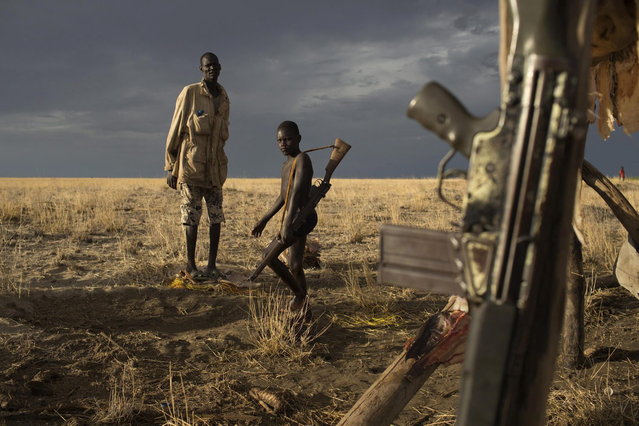
A Turkana man and a boy carrying a gun look on as a G3 battle rifle hangs from a structure used to dry fish at a fishing camp on the shores of Lake Turkana, some kilometres from Todonyang near the Kenya-Ethiopia border in northwestern Kenya October 12, 2013. (Photo by Siegfried Modola/Reuters)

A Turkana man and a boy carrying a gun look on as a G3 battle rifle hangs from a structure used to dry fish at a fishing camp on the shores of Lake Turkana, some kilometres from Todonyang near the Kenya-Ethiopia border in northwestern Kenya October 12, 2013The Turkana are traditionally nomadic pastoralists, but they have seen the pasture that they need to feed their herds suffer from recurring droughts and many have turned to fishing. However, Lake Turkana is overfished, and scarcity of food and pastureland is fuelling long-standing conflict with Ethiopian indigenous Dhaasanac, who have seen grazing grounds squeezed by large-scale government agricultural schemes in southern Ethiopia. The Dhaasanac now venture ever deeper into Kenyan territory in search of fish and grass, clashing with neighbours. Fighting between the communities has a long history, but the conflict has become ever more fatal as automatic weapons from other regional conflicts seep into the area. While the Turkana region is short of basics like grass and ground-water, it contains other resources including oil reserves and massive, newly discovered underground aquifers. (Photo by Siegfried Modola/Reuters)
Details
05 Dec 2013 12:08:00
Ocean voyage

Do you think that history is a science? Well, not exactly. First, and foremost, history is the state's “legend of wars”, it’s official regalia. Of course, public historians are not interested in scientific truth – quite the opposite. In this respect, any attempt to present a state’s history as altruistic and benevolent as possible is welcomed and encouraged – as opposed to any revisionism attempts that may be more accurate. In this matter, Chinese have surpassed us all – they revised in highly creative manner (but rather shamelessly) the technology already invented by Europeans, a process that resulted in oldest state on the planet. Here is an interesting paradox: ask any sinologist about the Middle Kingdom during second century B.C., and he will describe it to you in such a vivid manner as if he has been living there all his life – but as soon as you will ask him to describe Chinese history in the 19-20th centuries… let's say, his eagerness will be greatly diminished. However, we will discuss China in a different article, and in the meantime we will try to understand how exactly historic “legend of wars” is formed and functions – based on a specific and well-known example. A great example is Ferdinand Magellan's first voyage around the world.

Details
14 Nov 2011 09:11:00
Yang Juan, an employee at Goopal Group, takes a nap in her seat after lunch, in Beijing, China, April 21, 2016. (Photo by Jason Lee/Reuters)

Yang Juan, an employee at Goopal Group, takes a nap in her seat after lunch, in Beijing, China, April 21, 2016. Office workers sleeping on the job is a common sight in China, where a surplus of cheap labour can lead to downtime at work. But in China's technology sector, where business is growing faster than many start-up firms can hire new staff, workers burn the midnight oil to meet deadlines and compete with their rivals. Some companies provide sleeping areas and beds for workers to rest during late nights. (Photo by Jason Lee/Reuters)
Details
12 May 2016 14:53:00
Buddhist novice poses for a picture while monks gather to receive alms at Wat Phra Dhammakaya temple, in what organizers said was a meeting of over 100,000 monks, in Pathum Thani, outside Bangkok April 22, 2016. (Photo by Jorge Silva/Reuters)

Buddhist novice poses for a picture while monks gather to receive alms at Wat Phra Dhammakaya temple, in what organizers said was a meeting of over 100,000 monks, in Pathum Thani, outside Bangkok April 22, 2016. (Photo by Jorge Silva/Reuters)
Details
23 Apr 2016 13:27:00
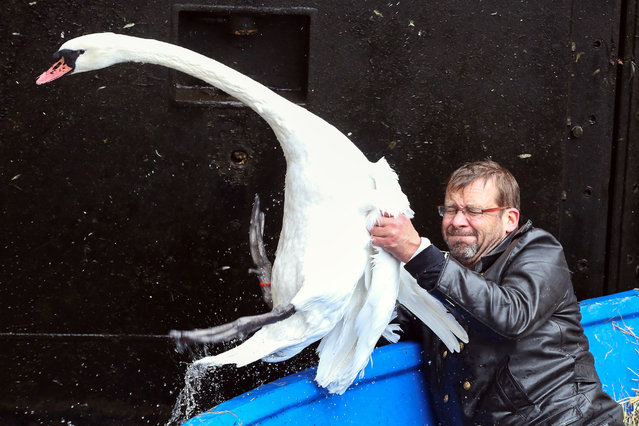
Olaf Niess catches swans on the river Alster near the town hall in Hamburg, Germany, 17 November 2015. The Alster swans are moving to their ice-free winter quarters on the Eppendorf Muehlenteich millpond until spring. (Photo by Bodo Marks/EPA)

Olaf Niess catches swans on the river Alster near the town hall in Hamburg, Germany, 17 November 2015. The Alster swans are moving to their ice-free winter quarters on the Eppendorf Muehlenteich millpond until spring. (Photo by Bodo Marks/EPA)
Details
18 Nov 2015 08:07:00
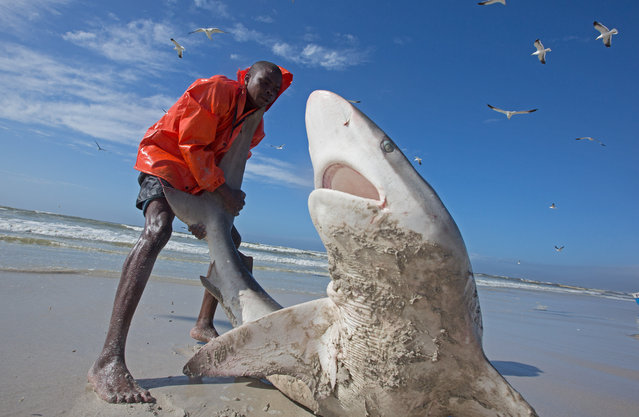
Bronze whaler shark (Carcharhinus brachyurus), caught in traditional seine net and released by fisherman, Muizenberg beach, Cape Town, South Africa on October 11, 2016. Action shots have captured fishermen trying to free a potentially deadly Bronze Whaler shark who was caught in their nets. The incredible images show the eight-foot-long 500-pound predator lunging its mouth towards the fishermen who are desperately trying to pull it back into the safety of the sea by its tail. Eventually they succeeded. (Photo by Chris and Monique Fallows/NPL)

Bronze whaler shark (Carcharhinus brachyurus), caught in traditional seine net and released by fisherman, Muizenberg beach, Cape Town, South Africa on October 11, 2016. Action shots have captured fishermen trying to free a potentially deadly Bronze Whaler shark who was caught in their nets. The incredible images show the eight-foot-long 500-pound predator lunging its mouth towards the fishermen who are desperately trying to pull it back into the safety of the sea by its tail. Eventually they succeeded. (Photo by Chris and Monique Fallows/NPL)
Details
13 Oct 2016 11:51:00
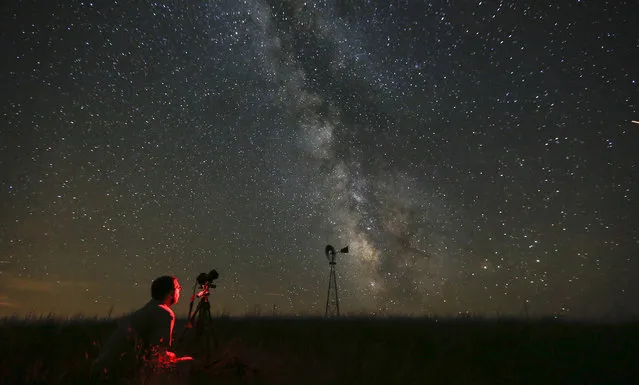
In this Wednesday, July 23, 2014 file photo, Omaha photographer Lane Hickenbottom photographs the night sky in a pasture near Callaway, Neb. With no moon in the sky, the Milky Way was visible to the naked eye. More than one-third of the world’s population can no longer see the Milky Way because of man-made lights, according to a scientific paper by Light Pollution Science and Technology Institute's Fabio Falchi and his team members, published on Friday, June 10, 2016. (Photo by Travis Heying/The Wichita Eagle via AP Photo)

In this Wednesday, July 23, 2014 file photo, Omaha photographer Lane Hickenbottom photographs the night sky in a pasture near Callaway, Neb. With no moon in the sky, the Milky Way was visible to the naked eye. More than one-third of the world’s population can no longer see the Milky Way because of man-made lights, according to a scientific paper by Light Pollution Science and Technology Institute's Fabio Falchi and his team members, published on Friday, June 10, 2016. (Photo by Travis Heying/The Wichita Eagle via AP Photo)
Details
11 Jun 2016 12:37:00