Loading...
Done
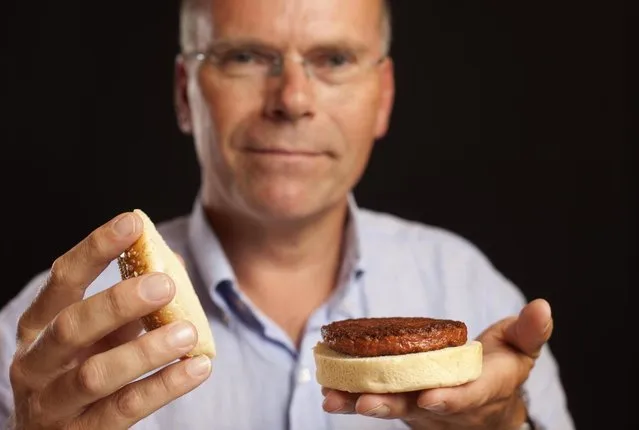
In this handout image provided by Ogilvy, a burger made from cultured beef, which has been developed by Professor Mark Post of Maastricht University in the Netherlands (pictured) is shown to the media during a press conference on August 5, 2013 in London, England. Cultured Beef could help solve the coming food crisis and combat climate change with commercial production of Cultured Beef beginning within ten to twenty years. (Photo by David Parry via Getty Images)

In this handout image provided by Ogilvy, a burger made from cultured beef, which has been developed by Professor Mark Post of Maastricht University in the Netherlands (pictured) is shown to the media during a press conference on August 5, 2013 in London, England. The in-vitro burger, cultured from cattle stem cells, the first example of what its creator says could provide an answer to global food shortages and help combat climate change, was fried in a pan and tasted by two volunteers. The burger is the result of years of research by Dutch scientist Mark Post, a vascular biologist at the University of Maastricht, who is working to show how meat grown in petri dishes might one day be a true alternative to meat from livestock.The meat in the burger has been made by knitting together around 20,000 strands of protein that has been cultured from cattle stem cells in Post's lab. (Photo by David Parry)
Details
06 Aug 2013 08:48:00
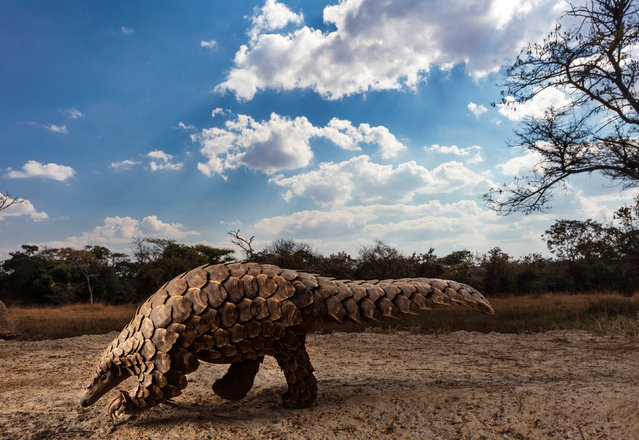
Pangolins in Crisis: Brent Stirton, South Africa; 1st place, Natural world and wildlife. “Pangolins are the world’s most illegally trafficked mammals, with an estimated one million trafficked to Asia in the last 10 years. Their scales are used in traditional Chinese and Vietnamese medicine, and their meat is sold as a high-priced delicacy. As a result, pangolins are listed as critically endangered and anyone who trades or consumes them is breaking the law. This body of work exposes the trade, while exploring aspects of illegality and celebrating the people who are trying to save these animals”. (Photo by Brent Stirton/Sony World Photography Awards 2020)

Pangolins in Crisis: Brent Stirton, South Africa; 1st place, Natural world and wildlife. “Pangolins are the world’s most illegally trafficked mammals, with an estimated one million trafficked to Asia in the last 10 years. Their scales are used in traditional Chinese and Vietnamese medicine, and their meat is sold as a high-priced delicacy. As a result, pangolins are listed as critically endangered and anyone who trades or consumes them is breaking the law. This body of work exposes the trade, while exploring aspects of illegality and celebrating the people who are trying to save these animals”. (Photo by Brent Stirton/Sony World Photography Awards 2020)
Details
11 Jun 2020 00:05:00
Yan Mengjie sits on a boat as she poses for photos near Erhai Lake in Dali Bai Autonomous Prefecture, Yunnan province, China on June 16, 2019. Erhai is one of China's biggest freshwater lakes and a backdrop to the city of Dali, which drew 47 million visitors last year, more than triple the number in 2010. Hotels and homestays have sprung up along a 31-mile (50-km) stretch of lakeside road to accommodate tourists. But officials ordered some hotels demolished after President Xi Jinping during a 2015 visit called for the lake to be protected. (Photo by Tingshu Wang/Reuters)

Yan Mengjie sits on a boat as she poses for photos near Erhai Lake in Dali Bai Autonomous Prefecture, Yunnan province, China on June 16, 2019. Erhai is one of China's biggest freshwater lakes and a backdrop to the city of Dali, which drew 47 million visitors last year, more than triple the number in 2010. Hotels and homestays have sprung up along a 31-mile (50-km) stretch of lakeside road to accommodate tourists. But officials ordered some hotels demolished after President Xi Jinping during a 2015 visit called for the lake to be protected. (Photo by Tingshu Wang/Reuters)
Details
25 Jun 2019 00:01:00
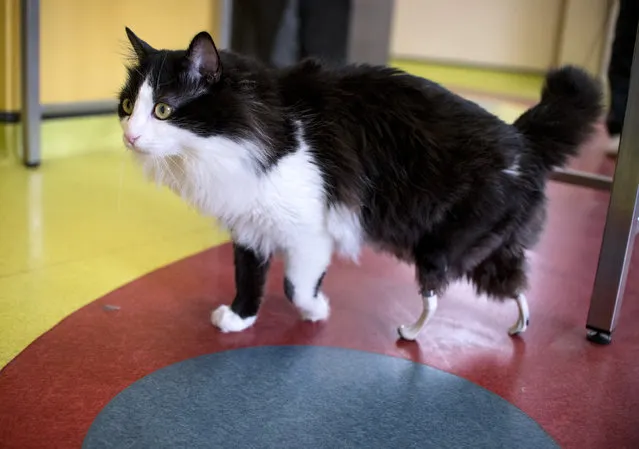
Pooh, a one-year-old cat, who lost his hind legs in an accident and has been given bionic paws, walks in a vet clinic in Sofia on January 31, 2017. Pooh, who is thought to have lost his legs in a car or train accident last April, is back on the prowl thanks to Bulgarian veterinary surgeon Vladislav Zlatinov. He is the first vet in Europe to successfully apply the pioneering method of Irish neuro-orthopaedic surgeon Noel Fitzpatrick, who shot to fame in 2009 when making Oscar the first bionic cat by fitting him with new hind legs in Britain. (Photo by Nikolay Doychinov/AFP Photo)

Pooh, a one-year-old cat, who lost his hind legs in an accident and has been given bionic paws, walks in a vet clinic in Sofia on January 31, 2017. Pooh, who is thought to have lost his legs in a car or train accident last April, is back on the prowl thanks to Bulgarian veterinary surgeon Vladislav Zlatinov. He is the first vet in Europe to successfully apply the pioneering method of Irish neuro-orthopaedic surgeon Noel Fitzpatrick, who shot to fame in 2009 when making Oscar the first bionic cat by fitting him with new hind legs in Britain. (Photo by Nikolay Doychinov/AFP Photo)
Details
03 Feb 2017 07:35:00
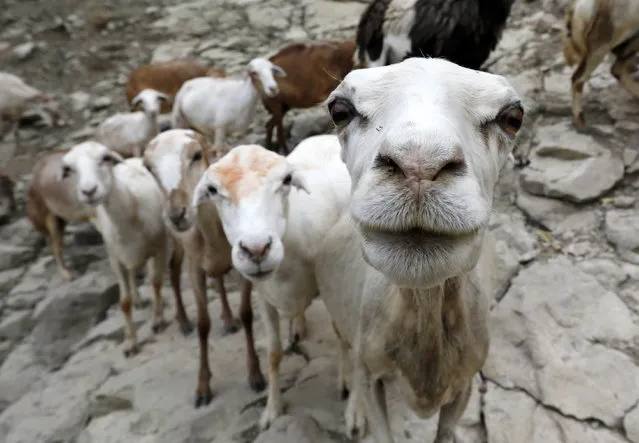
A flock of sheep and goats is led by shepherds to pastures at a mountain village on the outskirts of Sana'a, Yemen, 27 July 2023. At least eight million sheep and goats from about 470,000 pastoralist and agro pastoralist households across Yemen will be treated and vaccinated over the two years 2023 and 2024, in an effort to reduce livestock losses, improve production efficiency, and household income generation amid an acute food insecurity, the UN Food and Agriculture Organization (FAO) has reported. Livestock production in Yemen is a main income-generating activity for many rural and poor households. Yemen remains one of the worst humanitarian crises in the world with over 17 million people out of its 30-million population are food insecure due to a combination of prolonged conflicts and economic crisis. (Photo by Yahya Arhab/EPA)

A flock of sheep and goats is led by shepherds to pastures at a mountain village on the outskirts of Sana'a, Yemen, 27 July 2023. At least eight million sheep and goats from about 470,000 pastoralist and agro pastoralist households across Yemen will be treated and vaccinated over the two years 2023 and 2024, in an effort to reduce livestock losses, improve production efficiency, and household income generation amid an acute food insecurity, the UN Food and Agriculture Organization (FAO) has reported. (Photo by Yahya Arhab/EPA)
Details
01 Aug 2023 03:44:00
Bristol Museum & Art Gallery representatives on Monday, June 23, 2025 hold an empty frame against Avon Gorge in Bristol, which was painted by JMW Turner in The Rising Squall, Hot Wells, from St Vincent's Rock, Bristol (1792). A fundraising campaign has been launched to bring one of the earliest works by Turner back to the city of Bristol where the artist painted it when he was 17 years old. Bristol Museum & Art Gallery is now keen to acquire the work, which is believed to be the only oil painting Turner made of the city. (Photo by Ben Birchall/PA Images via Getty Images)

Bristol Museum & Art Gallery representatives on Monday, June 23, 2025 hold an empty frame against Avon Gorge in Bristol, which was painted by JMW Turner in The Rising Squall, Hot Wells, from St Vincent's Rock, Bristol (1792). A fundraising campaign has been launched to bring one of the earliest works by Turner back to the city of Bristol where the artist painted it when he was 17 years old. Bristol Museum & Art Gallery is now keen to acquire the work, which is believed to be the only oil painting Turner made of the city. (Photo by Ben Birchall/PA Images via Getty Images)
Details
22 Dec 2025 08:25:00
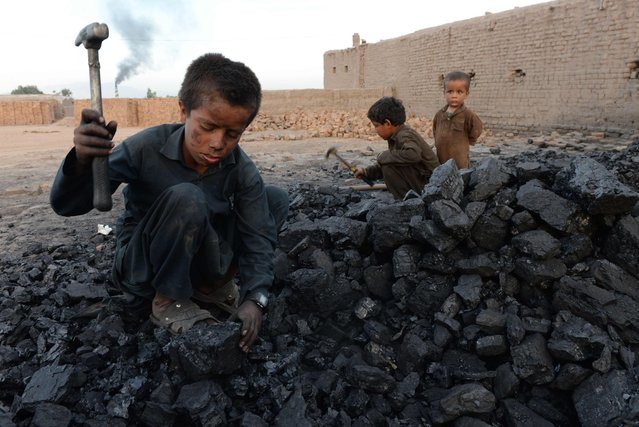
In this photograph taken on April 28, 2018, Afghan children work at a coal yard on the outskirts of Jalalabad, Afghanistan. (Photo by Noorullah Shirzada/AFP Photo)

In this photograph taken on April 28, 2018, Afghan children work at a coal yard on the outskirts of Jalalabad, Afghanistan. (Photo by Noorullah Shirzada/AFP Photo)
Details
05 Oct 2018 00:05:00
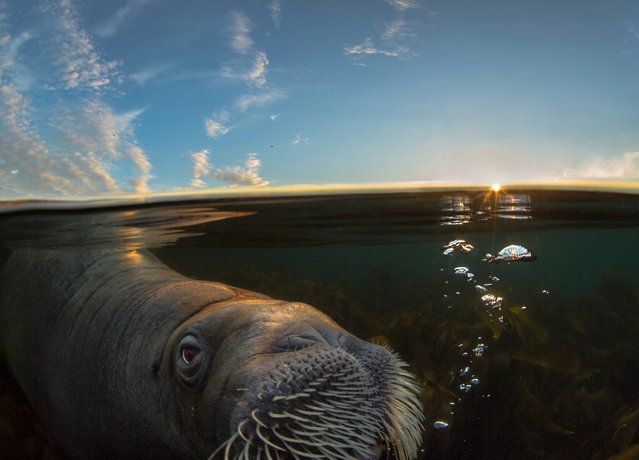
The Wildscreen festival is the world’s biggest celebration of screen-based natural history storytelling which takes place every two years in Bristol. Here: “Walrus in Midnight Sun”. Walrus feed mostly on bivalves in productive, shallow and often sandy habitats in the Arctic. This individual, though, arrived on a beach outside Tromsø, northern Norway, and found comfort on a stranded dead sperm whale. After two weeks he approached Audun, and only half a metre away he stretched his tusk forward and touched his hand gently. “This was one of the most memorable moments of my life”, Rikardsen says. He named the 500kg male Buddy. After two months, the dead whale was decomposed and Buddy suddenly disappeared. (Photo by Audun Rikardsen/Wildscreen 2016)

The Wildscreen festival is the world’s biggest celebration of screen-based natural history storytelling which takes place every two years in Bristol. Here: “Walrus in Midnight Sun”. Walrus feed mostly on bivalves in productive, shallow and often sandy habitats in the Arctic. This individual, though, arrived on a beach outside Tromsø, northern Norway, and found comfort on a stranded dead sperm whale. After two weeks he approached Audun, and only half a metre away he stretched his tusk forward and touched his hand gently. “This was one of the most memorable moments of my life”, Rikardsen says. He named the 500kg male Buddy. After two months, the dead whale was decomposed and Buddy suddenly disappeared. (Photo by Audun Rikardsen/Wildscreen 2016)
Details
07 Oct 2016 10:02:00