Loading...
Done
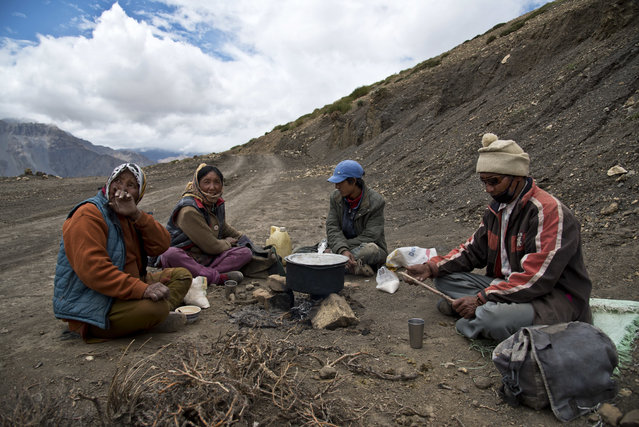
In this August 17, 2016, photo, from left to right, Chhering Chodom, 60, Tashi Yangzom, 50, Lobsang Chhering, 27, and Dorje Tandup, 58, drink milk tea on the side of the road. For centuries, the sleepy valley nestled in the Indian Himalayas remained a hidden Buddhist enclave forbidden to outsiders. Enduring the harsh year-round conditions of the high mountain desert, the people of Spiti Valley lived by a simple communal code – share the Earth's bounty, be hospitable to neighbors, and eschew greed and temptation at all turns. That's all starting to change, for better or worse. Since India began allowing its own citizens as well as outsiders to visit the valley in the early 1990s, tourism and trade have boomed. And the marks of modernization, such as solar panels, asphalt roads and concrete buildings, have begun to appear around some of the villages that dot the remote landscape at altitudes above 4,000 meters (13,000 feet). (Photo by Thomas Cytrynowicz/AP Photo)

In this August 17, 2016, photo, from left to right, Chhering Chodom, 60, Tashi Yangzom, 50, Lobsang Chhering, 27, and Dorje Tandup, 58, drink milk tea on the side of the road. For centuries, the sleepy valley nestled in the Indian Himalayas remained a hidden Buddhist enclave forbidden to outsiders. Enduring the harsh year-round conditions of the high mountain desert, the people of Spiti Valley lived by a simple communal code – share the Earth's bounty, be hospitable to neighbors, and eschew greed and temptation at all turns. That's all starting to change, for better or worse. (Photo by Thomas Cytrynowicz/AP Photo)
Details
15 Sep 2016 09:22:00
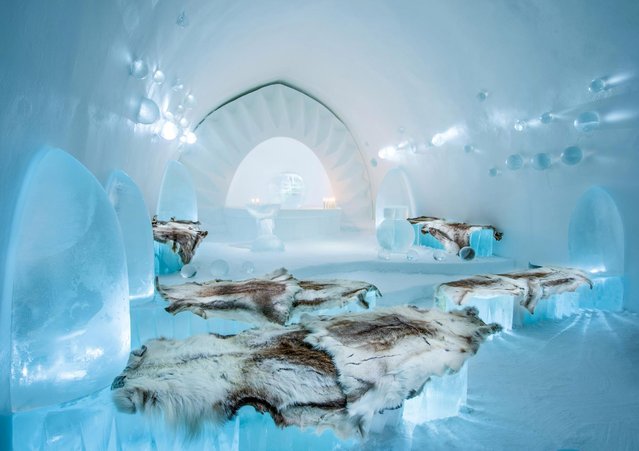
The suites made from ice and snow this year at the Ice Hotel include animal influences and theatre-inspired rooms. (Photo by Icehotel.com/Exclusivepix Media)

19 individually themed and hand crafted art suites have been newly designed by creatives from across the world – from a swedish artist who made a giant snow elephant in the room, to a french team who fused snow, ice and disco into a groovy sleeping experience. Each year, the hotel creates a new series of artist-designed accommodation spaces that add to the existing landscape of private rooms. (Photo by Icehotel.com/Exclusivepix Media)
Details
15 Mar 2017 00:04:00
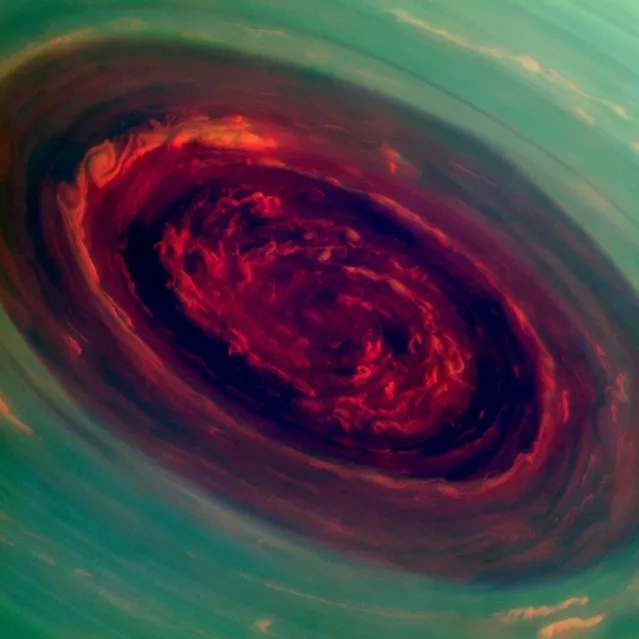
The spinning vortex of Saturn's north polar storm resembles a deep red rose of giant proportions surrounded by green foliage in this false-color image from NASA's Cassini spacecraft. (Photo by NASA/JPL-Caltech/SSI)

NASA's Cassini spacecraft has provided scientists the first close-up, visible-light views of a behemoth hurricane swirling around Saturn's north pole. In high-resolution pictures and video, scientists see the hurricane's eye is about 1,250 miles (2,000 kilometers) wide, 20 times larger than the average hurricane eye on Earth. Thin, bright clouds at the outer edge of the hurricane are traveling 330 mph(150 meters per second). The hurricane swirls inside a large, mysterious, six-sided weather pattern known as the hexagon. Photo: The spinning vortex of Saturn's north polar storm resembles a deep red rose of giant proportions surrounded by green foliage in this false-color image from NASA's Cassini spacecraft. (Photo by NASA/JPL-Caltech/SSI)
Details
31 May 2015 09:11:00
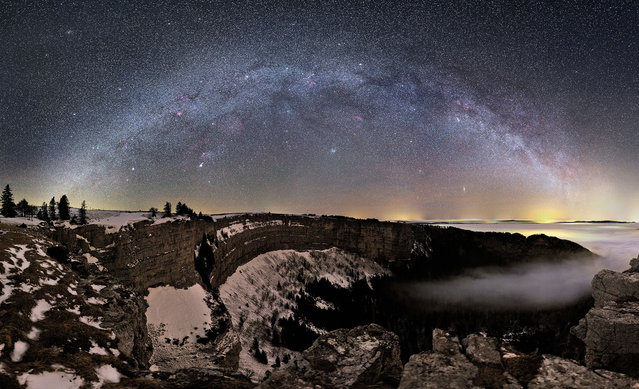
Milky Way over Switzerland

Milky Way over Switzerland

The Milky Way is the galaxy in which Earth is contained. This name derives from its appearance as a dim “milky” glowing band arching across the night sky, in which the naked eye cannot distinguish individual stars. The term “Milky Way” is a translation of the Classical Latin via lactea, from the Hellenistic Greek γαλαξίας κύκλος (pr. galaxías kýklos, “milky circle”). The Milky Way appears like a band because it is a disk-shaped structure being viewed from inside. The fact that this faint band of light is made up of stars was proven in 1610 when Galileo Galilei used his telescope to resolve it into individual stars. In the 1920s, observations by astronomer Edwin Hubble showed that the Milky Way is just one of many galaxies.


Details
20 Jun 2012 10:11:00


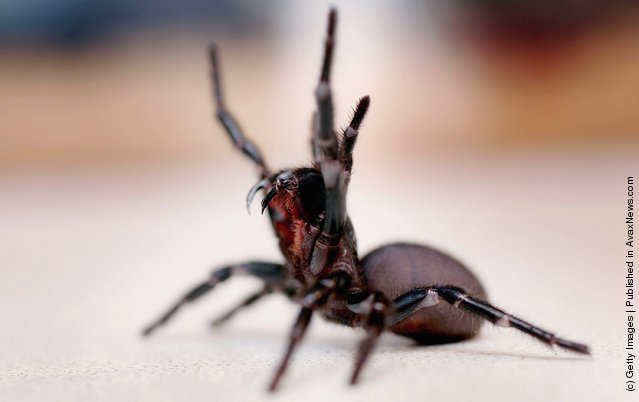
A Funnel Web spider is pictured at the Australian Reptile Park January 23, 2006 in Sydney, Australia. The Funnel Web is one of Australia's deadliest animals, with a venom that is packed with at least 40 different toxic proteins. A bite from a Funnel Web causes massive electrical over-load in the body's nervous system. Finally, fatalities occur from either heart attack or a pulmonary oedema, where the capillaries around the lungs begin to leak fluid and the patient effectively drowns. Death can come as quickly as two hours after a bite if no medical treatment is sought. Due to advances in anti-venom, there has been no death from a Funnel Web bite in Australia since 1980. Australia is home to some of the most deadly and poisonous animals on earth. (Photo by Ian Waldie/Getty Images)
Details
25 Apr 2011 07:49:00
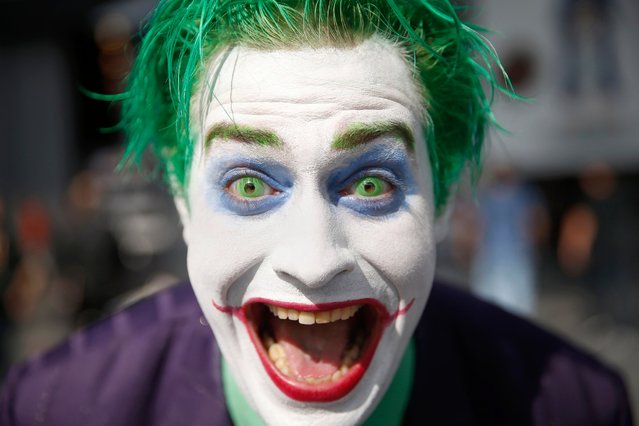
Trevor Olson, from Minnesota, dressed as the character “Joker”, poses for a photograph at New York's Comic Con convention, October 9, 2014, in New York City. (Photo by Shannon Stapleton/Reuters)

Trevor Olson, from Minnesota, dressed as the character “Joker”, poses for a photograph at New York's Comic Con convention, October 9, 2014, in New York City. The event draws thousands of costumed fans, panels of pop culture luminaries and features a sprawling floor of vendors in a space equivalent to more than three football fields in Javits Center. (Photo by Shannon Stapleton/Reuters)
Details
10 Oct 2014 12:20:00
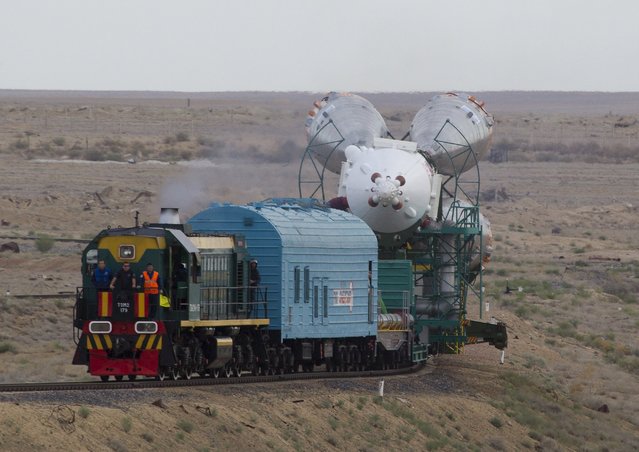
The Soyuz TMA-18M spacecraft is transported from an assembling hangar to its launch pad at the Baikonur cosmodrome, Kazakhstan, August 31, 2015. (Photo by Shamil Zhumatov/Reuters)

The Soyuz TMA-18M spacecraft is transported from an assembling hangar to its launch pad at the Baikonur cosmodrome, Kazakhstan, August 31, 2015. The Soyuz is scheduled to blast off with Aidyn Aimbetov of Kazakhstan, Sergei Volkov of Russia and Andreas Mogensen of Denmark to the International Space Station (ISS) on September 2, 2015. (Photo by Shamil Zhumatov/Reuters)
Details
01 Sep 2015 14:45:00


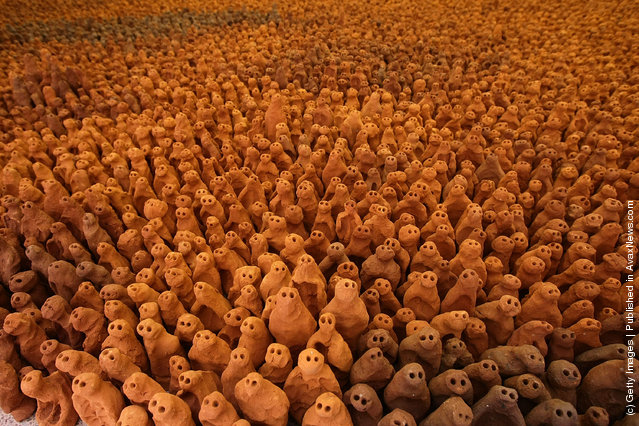
Figures from Antony Gormley's “Field For The British Isles” adorns an exhibition space in St Helen's College in the town of it's creation 15 years ago, June 23, 2008, St Helens, England. The installation of over 40,000 clay figures has returned to the place where it was made by local people from local clay. Artist Antony Gormley describes his creation as “25 tons of clay energised by fire, sensitised by touch and made conscious by being given eyes ... a field of gazes which looks at the observer making him or her its subject”. (Photo by Christopher Furlong/Getty Images)
Details
10 May 2011 09:20:00