Loading...
Done


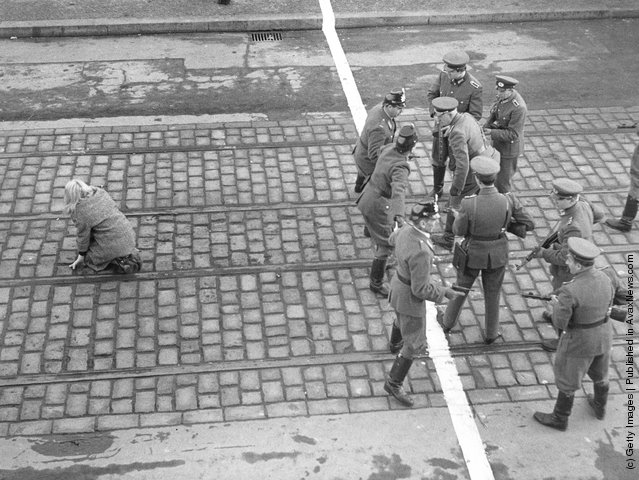
“The Berlin Wall (German: Berliner Mauer) was a barrier constructed by the German Democratic Republic (GDR, East Germany) starting on 13 August 1961, that completely cut off West Berlin from surrounding East Germany and from East Berlin. The barrier included guard towers placed along large concrete walls, which circumscribed a wide area (later known as the “death strip”) that contained anti-vehicle trenches, “fakir beds” and other defenses. The Soviet-dominated Eastern Bloc officially claimed that the wall was erected to protect its population from fascist elements conspiring to prevent the “will of the people” in building a socialist state in East Germany. However, in practice, the Wall served to prevent the massive emigration and defection that marked Germany and the communist Eastern Bloc during the post-World War II period”. – Wikipedia

Photo: West Berlin policemen and East German Volkspolizei face each other across the border in Berlin, circa 1955. (Photo by Three Lions/Hulton Archive/Getty Images)
Details
22 May 2011 10:49:00


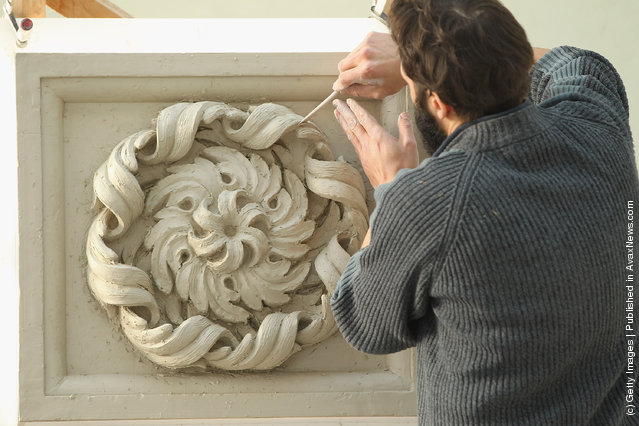
BERLIN, GERMANY - NOVEMBER 11: Sculptor Oleg Bessonov creates a rosette from clay at the Schlossbauhuette studio where a team of sculptors is creating decorative elements for the facade of the Berliner Schloss city palace on November 11, 2011 in Berlin, Germany. The Berliner Schloss was the residence of the Prussian Kaiser and was among the major architectural landmarks of Berlin until it was heavily damaged by Allied bombing in 1945. The communist authorities of East Berlin demolished the building in the 1950s, and today's Berlin government is pursuing an ambitious project to rebuild the palace according to a design by Italian architect Franco Stella, which will recreate the facade of the building but with a modern interior at a cost of approximately EUR 590 million. The Humboldt Forum, the foundation leading the project, has given the Schlossbauhuette sculptors the formidable task of recreating the hundreds of architectural elements that decorated the facade, and though some original pieces were saved, more often the sculptors have only old black and white photos as reference. (Photo by Sean Gallup/Getty Images)
Details
21 Nov 2011 11:22:00
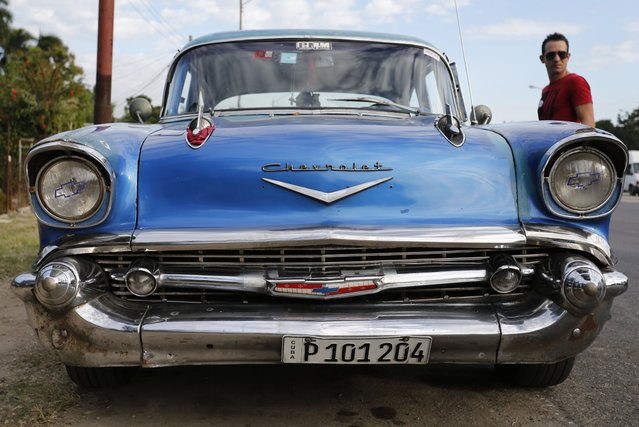
In this December 19, 2014 photo, a man stands beside his 1957 Chevrolet Bel-Air car in Havana, Cuba.  U.S. car sales have been banned in Cuba since 1959. Cubans have been have been forced to patch together Fords, Chevrolets and Chryslers that date back to before Fidel Castro's revolution which can make it appear like the country is stuck in a 1950s time warp. (Photo by Desmond Boylan/AP Photo)

In this December 19, 2014 photo, a man stands beside his 1957 Chevrolet Bel-Air car in Havana, Cuba. U.S. car sales have been banned in Cuba since 1959. Cubans have been have been forced to patch together Fords, Chevrolets and Chryslers that date back to before Fidel Castro's revolution which can make it appear like the country is stuck in a 1950s time warp. Since the Communist economic system isn't likely to change soon, many of those cars will have to stay on the road for years. (Photo by Desmond Boylan/AP Photo)
Details
26 Dec 2014 15:35:00
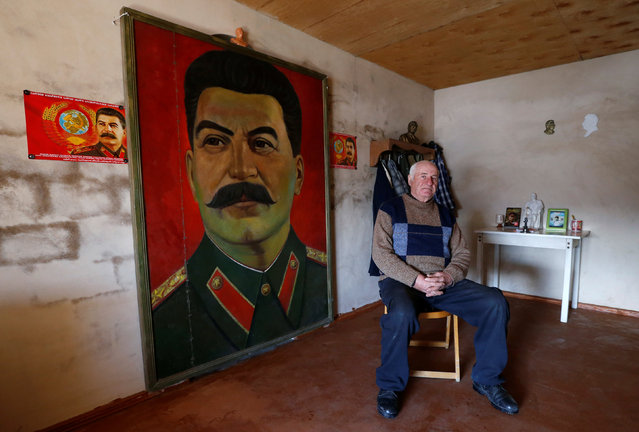
Retired builder Vasili Sidamonidze, 70, poses for a portrait at his home in Gori, Georgia, December 6, 2016. “Unfortunately, Stalin is not popular nowadays. Our people don't respect him. Only we, members of the (Communist) Party, respect him”, Sidamonidze said. “I always try to attend Stalin's birthday anniversaries in Gori. Unfortunately many people don't want to join us even if they live nearby. They look at us from their windows”. Stalin, who was born in Gori in 1878 and died in 1953, is largely reviled today in Georgia, which regained its independence during the 1991 collapse of the Soviet Union. Over the years, his memorials have been dismantled, most recently in 2010 when authorities removed a statue of the dictator from Gori's central square. But Stalin is still revered by a small group of mainly elderly supporters who stress his role in the industrialisation of the Soviet Union and in defeating Nazi Germany in World War Two. Each Dec. 21, a few dozen people mark his birthday by gathering outside a Gori museum dedicated to Stalin, where they make speeches and walk to the square where a 6-meter-high bronze statue of him once stood, calling for it to be reinstated. Opponents say it was a symbol of Moscow's still lingering shadow. In 2008, Russia fought a brief war with Georgia and recognised its breakaway regions of Abkhazia and South Ossetia as independent states. (Photo by David Mdzinarishvili/Reuters)

Retired builder Vasili Sidamonidze, 70, poses for a portrait at his home in Gori, Georgia, December 6, 2016. “Unfortunately, Stalin is not popular nowadays. Our people don't respect him. Only we, members of the (Communist) Party, respect him”, Sidamonidze said. “I always try to attend Stalin's birthday anniversaries in Gori. Unfortunately many people don't want to join us even if they live nearby. They look at us from their windows”. (Photo by David Mdzinarishvili/Reuters)
Details
17 Dec 2016 07:59:00


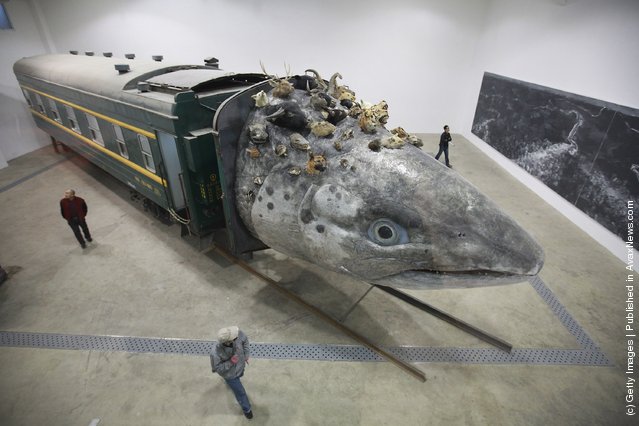
People visit Chinese artist Huang Yongping's installation art work named “Leviathanation” at Tang Contemporary Art of 798 Art District on March 29, 2011 in Beijing, China. The exhibition named “Tracing The Milky Way” will be last until May 14. (Photo by Feng Li/Getty Images)
Details
24 Apr 2011 07:37:00
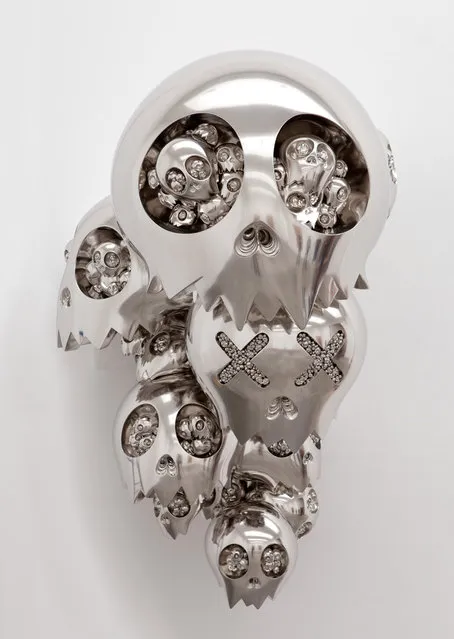
"Fate" Sculpture By Takashi Murakami

Takashi Murakami is an internationally prolific contemporary Japanese artist. He works in fine arts media—such as painting and sculpture—as well as what is conventionally considered commercial media —fashion, merchandise, and animation— and is known for blurring the line between high and low arts
Details
19 Apr 2013 10:14:00
A tattoo is displayed on the arm of a girl during Bandung Body Art Festival at in Bandung, West Java, on December 7, 2014. Upon its establishment in 2010, founders of the Bandung Body Art Festival sought to celebrate an art form that was once taboo and associated with criminals. Tattoos are now an increasingly acceptable part of Indonesia’s urban landscape, and the annual event this year continued its campaign with 45 tattoo artists offering their services for free at the Ganesha Cultural Center. (Photo by Rezza Estily/JG Photo)

A tattoo is displayed on the arm of a girl during Bandung Body Art Festival at in Bandung, West Java, on December 7, 2014. Upon its establishment in 2010, founders of the Bandung Body Art Festival sought to celebrate an art form that was once taboo and associated with criminals. Tattoos are now an increasingly acceptable part of Indonesia’s urban landscape, and the annual event this year continued its campaign with 45 tattoo artists offering their services for free at the Ganesha Cultural Center. (Photo by Rezza Estily/JG Photo)
Details
24 Dec 2014 14:08:00
An art installation formed with milk churns, made by land art artist Gerard Benoit a la Guillaume, is seen at the Chenau de Mayen in the resort of Leysin, Switzerland August 7, 2015. More than 80 milk churns were placed between the Tour d'Ai and the Tour de Mayen summits at an altitude of 2,000 meters (6,561 feet) above sea level under the direction of the artist, to be photographed for his ongoing art project entitled “Milk churns without borders”. (Photo by Denis Balibouse/Reuters)

An art installation formed with milk churns, made by land art artist Gerard Benoit a la Guillaume, is seen at the Chenau de Mayen in the resort of Leysin, Switzerland August 7, 2015. More than 80 milk churns were placed between the Tour d'Ai and the Tour de Mayen summits at an altitude of 2,000 meters (6,561 feet) above sea level under the direction of the artist, to be photographed for his ongoing art project entitled “Milk churns without borders”. (Photo by Denis Balibouse/Reuters)
Details
08 Aug 2015 13:16:00