Loading...
Done
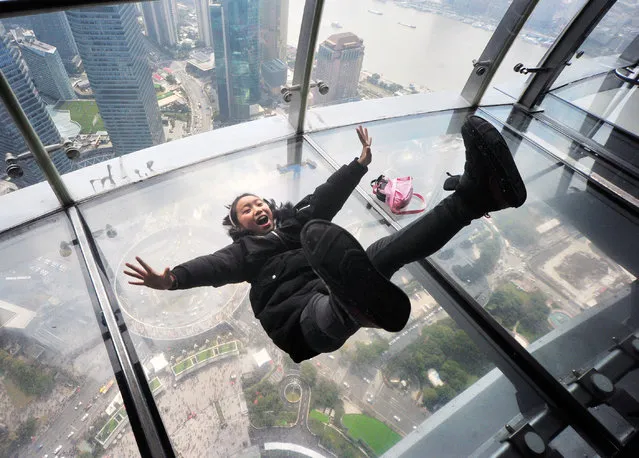
A young girl plays on the glass bottom platform of the Oriental Pear TV Tower as she travels with her family on the second day of the Chinese Lunar New Year holiday, also known as Spring Festival, in Shanghai, China on February 18, 2018. Some 287 million tourists travelled in China during the first four days of the week-long Chinese Lunar New Year holiday, up 11.1 percent from the same period last year, new data showed Sunday (18 February 2018). Tourism revenue rose 11.6 percent to 352.7 billion yuan (55.61 billion U.S. dollars) in the four days, the China National Tourism Administration (CNTA) said. On Sunday alone, some 73 million tourist trips were made across the country, up 15.3 percent, while tourism revenue rose 16.6 percent to 94.4 billion yuan. (Photo by Imaginechina/Rex Features/Shutterstock)

A young girl plays on the glass bottom platform of the Oriental Pear TV Tower as she travels with her family on the second day of the Chinese Lunar New Year holiday, also known as Spring Festival, in Shanghai, China on February 18, 2018. Some 287 million tourists travelled in China during the first four days of the week-long Chinese Lunar New Year holiday, up 11.1 percent from the same period last year, new data showed Sunday. (Photo by Imaginechina/Rex Features/Shutterstock)
Details
21 Feb 2018 00:03:00
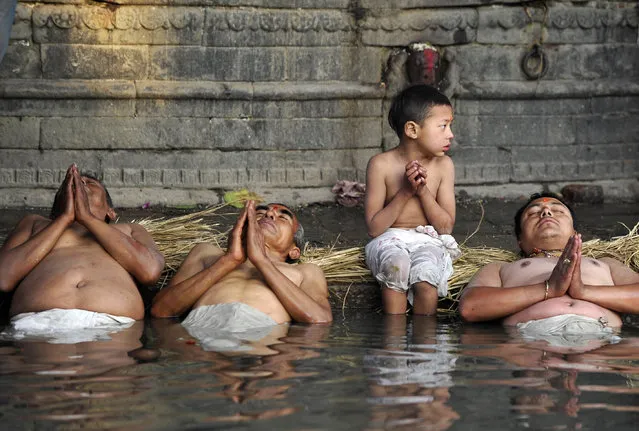
Nepalese Hindu devotees take part in a bathing ritual on the last day of the month-long Swasthani Festival in the Hanumante River at Bhaktapur on the outskirts of Kathmandu on February 22, 2016. Devotees mark the Swasthani Festival with fasting, and with women in particular undertaking rituals in the hope of a prosperous life for her family and conjugal happiness. (Photo by Prakash Mathema/AFP Photo)

Nepalese Hindu devotees take part in a bathing ritual on the last day of the month-long Swasthani Festival in the Hanumante River at Bhaktapur on the outskirts of Kathmandu on February 22, 2016. Devotees mark the Swasthani Festival with fasting, and with women in particular undertaking rituals in the hope of a prosperous life for her family and conjugal happiness. (Photo by Prakash Mathema/AFP Photo)
Details
23 Feb 2016 11:52:00
Amazing World By Al Hogue

Light is the sole reason why life exists. It provides us with warmth; it allows us to see; it nourishes all the living things on this planet. Many painters, especially the masters of Old Renaissance Period, have recognized the importance of light and its intimate connection with nature and life itself. In their paintings they gave tribute to light, giving the impression that their paintings had a light source hidden within them. Al Hogue, the artist who created the paintings that you see before you, has studied their techniques for many years. As time went by, light permeated not only his paintings by also his life, becoming his sole philosophy.
Details
06 Mar 2015 06:03:00
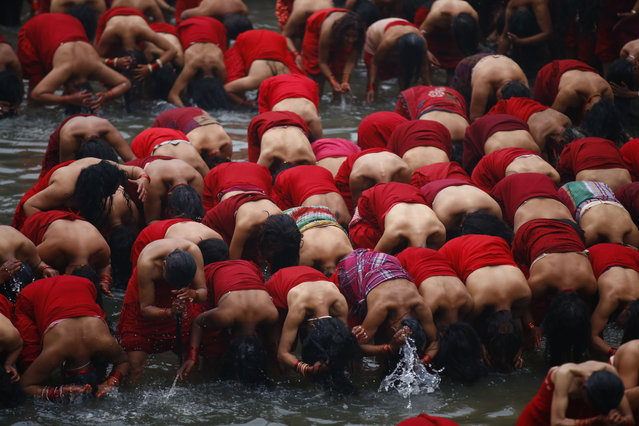
Nepalese devotee women take a holy bath after offering prayers in Pashupathinath Temple premise during the month-long Swasthani Bratakatha festival, devoted to goddess Shree Swasthani in Kathmandu on February 8, 2016. Devotees recite Holy Scripture and women pray for wellbeing of their spouses throughout the month-long fast. (Photo by Skanda Gautam via ZUMA Wire)

Nepalese devotee women take a holy bath after offering prayers in Pashupathinath Temple premise during the month-long Swasthani Bratakatha festival, devoted to goddess Shree Swasthani in Kathmandu on February 8, 2016. Devotees recite Holy Scripture and women pray for wellbeing of their spouses throughout the month-long fast. (Photo by Skanda Gautam via ZUMA Wire)
Details
09 Feb 2016 13:34:00
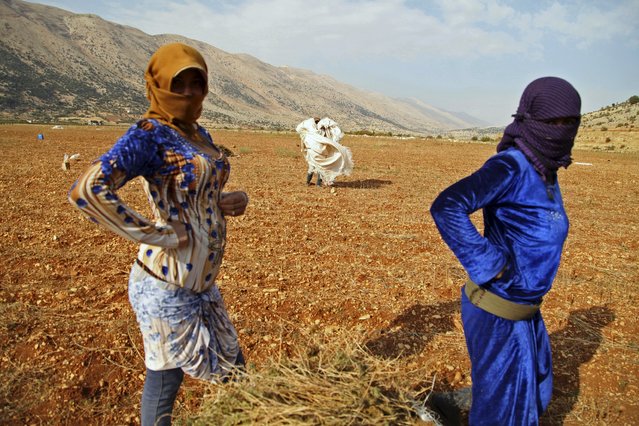
Aisha, 15, (L) (who asked to withhold her last name), a Syrian refugee from Raqqa, waits with a fellow refugee while harvesting cannabis in the Bekaa valley, Lebanon October 19, 2015. Syrian refugees work to harvest and process spiky-leafed cannabis plants in neighbouring Lebanon’s Bekaa Valley. (Photo by Alia Haju/Reuters)

Aisha, 15, (L) (who asked to withhold her last name), a Syrian refugee from Raqqa, waits with a fellow refugee while harvesting cannabis in the Bekaa valley, Lebanon October 19, 2015. Syrian refugees work to harvest and process spiky-leafed cannabis plants in neighbouring Lebanon’s Bekaa Valley. Often farmers of cotton and wheat back home in Raqqa province – now the de facto capital of Islamic State – the conflict in Syria drove them to seek safety in a region where Syrian migrant workers used to spend a few months a year before returning home. (Photo by Alia Haju/Reuters)
Details
24 Dec 2015 08:03:00
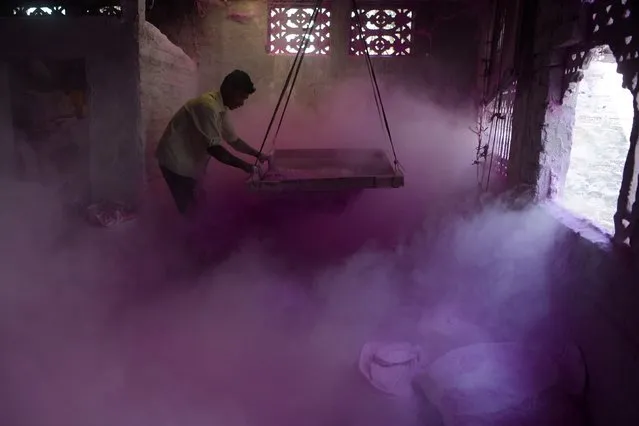
An Indian labourer sifts coloured powder, known as “gulal”, to be used during the forthcoming spring festival of Holi, inside a factory at Fulbari village on the outskirts of Siliguri on March 6, 2017. Holi, the popular Hindu spring festival of colours is observed in India at the end of the winter season on the last full moon of the lunar month, and will be celebrated on March 13 this year. (Photo by Diptendu Dutta/AFP Photo)

An Indian labourer sifts coloured powder, known as “gulal”, to be used during the forthcoming spring festival of Holi, inside a factory at Fulbari village on the outskirts of Siliguri on March 6, 2017. Holi, the popular Hindu spring festival of colours is observed in India at the end of the winter season on the last full moon of the lunar month, and will be celebrated on March 13 this year. (Photo by Diptendu Dutta/AFP Photo)
Details
08 Mar 2017 00:04:00
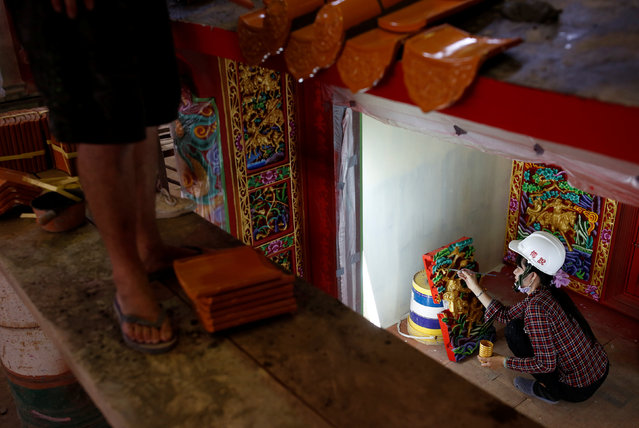
An employee paints a ready-made Chinese traditional temple at the Chuanso factory that manufactures religious objects in Pingtung, Taiwan July 5, 2016. (Photo by Tyrone Siu/Reuters)

Some companies in Taiwan spend months building temples with bricks and cement, but Lin Fu-Chun's firm simply pours concrete into a giant mould and waits for it to dry. The 78-year-old Lin said his temple factory, Chuanso, needed just over six weeks to finish a building that normally took six months with conventional methods – and moulding was 40 percent cheaper. Here: An employee paints a ready-made Chinese traditional temple at the Chuanso factory that manufactures religious objects in Pingtung, Taiwan July 5, 2016. (Photo by Tyrone Siu/Reuters)
Details
29 Jul 2016 12:57:00
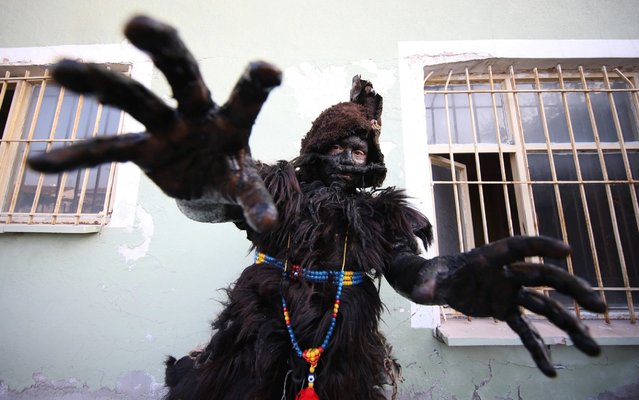
A leather worker with his frightening types of clothes prepares after painted themselves using chimney soot as they participate in a programme within the September 6 celebrations, in Balikesir, Turkey on September 06, 2019. According to the story, “Tulutabaklar” were painting themselves with ash and wearing goatskin or sheep skin to frighten the Greek soldiers occupying Balikesir during the National Struggle period. Every year on September 6, Tulutabaklar perform this ritual as part of the celebration of liberation of the city for 96 years. (Photo by Ali Atmaca/Anadolu Agency via Getty Images)

A leather worker with his frightening types of clothes prepares after painted themselves using chimney soot as they participate in a programme within the September 6 celebrations, in Balikesir, Turkey on September 06, 2019. According to the story, “Tulutabaklar” were painting themselves with ash and wearing goatskin or sheep skin to frighten the Greek soldiers occupying Balikesir during the National Struggle period. Every year on September 6, Tulutabaklar perform this ritual as part of the celebration of liberation of the city for 96 years. (Photo by Ali Atmaca/Anadolu Agency via Getty Images)
Details
09 Sep 2019 00:05:00