Loading...
Done
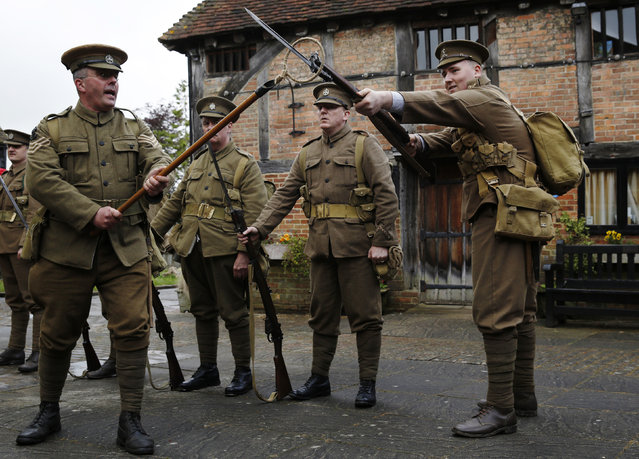
Factory landlord Lawrence Taylor (L), portraying a Colour Sergeant from the King's Royal Rifle Corps, part of the Rifles Living History Society, performs a drill with Connor Young (R) of the Queen's Own Royal West Kent Regiment Living History Group as they recreate the life of a First World War soldier at the Eden Valley Museum in Edenbridge in southeast England May 10, 2014. (Photo by Luke MacGregor/Reuters)

Factory landlord Lawrence Taylor (L), portraying a Colour Sergeant from the King's Royal Rifle Corps, part of the Rifles Living History Society, performs a drill with Connor Young (R) of the Queen's Own Royal West Kent Regiment Living History Group as they recreate the life of a First World War soldier at the Eden Valley Museum in Edenbridge in southeast England May 10, 2014. Lawrence has always had an interest in military history and specifically “The Rifles” – his veteran father's WWII regiment. When he became a re-enactor he chose not to re-enact WWII as many of the veterans are still alive, and he felt uncomfortable as he remembers his father would have flashbacks and nightmares about the war. United by a fascination with military history and a fondness for dressing up, groups such as the Rifles Living History Society and the Queen's Own Royal West Kent Regiment Living History Group get together to recreate aspects of life during the First World War. Reuters photographer Luke MacGregor photographed members of the groups, both as they took part in living history events and at their day jobs. (Photo by Luke MacGregor/Reuters)
Details
26 Aug 2014 10:12:00
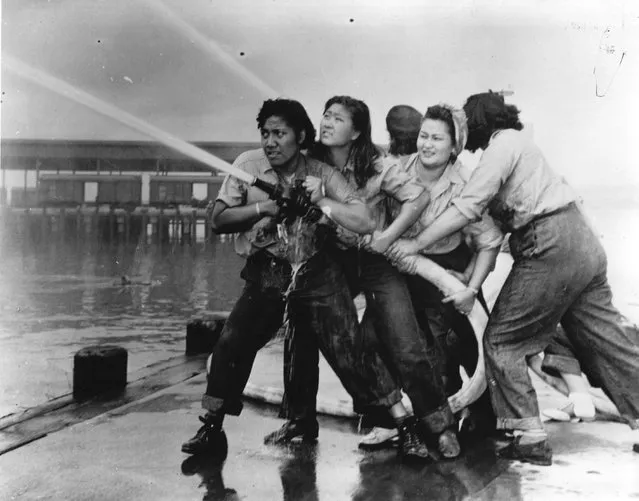
Women fire fighters directing a hose after the Japanese attack on the US naval base at Pearl Harbour (Pearl Harbor). (Photo by Three Lions/Getty Images)

“Pearl Harbor, known to Hawaiians as Puʻuloa, is a lagoon harbor on the island of Oʻahu, Hawaiʻi, west of Honolulu. Much of the harbor and surrounding lands is a United States Navy deep-water naval base. It is also the headquarters of the U.S. Pacific Fleet. The attack on Pearl Harbor by the Empire of Japan on December 7, 1941, brought the United States into World War II”. – Wikipedia

Photo: Women fire fighters directing a hose after the Japanese attack on the US naval base at Pearl Harbour (Pearl Harbor). (Photo by Three Lions)


Details
07 Dec 2012 09:01:00
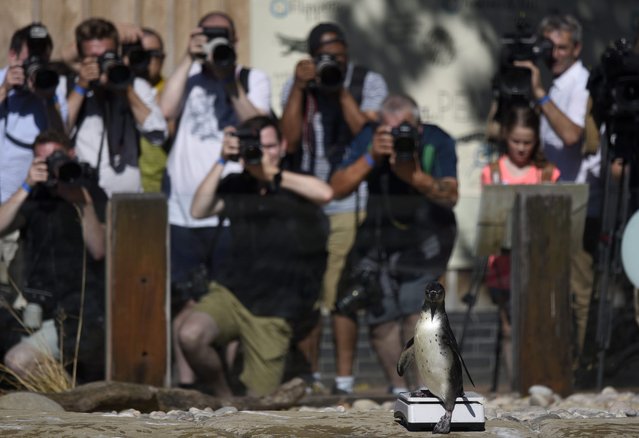
A Humboldt penguin stands on weighing scales whilst being photographed by members of the press during a photocall at the annual weigh-in at London Zoo in London, Britain, 24 August 2016. Every animal that is in the zoo is weighed and measured and the statistics recorded so the data can be shared with zoos across the world. (Photo by Hannah McKay/EPA)

A Humboldt penguin stands on weighing scales whilst being photographed by members of the press during a photocall at the annual weigh-in at London Zoo in London, Britain, 24 August 2016. Every animal that is in the zoo is weighed and measured and the statistics recorded so the data can be shared with zoos across the world. (Photo by Hannah McKay/EPA)
Details
25 Aug 2016 10:06:00
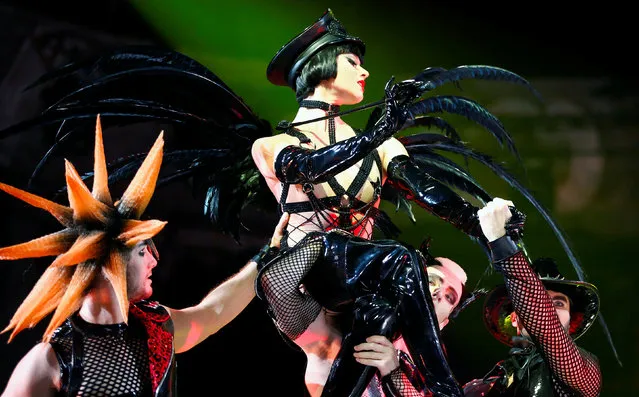
Dancers attend a photocall for the new “The One – Grand Show” at Friedrichstadt-Palast in Berlin, Germany September 28, 2016. (Photo by Hannibal Hanschke/Reuters)

Dancers attend a photocall for the new “The One – Grand Show” at Friedrichstadt-Palast in Berlin, Germany September 28, 2016. The show, which features costumes by French fashion designer Jean Paul Gaultier, premieres on 06 October. (Photo by Hannibal Hanschke/Reuters)
Details
29 Sep 2016 09:49:00
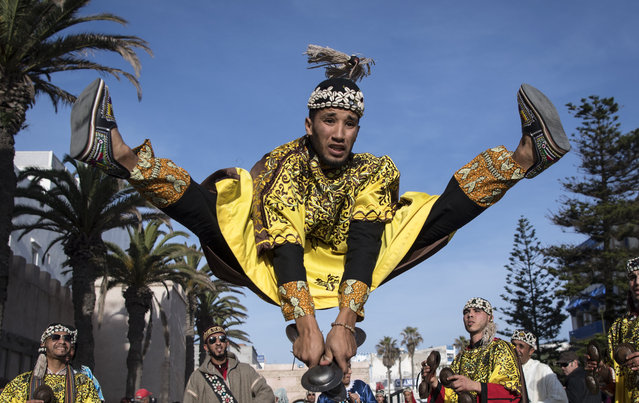
A Gnawa traditional group performs in the city of Essaouira on December 14, 2019, to celebrate the decision of adding the Gnawa culture to UNESCO's list of Intangible Cultural Heritage of Humanity. Gnawa culture, a centuries-old Moroccan practice rooted in music, African rituals and Sufi traditions, was added to UNESCO's list of Intangible Cultural Heritage of Humanity earlier in the week. Gnawa refers to a “set of musical productions, fraternal practices and therapeutic rituals where the secular mixes with the sacred”, according to the nomination submitted by Morocco. Often dressed in colourful outfits, Gnawa musicians play the guenbri, a type of lute with three strings, accompanied by steel castanets called krakebs. (Photo by Fadel Senna/AFP Photo)

A Gnawa traditional group performs in the city of Essaouira on December 14, 2019, to celebrate the decision of adding the Gnawa culture to UNESCO's list of Intangible Cultural Heritage of Humanity. Gnawa culture, a centuries-old Moroccan practice rooted in music, African rituals and Sufi traditions, was added to UNESCO's list of Intangible Cultural Heritage of Humanity earlier in the week. Gnawa refers to a “set of musical productions, fraternal practices and therapeutic rituals where the secular mixes with the sacred”, according to the nomination submitted by Morocco. Often dressed in colourful outfits, Gnawa musicians play the guenbri, a type of lute with three strings, accompanied by steel castanets called krakebs. (Photo by Fadel Senna/AFP Photo)
Details
18 Dec 2019 00:05:00
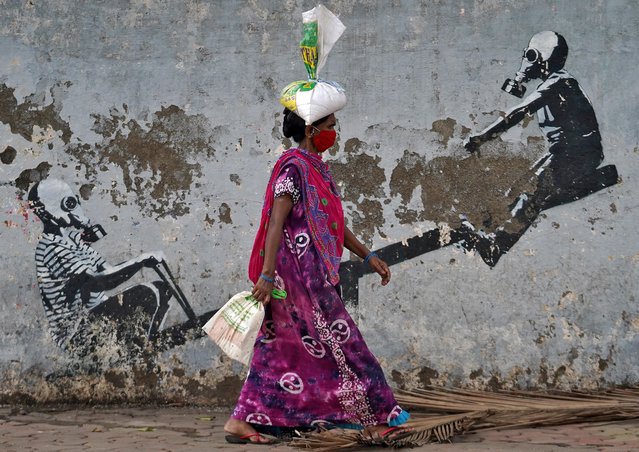
A woman wearing a protective face mask walks past a graffiti, after authorities eased lockdown restrictions that were imposed to slow the spread of the coronavirus disease (COVID-19), in Mumbai, India, June 12, 2020. (Photo by Hemanshi Kamani/Reuters)

A woman wearing a protective face mask walks past a graffiti, after authorities eased lockdown restrictions that were imposed to slow the spread of the coronavirus disease (COVID-19), in Mumbai, India, June 12, 2020. (Photo by Hemanshi Kamani/Reuters)
Details
02 Jul 2020 00:03:00
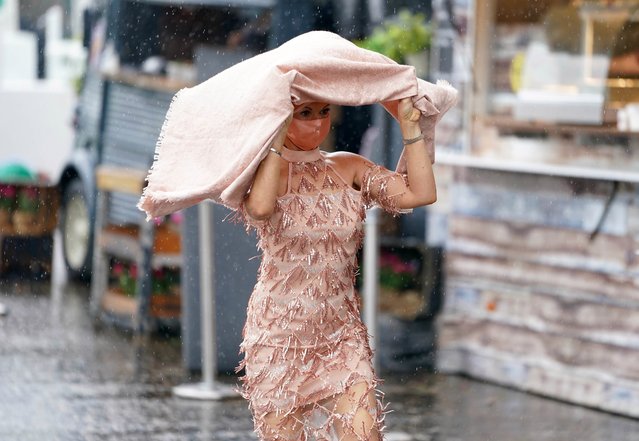
Racegoers try to shelter from the rain during day one of the Cazoo Derby Festival at Epsom Racecourse on Friday, June 4, 2021. (Photo by John Walton/PA Images via Getty Images)

Racegoers try to shelter from the rain during day one of the Cazoo Derby Festival at Epsom Racecourse in Surrey, United Kingdom on Friday, June 4, 2021. (Photo by John Walton/PA Images via Getty Images)
Details
05 Jun 2021 09:15:00
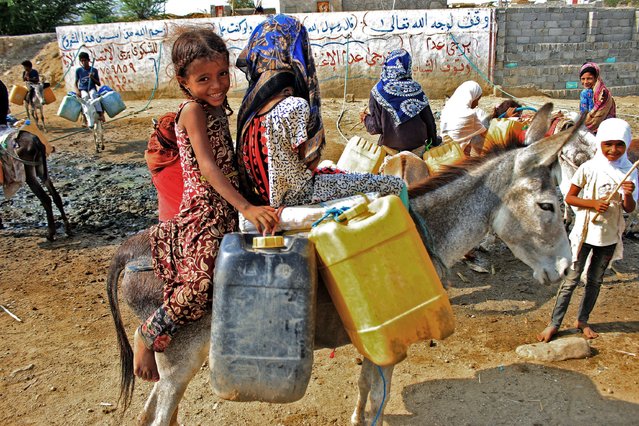
Children riding on donkeys queue to fill their jerrycans with water from a cistern at a make-shift camp for the internally displaced in Yemen's northern Hajjah province on July 12, 2021, amidst an extreme heat wave and severe water shortage. (Photo by Essa Ahmed/AFP Photo)

Children riding on donkeys queue to fill their jerrycans with water from a cistern at a make-shift camp for the internally displaced in Yemen's northern Hajjah province on July 12, 2021, amidst an extreme heat wave and severe water shortage. (Photo by Essa Ahmed/AFP Photo)
Details
13 Aug 2021 09:30:00