The Indiana Pacemates perform during an NBA game between the Indiana Pacers and the Cleveland Cavaliers at Gainbridge Fieldhouse in Indianapolis on January 14, 2025. (Photo by USA Today)
An aerial drone photo shows a view of the Wujiangzhai scenic spot in Zunyi, southwest China's Guizhou Province, March 14, 2024. The Wujiangzhai scenic spot, with its natural landscape and local folk customs, offers a blend of sightseeing, leisure activities and exhibitions, making it a popular destination for tourists. (Photo by Xinhua News Agency/Rex Features/Shutterstock)
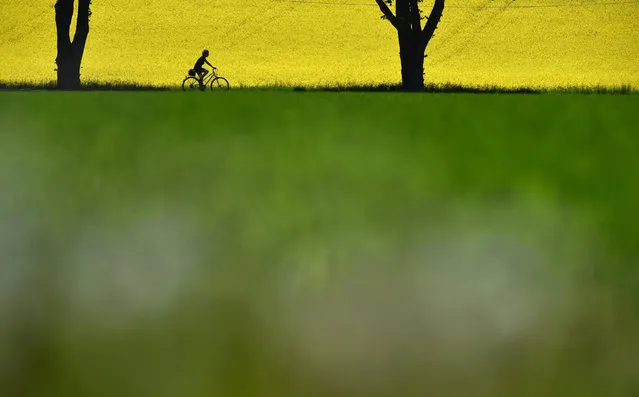
A cyclist drives past a flowering rapeseed field not far from the small Bavarian village of Schoengeising, near Munich, during a nice, warm sunny weather day on May 17, 2017. (Photo by Christof Stache/AFP Photo)
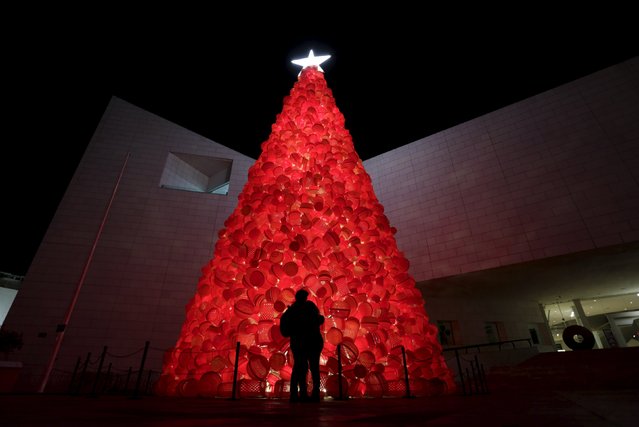
A couple hugs while standing near a Christmas tree made out of plastic bins and plastic hampers outside the Museum of History in Monterrey, Mexico, December 4, 2015. The humble Christmas tree has a rich history, from evergreen trees used to symbolise eternal life in Ancient Egypt to tree worship among pagan Europeans. The modern version has its origins in Germany, where the song “O Tannenbaum” is still a festive favourite. Today the traditional tree with lights and decorations appears in cities including Washington, Moscow and Beirut. Alternative constructions range from recycled rubbish in Mexico City to old window frames in Rakvere, Estonia. Whatever the shape or size, the message is the same: Merry Christmas. (Photo by Neil Hall/Reuters)
Jorge (2nd R), 31, who is among members of lesbian, gay, bisexual and transgender (LGBT) community and his brother Paulo, 28, (R) laugh at Arouche Square in downtown Sao Paulo, Brazil, November 20, 2016. (Photo by Nacho Doce/Reuters)
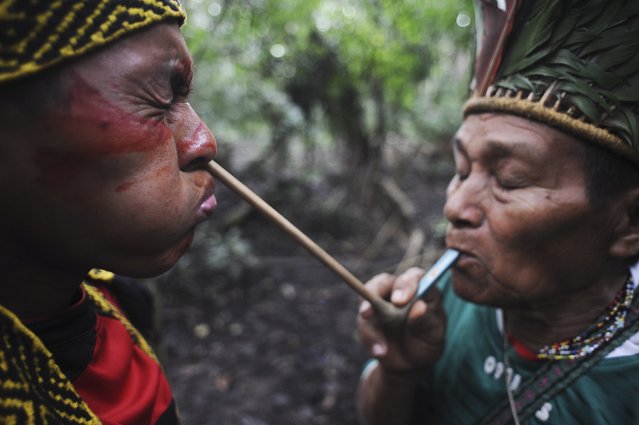
A spiritual leader (R) of the Huni Kui Indian tribe blows an herbal powder into the nose of a tribal member during a ceremony outside the village of Novo Segredo along the Envira river of Brazil's northwestern Acre state, March 9, 2014. Many indigenous groups, including the Huni Kui, Ashaninka, and Madija, live in villages in the Brazilian rainforest near the border with Peru. (Photo by Lunae Parracho/Reuters)