Loading...
Done
A performer wearing a lion mask performs the Ise Daikagura lion dance at the remote village of Yamanawa on February 08, 2021 in Ryuo, Japan. Ise Daikagura is a group of traditional Lion Dance performers who pray in front of farmers houses and businesses for good grain harvests and disease-free lives. Performers play sacred music using drums and flutes with two lion mask dancers. A lion mask is considered a symbol of God, who enters the house and performs in front of the Shinto God, a statue placed inside the house, mostly in the kitchen. These prayers are called “Kamodo Barai”. After the prayers, they are gifted with money, rice, sake and Japanese sweets from the householders. A group can travel for more than one hundred days to thousands of households and businesses throughout rural-villages in western Japan, and pray to those who are unable to visit the country’s most sacred shrine, the Grand Ise Shrine in Mie Prefecture. The group started its performance in the Edo era between 1603 to 1868 according to Japanese history. The Japanese government designated it as an important folk cultural national property in 1981. (Photo by Buddhika Weerasinghe/Getty Images)

A performer wearing a lion mask performs the Ise Daikagura lion dance at the remote village of Yamanawa on February 08, 2021 in Ryuo, Japan. Ise Daikagura is a group of traditional Lion Dance performers who pray in front of farmers houses and businesses for good grain harvests and disease-free lives. (Photo by Buddhika Weerasinghe/Getty Images)
Details
18 Feb 2021 09:27:00
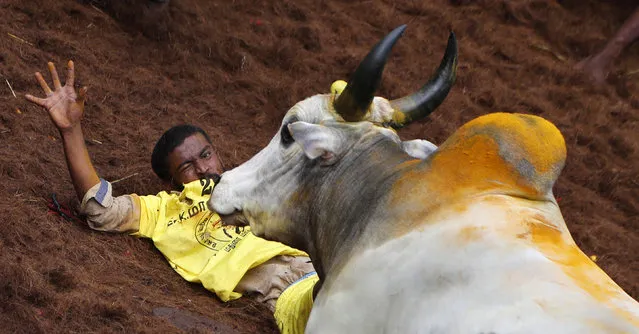
In this Thursday, January 17, 2019, photo, an Indian tamer reacts as a bull charges towards him during a traditional bull-taming festival called Jallikattu, in the village of Allanganallur, near Madurai, Tamil Nadu state, India. (Photo by Aijaz Rahi/AP Photo)

In this Thursday, January 17, 2019, photo, an Indian tamer reacts as a bull charges towards him during a traditional bull-taming festival called Jallikattu, in the village of Allanganallur, near Madurai, Tamil Nadu state, India. Jallikattu involves releasing a bull into a crowd of people who are expected to hang on to the animal's hump for a stipulated distance or hold on to the hump for a minimum of three jumps made by the bull. The sport, performed during the four-day “Pongal” or winter harvest festival, is hugely popular in Tamil Nadu. (Photo by Aijaz Rahi/AP Photo)
Details
21 Jan 2019 00:01:00
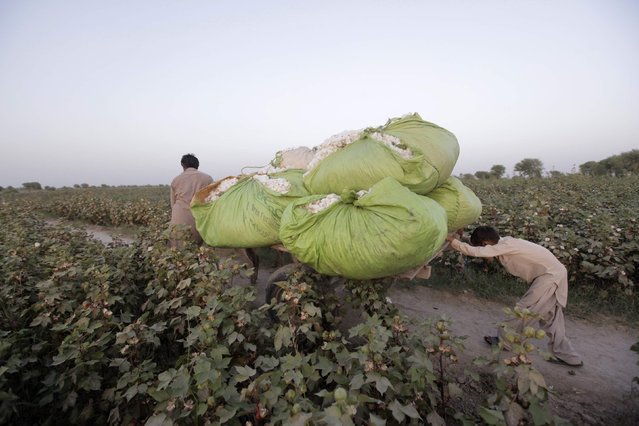
A boy pushes a donkey cart loaded with bundles of cotton blooms that were collected by women cotton pickers in Meeran Pur village, north of Karachi September 25, 2014. Women make up the bulk of Pakistan's half a million cotton producers, but labour rights activists say they are often exploited by overseers, who often withhold their wages and may subject some of them to sexual harassment. (Photo by Akhtar Soomro/Reuters)

A boy pushes a donkey cart loaded with bundles of cotton blooms that were collected by women cotton pickers in Meeran Pur village, north of Karachi September 25, 2014. Women make up the bulk of Pakistan's half a million cotton producers, but labour rights activists say they are often exploited by overseers, who often withhold their wages and may subject some of them to sexual harassment. (Photo by Akhtar Soomro/Reuters)
Details
10 Dec 2014 12:27:00
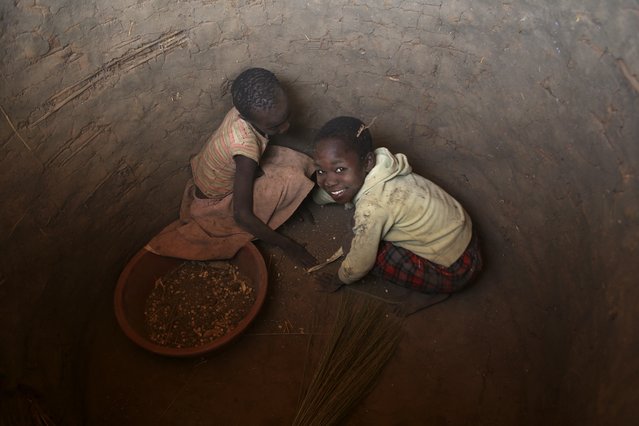
Children clean the interior of a granary in preparation for grain storage in Odek village, north of Uganda capital Kampala February 14, 2015. Odek is the birthplace of Joseph Kony, founder and leader of the rebel group Lord's Resistance Army. (Photo by James Akena/Reuters)

Children clean the interior of a granary in preparation for grain storage in Odek village, north of Uganda capital Kampala February 14, 2015. Odek is the birthplace of Joseph Kony, founder and leader of the rebel group Lord's Resistance Army. The LRA rose up against the government in northern Uganda under the leadership of Kony in the late 1980s and has been accused of abducting children to serve as fighters and s*x slaves. (Photo by James Akena/Reuters)
Details
24 Feb 2015 14:36:00
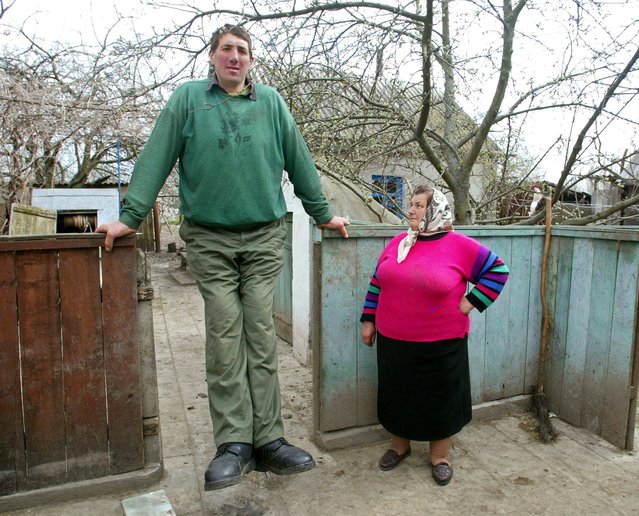
Ukraine's Leonid Stadnyk, who stands at a height of 2.53 metres (eight feet four inches) and may be considered the world's tallest living man, near his house in the village of Podolyantsi in Ukraine's Zhytomyr region, about 200 km (124 miles) from the capital Kiev, 2005. (Photo by Reuters/STR New)

Ukraine's Leonid Stadnyk, who stands at a height of 2.53 metres (eight feet four inches) and may be considered the world's tallest living man, near his house in the village of Podolyantsi in Ukraine's Zhytomyr region, about 200 km (124 miles) from the capital Kiev, 2005. (Photo by Reuters/Stringer)
Details
29 Aug 2014 11:56:00
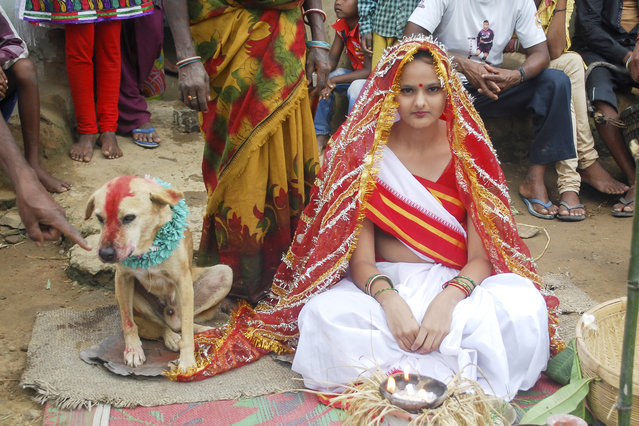
Mangli Munda poses on her wedding day with a stray dog in Jharkhand, India on August 30, 2014. An 18-year-old Indian girl has married a stray dog as a part of a tribal ritual designed to ward off an evil spell. (Photo by Barcroft Media/ABACAPress)

Mangli Munda poses on her wedding day with a stray dog in Jharkhand, India on August 30, 2014. An 18-year-old Indian girl has married a stray dog as a part of a tribal ritual designed to ward off an evil spell. Village elders hastily organised the wedding between Mangli Munda and the canine as the teenager is believed to be bringing bad luck to her community in a remote village in Jharkhand state. Mangli's father Sri Amnmunda agreed and even found a stray dog named Sheru as a match for his daughter. And while Mangli was a hesitant bride, she believes that the ceremony will help ensure that her future human husband will have a long life. (Photo by Barcroft Media/ABACAPress)
Details
04 Sep 2014 08:31:00
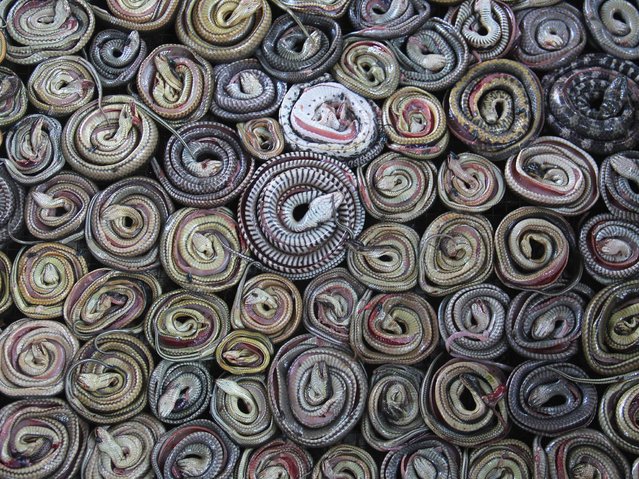
Snakes are collected and rolled before putting into the oven on March 2, 2014 in the village of Kertasura, Cirebon, Indonesia. (Photo by Nurcholis Anhari Lubis/Getty Images)

Snakes are collected and rolled before putting into the oven on March 2, 2014 in the village of Kertasura, Cirebon, Indonesia. At slaughter house snake skins measuring in the hundreds of metres, are sold to bag factories in the West and Central Java provinces on a monthly basis. From snake skin was manufactured into bags, shoes, wallets and belts. The price of a bag made from snake skin costs between 150,000 rupiah ($15 USD) and 300,000 rupiah ($30 USD), depending on its size. When snake skins reach Western fashion houses their price can increase dramatically and sell for up to $4,000 USD. (Photo by Nurcholis Anhari Lubis/Getty Images)
Details
05 Mar 2014 07:31:00
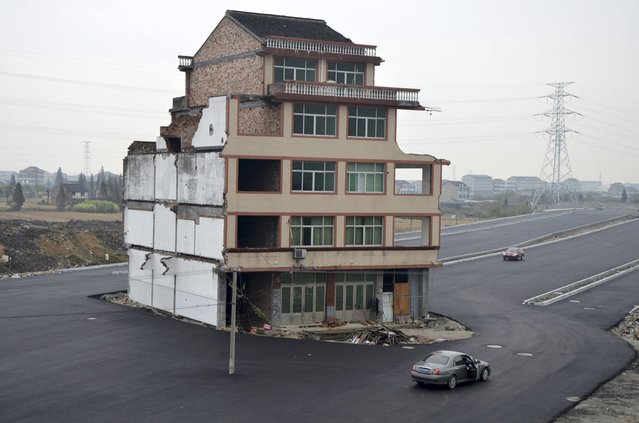
An isolated five-floor building stands in the middle of a new road on November 22, 2012 in Wenling, Zhejiang Province of China. Zhejiang Province of China. 67-year-old Luo Baogen and his 65-year-old wife from Xiazhangyang village still live in the half-demolished residential building, because they are dissatisfied with the relocation compensation. The road, which leads to the Wenling Railway Station, has not been put into use. (Photo by ChinaFotoPress)

An isolated five-floor building stands in the middle of a new road on November 22, 2012 in Wenling, Zhejiang Province of China. Zhejiang Province of China. 67-year-old Luo Baogen and his 65-year-old wife from Xiazhangyang village still live in the half-demolished residential building, because they are dissatisfied with the relocation compensation. The road, which leads to the Wenling Railway Station, has not been put into use. (Photo by China Foto Press)
Details
25 Nov 2012 09:49:00