Loading...
Done
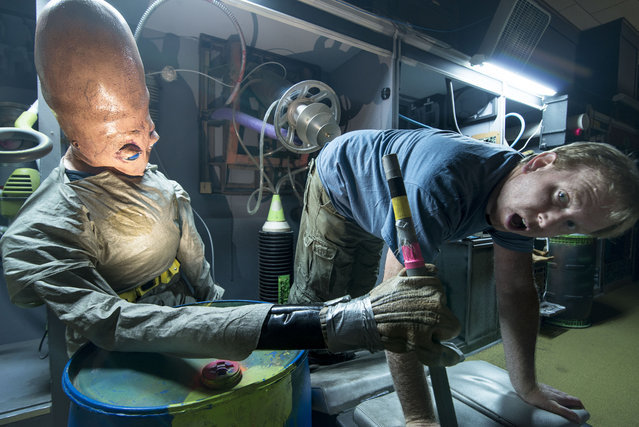
Chris has fun with one of the exhibits. (Photo by Chris Burton/Caters News Agency)

A UFO enthusiast who found himself locked in the iconic Roswell museum has shared the pictures he took with aliens to pass the time. Chris Burton, from the U.K., had dreamed of visiting Roswell, N.M., since he was a child but was stunned when he found himself locked in the International UFO Museum and Research Center during a recent trip. The 42-year-old used the unique opportunity to get interactive with the usually out of bounds exhibits and set up some funny snaps with the extraterrestrials – posing for a beer with one alien and taking a nap with another. (Photo by Chris Burton/Caters News Agency)
Details
24 Dec 2017 08:48:00
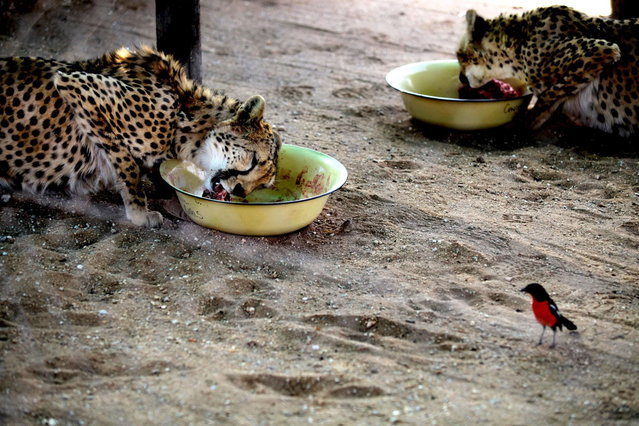
Young cheetahs eat meat at The Cheetah Conservation Fund (CCF) center in Otjiwarongo, Namibia, on August 13, 2013. The CCF started breeding Anatolian livestock dogs to promote cheetah-friendly farming after some 10,000 big cats – the current total worldwide population – were killed or moved off farms in the 1980s.  Up to 1,000 cheetahs were being killed a year, mostly by farmers who saw them as livestock killers. But the use of dogs has slashed losses for sheep and goat farmers and led to less retaliation against the vulnerable cheetah. (Photo by Jennifer Bruce/AFP Photo)

Young cheetahs eat meat at The Cheetah Conservation Fund (CCF) center in Otjiwarongo, Namibia, on August 13, 2013. The CCF started breeding Anatolian livestock dogs to promote cheetah-friendly farming after some 10,000 big cats – the current total worldwide population – were killed or moved off farms in the 1980s. Up to 1,000 cheetahs were being killed a year, mostly by farmers who saw them as livestock killers. But the use of dogs has slashed losses for sheep and goat farmers and led to less retaliation against the vulnerable cheetah. (Photo by Jennifer Bruce/AFP Photo)
Details
29 Aug 2013 10:56:00
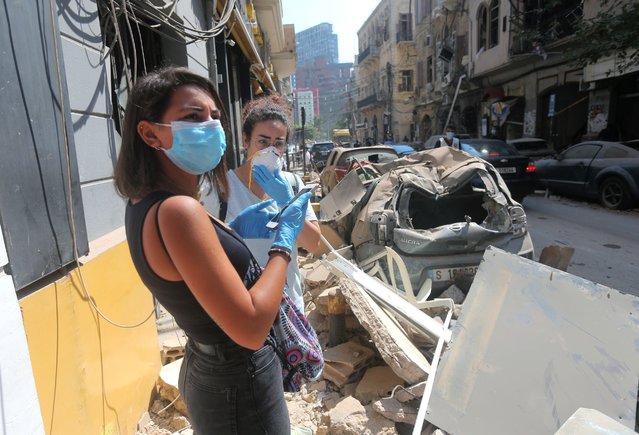
Young Lebanese women wearing protective masks and gloves against the coronavirus pandemic, stand on August 5, 2020 amid the rubble in Beirut's Gimmayzeh commercial district which was heavily damaged by the previous day's powerful explosion that tore through Lebanon's capital, resulting from the ignition of a huge depot of ammonium nitrate at the city's main port. Rescuers searched for survivors in Beirut after a cataclysmic explosion at the port sowed devastation across entire neighbourhoods, killing more than 100 people, wounding thousands and plunging Lebanon deeper into crisis. The blast, which appeared to have been caused by a fire igniting 2,750 tonnes of ammonium nitrate left unsecured in a warehouse, was felt as far away as Cyprus, some 150 miles (240 kilometres) to the northwest. (Photo by AFP Photo/Stringer)

Young Lebanese women wearing protective masks and gloves against the coronavirus pandemic, stand on August 5, 2020 amid the rubble in Beirut's Gimmayzeh commercial district which was heavily damaged by the previous day's powerful explosion that tore through Lebanon's capital, resulting from the ignition of a huge depot of ammonium nitrate at the city's main port. Rescuers searched for survivors in Beirut after a cataclysmic explosion at the port sowed devastation across entire neighbourhoods, killing more than 100 people, wounding thousands and plunging Lebanon deeper into crisis. The blast, which appeared to have been caused by a fire igniting 2,750 tonnes of ammonium nitrate left unsecured in a warehouse, was felt as far away as Cyprus, some 150 miles (240 kilometres) to the northwest. (Photo by AFP Photo/Stringer)
Details
10 Aug 2020 00:05:00
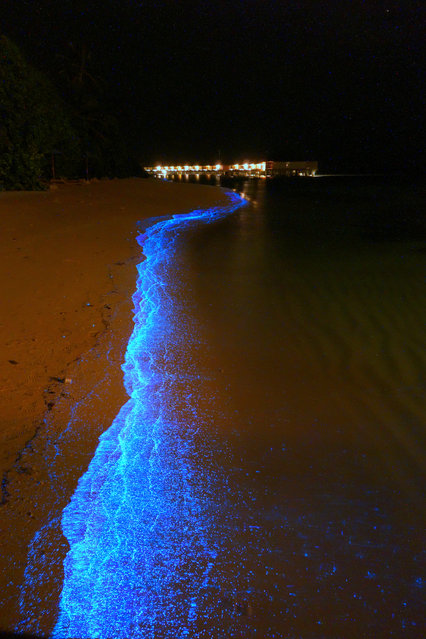
Bioluminescent phytoplankton washes up on Maldives beach. (Photo by Will Ho)

While vacationing on the Maldives Islands, Taiwanese amateur photographer Will Ho stumbled onto an incredible stretch of beach covered in millions of bioluminescent phytoplankton. These tiny organisms glow similarly to fireflies and tend to emit light when stressed, such as when waves crash or when they are otherwise agitated. While the phenomenon and its chemical mechanisms have been known for some time, biologists have only recently began to understand the reasons behind it. Photo: Bioluminescent phytoplankton washes up on Maldives beach. (Photo by Will Ho)
Details
07 Feb 2014 10:03:00
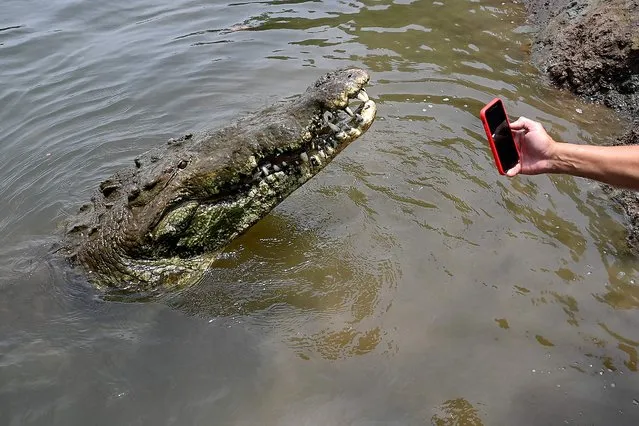
Jaison Vargas, crocodile tour guide, takes a picture of an American crocodile (Crocodylus acutus) during a tour at the Tarcoles river, in Tarcoles, Garabito municipality, Costa Rica, on March 31, 2022. Crocodile tours in the estuary of the Tarcoles River are a popular attraction for visitors to Costa Rica's Pacific coast, as the area gets back on its feet after being shaken by the pandemic. The river is home to nearly 500 species of birds and some 2,000 American crocodiles, many of which have been named after famous people. (Photo by Luis Acosta/AFP Photo)

Jaison Vargas, crocodile tour guide, takes a picture of an American crocodile (Crocodylus acutus) during a tour at the Tarcoles river, in Tarcoles, Garabito municipality, Costa Rica, on March 31, 2022. Crocodile tours in the estuary of the Tarcoles River are a popular attraction for visitors to Costa Rica's Pacific coast, as the area gets back on its feet after being shaken by the pandemic. The river is home to nearly 500 species of birds and some 2,000 American crocodiles, many of which have been named after famous people. (Photo by Luis Acosta/AFP Photo)
Details
10 Apr 2022 04:56:00
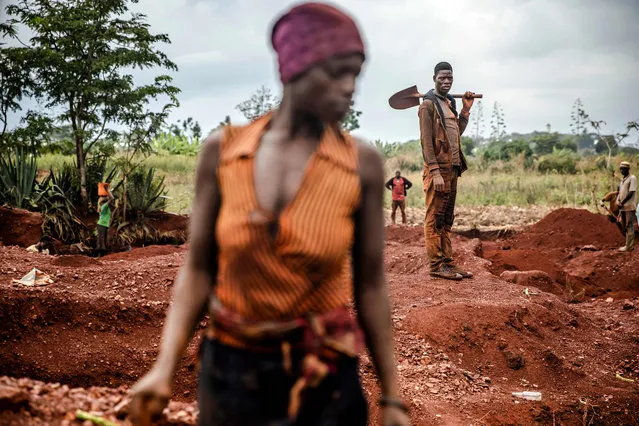
A gold miner observes from the distance how some women miners work at an open-pit gold mine in Nyarugusu, Geita Region, Tanzania on May 27, 2022. Tanzania is a land rich in minerals and one of the main gold producers in Africa, with gold representing more than 90% of the country's mineral exports. Artisanal and small-scale gold mining have culturally and historically relegated women's participation. The extractive sector in Tanzania has historically been a male-dominated industry with high levels of harassment, sеxual abuse, discrimination and misconceptions over women's involvement, and contributions following traditional beliefs. (Photo by Luis Tato/AFP Photo)

A gold miner observes from the distance how some women miners work at an open-pit gold mine in Nyarugusu, Geita Region, Tanzania on May 27, 2022. Tanzania is a land rich in minerals and one of the main gold producers in Africa, with gold representing more than 90% of the country's mineral exports. Artisanal and small-scale gold mining have culturally and historically relegated women's participation. The extractive sector in Tanzania has historically been a male-dominated industry with high levels of harassment, sеxual abuse, discrimination and misconceptions over women's involvement, and contributions following traditional beliefs. (Photo by Luis Tato/AFP Photo)
Details
13 Jun 2022 04:31:00
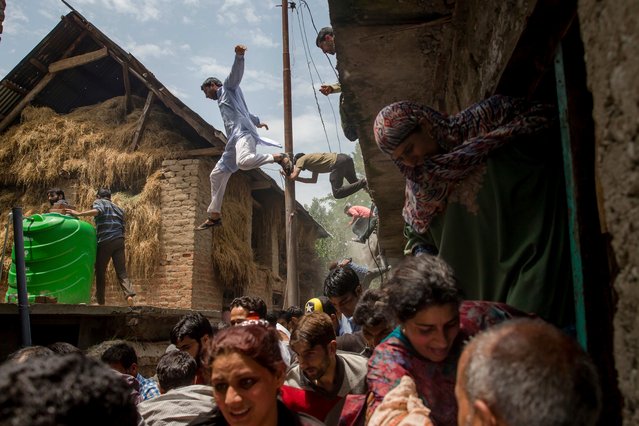
Kashmiri villagers inspecting a house damaged in a gun battle flee from it after hearing rumors of Indian army soldiers returning back to the site, which turned out to be false, in Kundalan village, some 60 Kilometres south of Srinagar, Indian controlled Kashmir, Tuesday, July 10, 2018. Government forces fired at protesters Tuesday in Indian-controlled Kashmir, killing a teenage boy and wounding at least 120 more who had been trying to reach the site of a gunbattle in which soldiers killed two rebels, police and residents said. (Photo by Dar Yasin/AP Photo)

Kashmiri villagers inspecting a house damaged in a gun battle flee from it after hearing rumors of Indian army soldiers returning back to the site, which turned out to be false, in Kundalan village, some 60 Kilometres south of Srinagar, Indian controlled Kashmir, Tuesday, July 10, 2018. Government forces fired at protesters Tuesday in Indian-controlled Kashmir, killing a teenage boy and wounding at least 120 more who had been trying to reach the site of a gunbattle in which soldiers killed two rebels, police and residents said. (Photo by Dar Yasin/AP Photo)
Details
16 Jul 2018 00:03:00
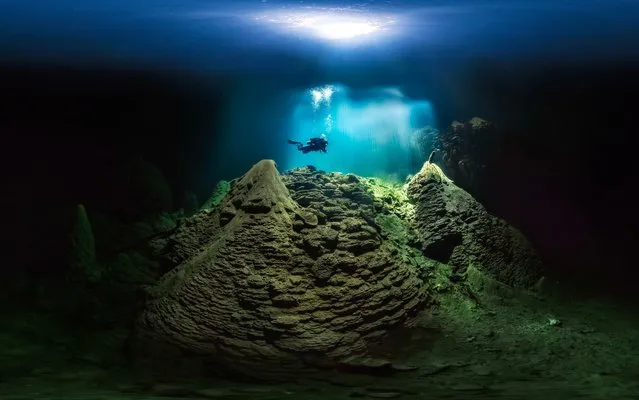
Cave Diver, Anhumas Abyss, Bonito, Brazil: The Anhumas Abyss is an underground cavern with a crystal-clear lake below, more than 260 feet (79 m) deep. A visitor must enter through a narrow opening at the top of the chamber and rappel into the cave. Snorkeling and scuba diving in the lake reveal amazing scenery. Distinctive, conical limestone stalagmites and stalactites occupy the lake and the surrounding area, some reaching 65 feet (20 m) high. “One must rappel about 235 feet (72 m) to get down into this deep lake. The photo was taken at a depth of 50 feet (15 m). It was a challenge to create the image because of the high contrast, plus the diver could not see into the darkness, making communication impossible”. (Photo by Marcio Cabral/Nature’s Best Photography Awards 2017)

Cave Diver, Anhumas Abyss, Bonito, Brazil: The Anhumas Abyss is an underground cavern with a crystal-clear lake below, more than 260 feet (79 m) deep. A visitor must enter through a narrow opening at the top of the chamber and rappel into the cave. Snorkeling and scuba diving in the lake reveal amazing scenery. Distinctive, conical limestone stalagmites and stalactites occupy the lake and the surrounding area, some reaching 65 feet (20 m) high. (Photo by Marcio Cabral/Nature’s Best Photography Awards 2017)
Details
26 Oct 2017 08:10:00