Loading...
Done
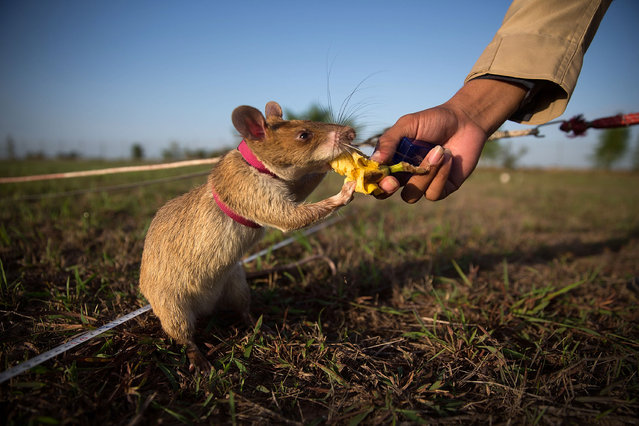
A mine detection rat is given banana as a reward after successfully identifying an inactive mine on July 2, 2015 in Siem Reap, Cambodia. (Photo by Taylor Weidman/Getty Images)

A mine detection rat is given banana as a reward after successfully identifying an inactive mine on July 2, 2015 in Siem Reap, Cambodia. The Cambodian Mine Action Center (CMAC) working with the Belgian NGO APOPO has recently begun testing the feasability of using large mine detection rats from Tanzania to help clear fields of mines and unexploded ordnance in one of the most bombed and mined countries in the world. (Photo by Taylor Weidman/Getty Images)
Details
03 Jul 2015 13:31:00
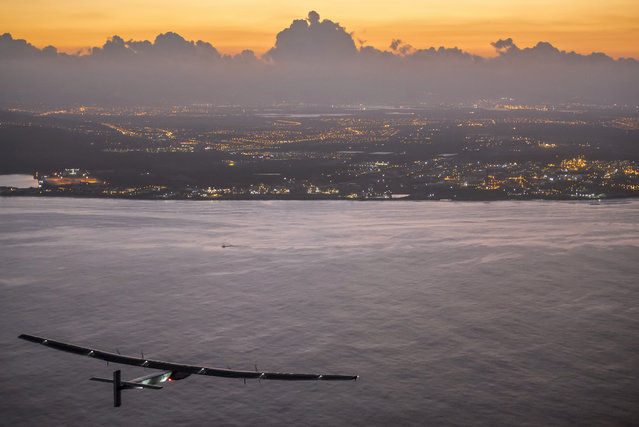
In this photo provided by Jean Revillard, Solar Impulse 2, a plane powered by the sun's rays and piloted by Andre Borschberg, approaches Kalaeloa Airport near Honolulu, Friday, July 3, 2015. (Photo by Jean Revillard/Global Newsroom via AP Photo)

In this photo provided by Jean Revillard, Solar Impulse 2, a plane powered by the sun's rays and piloted by Andre Borschberg, approaches Kalaeloa Airport near Honolulu, Friday, July 3, 2015. His 120-hour voyage from Nagoya, Japan broke the record for the world's longest nonstop solo flight, his team said. (Photo by Jean Revillard/Global Newsroom via AP Photo)
Details
04 Jul 2015 11:37:00
Rugby Union, New Zealand vs Tonga, IRB Rugby World Cup 2015 Pool C, St James' Park, Newcastle, Englandon October 9, 2015: Fans is fancy dress before the game. (Photo by Andrew Yates/Reuters)

Rugby Union, New Zealand vs Tonga, IRB Rugby World Cup 2015 Pool C, St James' Park, Newcastle, Englandon October 9, 2015: Fans is fancy dress before the game. (Photo by Andrew Yates/Reuters)
Details
11 Oct 2015 08:09:00
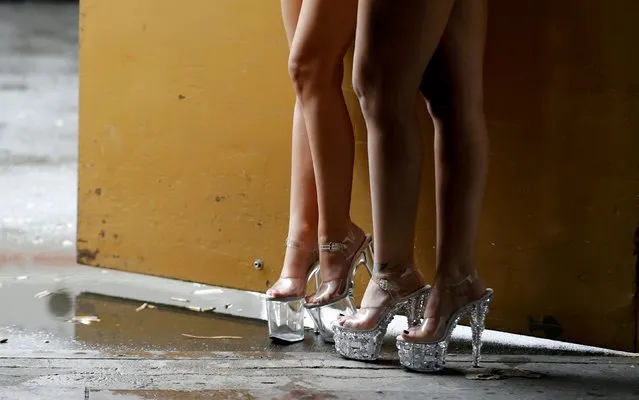
p*rn actresses take a break at the Venus erotic fair in Berlin, Germany, October 15, 2015. (Photo by Fabrizio Bensch/Reuters)

Pоrn actresses take a break at the Venus erotic fair in Berlin, Germany, October 15, 2015. The event, which represents the erotic business in the German capital, is open till October 18, 2015. (Photo by Fabrizio Bensch/Reuters)
Details
17 Oct 2015 08:07:00
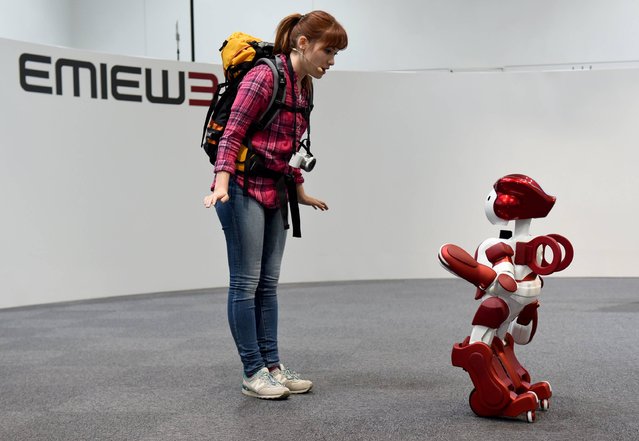
The “EMIEW3” robot (R) demonstrates communicating with a visitor during a press preview in Tokyo on April 8, 2016. Japanese electronics giant Hitachi unveiled its humanoid customer service and guidance robot “EMIEW3” and “remote brain” robotics IT platform. (Photo by Toshifumi Kitamura/AFP Photo)

The “EMIEW3” robot (R) demonstrates communicating with a visitor during a press preview in Tokyo on April 8, 2016. Japanese electronics giant Hitachi unveiled its humanoid customer service and guidance robot “EMIEW3” and “remote brain” robotics IT platform. (Photo by Toshifumi Kitamura/AFP Photo)
Details
08 Apr 2016 15:26:00
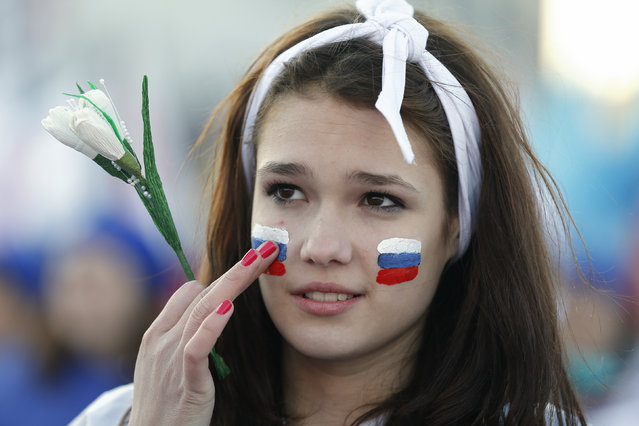
A girl with Russian national flags painted on her cheeks takes part in celebrations marking the first anniversary of Russia's annexation of Crimea, in central Simferopol March 16, 2015. (Photo by Maxim Shemetov/Reuters)

A girl with Russian national flags painted on her cheeks takes part in celebrations marking the first anniversary of Russia's annexation of Crimea, in central Simferopol March 16, 2015. Russia marks one year anniversary of annexation of Ukraine's Crimea peninsula this week. (Photo by Maxim Shemetov/Reuters)
Details
18 Mar 2015 11:30:00
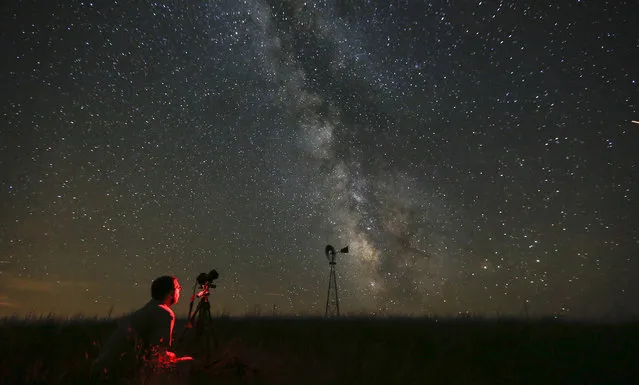
In this Wednesday, July 23, 2014 file photo, Omaha photographer Lane Hickenbottom photographs the night sky in a pasture near Callaway, Neb. With no moon in the sky, the Milky Way was visible to the naked eye. More than one-third of the world’s population can no longer see the Milky Way because of man-made lights, according to a scientific paper by Light Pollution Science and Technology Institute's Fabio Falchi and his team members, published on Friday, June 10, 2016. (Photo by Travis Heying/The Wichita Eagle via AP Photo)

In this Wednesday, July 23, 2014 file photo, Omaha photographer Lane Hickenbottom photographs the night sky in a pasture near Callaway, Neb. With no moon in the sky, the Milky Way was visible to the naked eye. More than one-third of the world’s population can no longer see the Milky Way because of man-made lights, according to a scientific paper by Light Pollution Science and Technology Institute's Fabio Falchi and his team members, published on Friday, June 10, 2016. (Photo by Travis Heying/The Wichita Eagle via AP Photo)
Details
11 Jun 2016 12:37:00
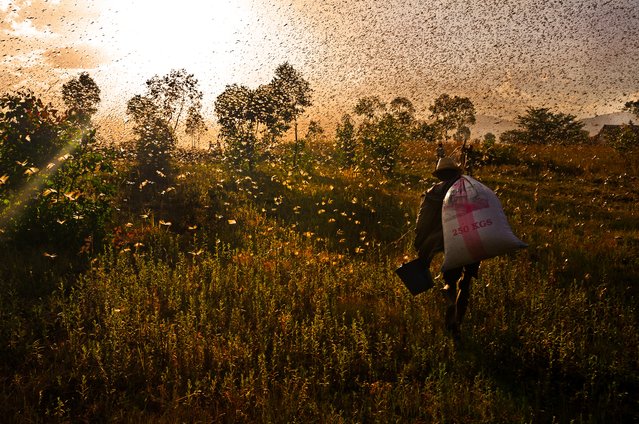
“Locusts & Men”. Oppression, interaction, collaboration. In the life cycle of nature nothing is lost, but the coexistence of different species is sometimes difficult. In Madagascar periodically returns the archaic antagonism between man and the migratory locust, in a circle of life where the two species are looking for space and food for their survival. Photo location: Madagascar, 2013. (Photo and caption by Michele Martinelli/National Geographic Photo Contest)

“Locusts & Men”. Oppression, interaction, collaboration. In the life cycle of nature nothing is lost, but the coexistence of different species is sometimes difficult. In Madagascar periodically returns the archaic antagonism between man and the migratory locust, in a circle of life where the two species are looking for space and food for their survival. At the end of the day a man walks home carrying on his shoulders the heavy bag which contains the locusts captured during the day. The insects provide nutritious meals for the man and his family. Photo location: Madagascar, 2013. (Photo and caption by Michele Martinelli/National Geographic Photo Contest)

ATTENTION! All pictures are presented in high resolution. To see Hi-Res images – just TWICE click on any picture. In other words, click small picture – opens the BIG picture. Click BIG picture – opens VERY BIG picture.
Details
03 Dec 2013 10:59:00