Loading...
Done
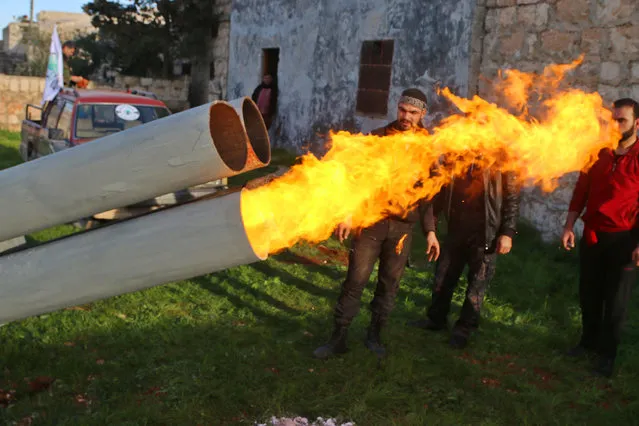
Al-Shamiyah Front fighters inspect a new locally-made cannon named “Borkan” (Volcano) as it was being launched towards forces loyal to Syria's president Bashar Al-Assad located in Aleppo artillery school, March 7, 2015. The “Borkan” is made out of four tubes attached to a loader, which can fire four shells at a time, and have a range of three kilometers (1.86 miles). (Photo by Abdalrhman Ismail/Reuters)

Al-Shamiyah Front fighters inspect a new locally-made cannon named “Borkan” (Volcano) as it was being launched towards forces loyal to Syria's president Bashar Al-Assad located in Aleppo artillery school, March 7, 2015. The “Borkan” is made out of four tubes attached to a loader, which can fire four shells at a time, and have a range of three kilometers (1.86 miles). (Photo by Abdalrhman Ismail/Reuters)
Details
24 Mar 2015 10:11:00
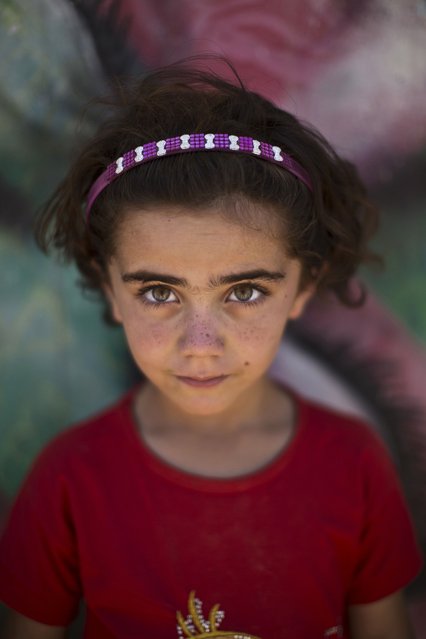
In this Tuesday, July 29, 2014, photo, Syrian refugee Samah, 5, poses for a picture at Zaatari refugee camp, near the Syrian border, in Mafraq, Jordan. More than 2.8 million Syrian children inside and outside the country – nearly half the school-aged population – cannot get an education because of the devastation from the civil war, according to the U.N. children's agency, UNICEF. (Photo by Muhammed Muheisen/AP Photo)

In this Tuesday, July 29, 2014, photo, Syrian refugee Samah, 5, poses for a picture at Zaatari refugee camp, near the Syrian border, in Mafraq, Jordan. More than 2.8 million Syrian children inside and outside the country – nearly half the school-aged population – cannot get an education because of the devastation from the civil war, according to the U.N. children's agency, UNICEF. That number is likely higher, as UNICEF can't count the children whose parents didn't register with the United Nations refugee agency. (Photo by Muhammed Muheisen/AP Photo)
Details
03 Aug 2014 07:46:00
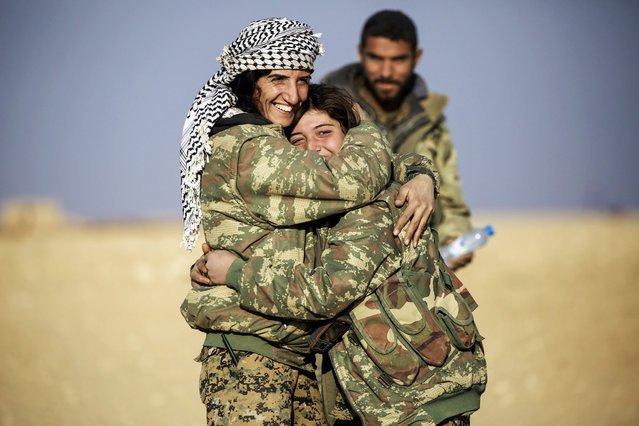
Rougine, a 19-year-old female Arab fighter among the Syrian Democratic Forces, made up of US-backed Kurdish and Arab fighters, stands in fatigues embracing another colleague near the village of al-Torshan, 20 km on the outskirts of Raqa on February 6, 2017. Unlike Syria's Kurds, who have emphasised gender equality in both their militias and nascent autonomous governing institutions in north and northeast Syria, the Arab tribes in the same region are among the more conservative segments of the country's population, and most Arab families find the concept of female fighters “hard to accept”. (Photo by Delil Souleiman/AFP Photo)

Rougine, a 19-year-old female Arab fighter among the Syrian Democratic Forces, made up of US-backed Kurdish and Arab fighters, stands in fatigues embracing another colleague near the village of al-Torshan, 20 km on the outskirts of Raqa on February 6, 2017. (Photo by Delil Souleiman/AFP Photo)
Details
13 Feb 2017 00:05:00
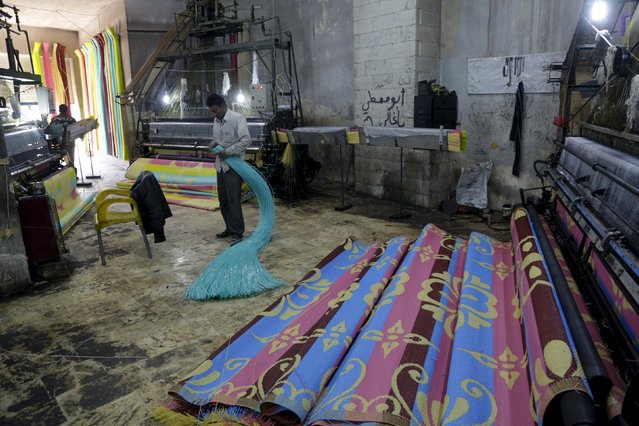
A man prepares plastic strings, used to produce mats, inside a mat factory in the rebel-controlled area of Maarshureen town in Idlib province, Syria, December 22, 2015. The town is known for the significant number of mat factories which exports its production mainly to nearby Iraq through checkpoints controlled by insurgents. But in the past months the business has declined due to heavy airstrikes against insurgents, vendors said. (Photo by Khalil Ashawi/Reuters)

A man prepares plastic strings, used to produce mats, inside a mat factory in the rebel-controlled area of Maarshureen town in Idlib province, Syria, December 22, 2015. The town is known for the significant number of mat factories which exports its production mainly to nearby Iraq through checkpoints controlled by insurgents. But in the past months the business has declined due to heavy airstrikes against insurgents, vendors said. (Photo by Khalil Ashawi/Reuters)
Details
24 Dec 2015 08:00:00
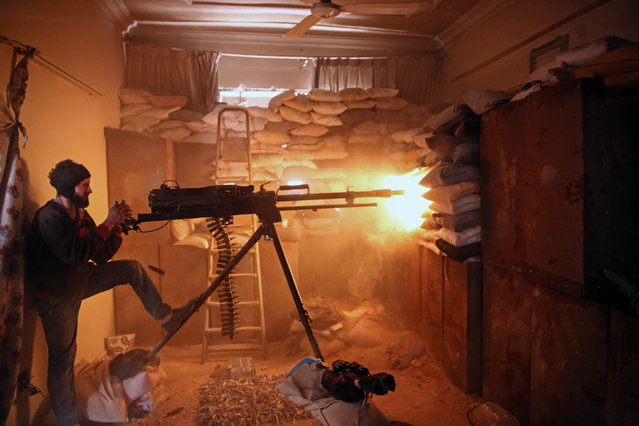
An opposition fighter from the Failaq al-Rahman brigade fires a heavy machine gun in Jobar, a rebel-held district on the eastern outskirts of the Syrian capital Damascus, on March 19, 2017. (Photo by Amer Almohibany/AFP Photo)

An opposition fighter from the Failaq al-Rahman brigade fires a heavy machine gun in Jobar, a rebel-held district on the eastern outskirts of the Syrian capital Damascus, on March 19, 2017. (Photo by Amer Almohibany/AFP Photo)
Details
02 Apr 2017 10:11:00
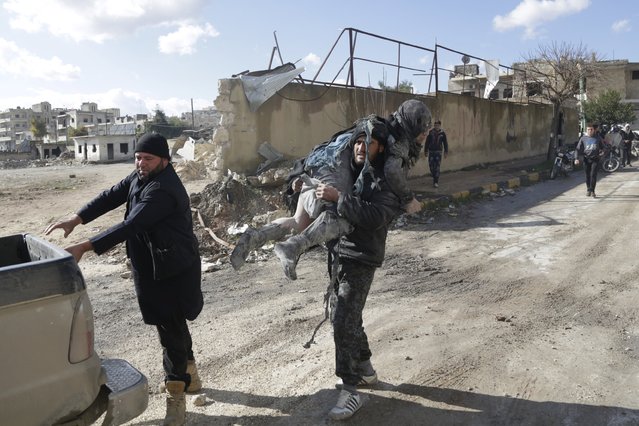
A man carries an injured woman in a site hit by what activists said were airstrikes carried out by the Russian air force in the rebel-controlled area of Maaret al-Numan town in Idlib province, Syria January 9, 2016. (Photo by Khalil Ashawi/Reuters)

A man carries an injured woman in a site hit by what activists said were airstrikes carried out by the Russian air force in the rebel-controlled area of Maaret al-Numan town in Idlib province, Syria January 9, 2016. At least 70 people died in what activists said where four vacuum bombs dropped by the Russian air force in the town of Maaret al-Numan; other air strikes where also carried out in the towns of Saraqib, Khan Sheikhoun and Maar Dabseh, in Idlib. (Photo by Khalil Ashawi/Reuters)
Details
10 Jan 2016 12:08:00
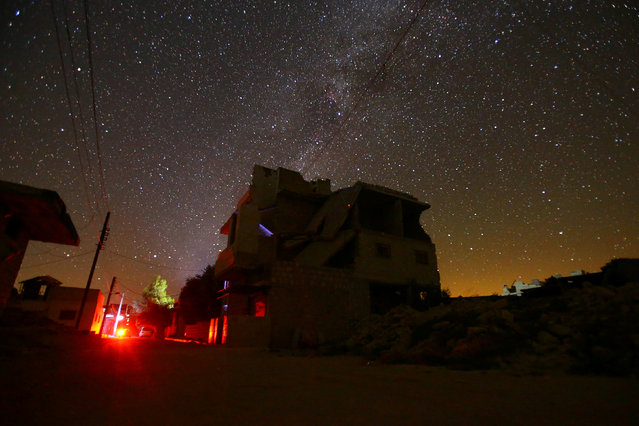
Damaged buildings stand in the rebel-controlled area of Maaret al-Numan in Idlib province, Syria September 6, 2016. (Photo by Ammar Abdullah/Reuters)

Damaged buildings stand in the rebel-controlled area of Maaret al-Numan in Idlib province, Syria September 6, 2016. (Photo by Ammar Abdullah/Reuters)
Details
15 Dec 2016 09:11:00
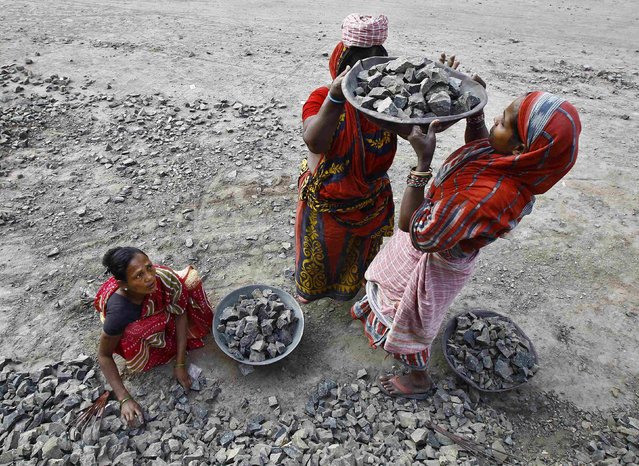
Women labourers work at the construction site of a road in Kolkata January 8, 2015. Across towns and cities in India, it is not uncommon to see women cleaning building sites, carrying bricks and or shoveling gravel - helping construct the infrastructure necessary for the country's economic and social development. (Photo by Rupak De Chowdhuri/Reuters)

Women labourers work at the construction site of a road in Kolkata January 8, 2015. Across towns and cities in India, it is not uncommon to see women cleaning building sites, carrying bricks and or shoveling gravel – helping construct the infrastructure necessary for the country's economic and social development. They help build roads, railway tracks, airports, and offices. They lay pipes for clean water supplies, cables for telecommunications, and dig the drains for sewage systems. But although women make up at least 20 percent of India's 40 million construction workers, they are less recognized than male workers with lower pay and often prone to safety hazards and sexual harassment. They are often unaware of their rights or scared to complain, say activists now trying to campaign for better treatment of women in the construction industry. (Photo by Rupak De Chowdhuri/Reuters)
Details
15 Jan 2015 13:47:00