Loading...
Done
“Leopard Hunting a Stork”. “One-shot capture. I watched the leopard stalking the stork, I only had time to focus at 400mm, no time to change to high speed, I watched the stork, and as soon as it flapped its wings, I shot one shot”. (Photo by Paul Rifkin/National Geographic Travel Photographer of the Year Contest)

“Leopard Hunting a Stork”. “One-shot capture. I watched the leopard stalking the stork, I only had time to focus at 400mm, no time to change to high speed, I watched the stork, and as soon as it flapped its wings, I shot one shot”. (Photo by Paul Rifkin/National Geographic Travel Photographer of the Year Contest)
Details
04 Jun 2018 00:03:00
Tourists standing near the sea shore are hit by a wave, which surged past a barrier under the influence of Typhoon Chan-hom, in Qingdao, Shandong province, China, July 12, 2015. (Photo by Reuters/Stringer)

Tourists standing near the sea shore are hit by a wave, which surged past a barrier under the influence of Typhoon Chan-hom, in Qingdao, Shandong province, China, July 12, 2015. One of the most powerful typhoons to strike eastern China in decades disrupted air, rail and sea transport on Saturday after forcing the evacuation of more than a million people from the provinces of Zhejiang and Jiangsu, state media reported. (Photo by Reuters/Stringer)
Details
13 Jul 2015 10:47:00
Employees work at a sorting centre of Zhongtong (ZTO) Express ahead of the Singles Day shopping festival, Chaoyang District, Beijing, November 8, 2015. (Photo by Jason Lee/Reuters)

Employees work at a sorting centre of Zhongtong (ZTO) Express ahead of the Singles Day shopping festival, Chaoyang District, Beijing, November 8, 2015. On China's giant Singles Day internet shopping festival, the country's delivery firms are stretched so thin that they are looking for tie-ups, listings and new investors to husband their resources. (Photo by Jason Lee/Reuters)

Details
13 Nov 2015 08:00:00
Local residents crowd a swimming pool during a hot weather in Suining, Sichuan province, 27 July 2008. (Photo by Reuters/Stringer)

Local residents crowd a swimming pool during a hot weather in Suining, Sichuan province, 27 July 2008. (Photo by Reuters/Stringer)
Details
19 Sep 2016 08:54:00
Monks take pictures with their mobile phones of the mummified body of a monk at Puzhao temple in Quanzhou, Fujian Province, China, January 10, 2016. (Photo by Reuters/Stringer)

Monks take pictures with their mobile phones of the mummified body of a monk at Puzhao temple in Quanzhou, Fujian Province, China, January 10, 2016. According to local media, the monk named Fuhou died three years ago at the age of 94 and his remains was placed in a vat and turned into a mummy as a sign of respect. (Photo by Reuters/Stringer)
Details
14 Jan 2016 08:01:00
A rescuer saves a resident from a flooded area in Wuhan, Hubei Province, China, July 2, 2016. (Photo by Reuters/China Daily)

A rescuer saves a resident from a flooded area in Wuhan, Hubei Province, China, July 2, 2016. (Photo by Reuters/China Daily)
Details
04 Jul 2016 08:33:00
Merit: A Night at Deadvlei. The night before returning to Windhoek, we spent several hours at Deadveli. The moon was bright enough to illuminate the sand dunes in the distance, but the skies were still dark enough to clearly see the milky way and magellanic clouds. Deadveli means “dead marsh. (Photo and caption by Beth McCarley/National Geographic Traveler Photo Contest)

Merit: A Night at Deadvlei. The night before returning to Windhoek, we spent several hours at Deadveli. The moon was bright enough to illuminate the sand dunes in the distance, but the skies were still dark enough to clearly see the milky way and magellanic clouds. Deadveli means “dead marsh. The camelthorn trees are believed to be about 900 years old, but have not decomposed because the environment is so dry. (Photo and caption by Beth McCarley/National Geographic Traveler Photo Contest)
Details
04 Aug 2015 11:50:00
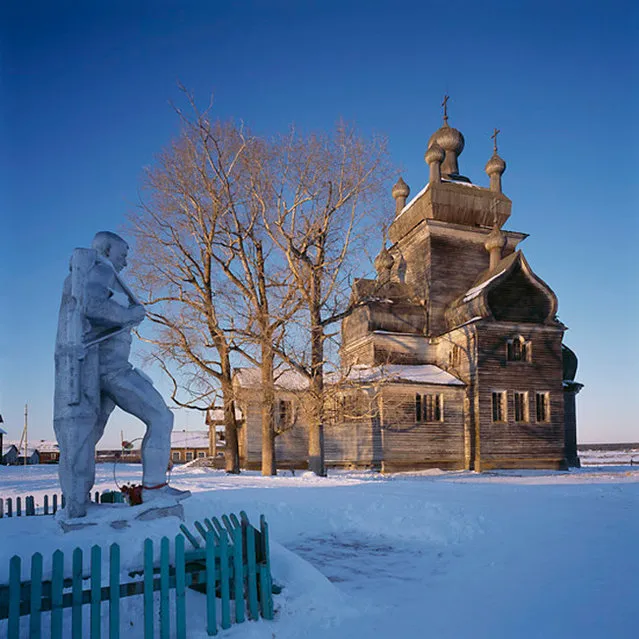
Wooden Churches - Travelling In The Russian North By Richard Davies Part 2

While communism, collectivism, worms, dry rot and casual looting failed to destroy the majestic wooden churches of Russia, it may be ordinary neglect that finally does them in. Dwindled now to several hundred remaining examples, these glories of vernacular architecture lie scattered amid the vastness of the world’s largest country. Just over a decade ago, Richard Davies, a British architectural photographer, struck out on a mission to record the fragile and poetic structures. Austerely beautiful and haunting, “Wooden Churches: Traveling in the Russian North” (White Sea Publishing; $132) is the result. Covering thousands of miles, Mr. Davies described how he and the writer Matilda Moreton tracked down the survivors from among the thousands of onion-domed structures built after Prince Vladimir converted to Christianity in 988.

See also: Wooden Churches Part1


Details
28 Nov 2013 12:13:00