Loading...
Done
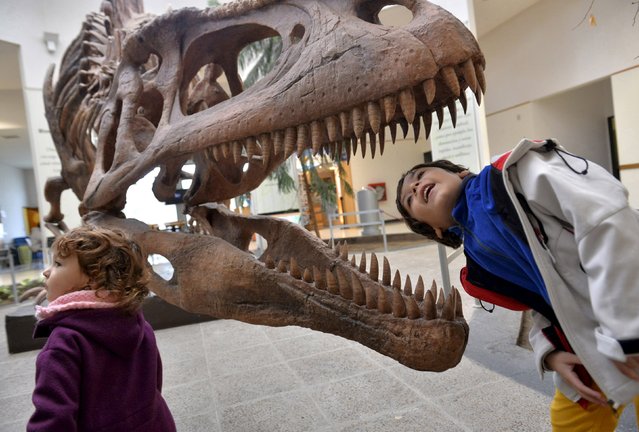
A boy looks inside the skull of a Tyrannosaurus Rex replica at the Egidio Feruglio Museum in Trelew, Argentina, in this May 18, 2014 file photograph. Scientists on July 28, 2015 unveiled a comprehensive analysis of the teeth of the group of carnivorous dinosaurs called theropods, which include the Tyrannosaurus Rex, detailing a unique serrated structure that let them chomp efficiently through the flesh and bones of large prey. (Photo by Maxi Jonas/Reuters)

A boy looks inside the skull of a Tyrannosaurus Rex replica at the Egidio Feruglio Museum in Trelew, Argentina, in this May 18, 2014 file photograph. Scientists on July 28, 2015 unveiled a comprehensive analysis of the teeth of the group of carnivorous dinosaurs called theropods, which include the Tyrannosaurus Rex, detailing a unique serrated structure that let them chomp efficiently through the flesh and bones of large prey. (Photo by Maxi Jonas/Reuters)
Details
29 Jul 2015 11:55:00
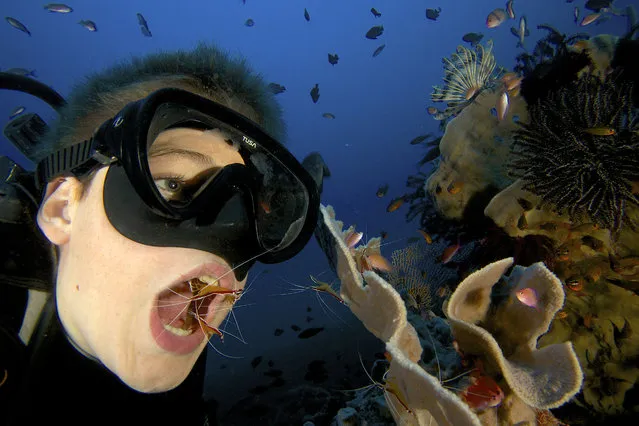
These unique photos capture the moment a boy has his teeth picked clean by amazing underwater shrimp. These fascinating creatures spend their lives diving inside the mouths of fish to remove the parasites that lurk there. Russell Laman imitated the behaviour of the surrounding fish swarm to entice the cleaner shrimp into his mouth whilst snorkelling with his father Tim Laman in Bali, Indonesia. The 13-year-old queued with the waiting fish and then opened his mouth when the shrimps came near. (Photo by Tim Laman/Caters News)

These unique photos capture the moment a boy has his teeth picked clean by amazing underwater shrimp. These fascinating creatures spend their lives diving inside the mouths of fish to remove the parasites that lurk there. Russell Laman imitated the behaviour of the surrounding fish swarm to entice the cleaner shrimp into his mouth whilst snorkelling with his father Tim Laman in Bali, Indonesia. The 13-year-old queued with the waiting fish and then opened his mouth when the shrimps came near. (Photo by Tim Laman/Caters News)
Details
17 Jul 2014 12:01:00
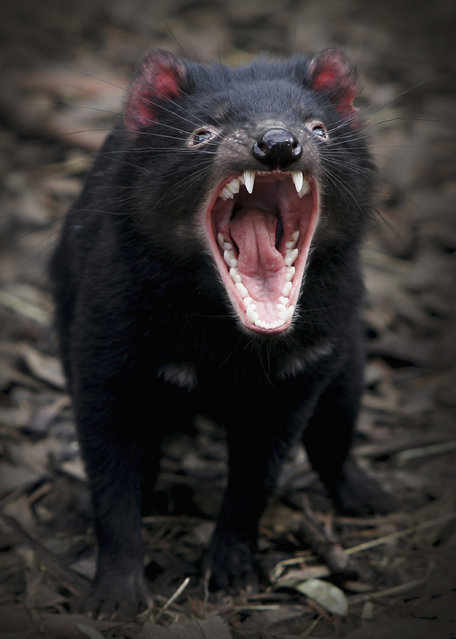
A Tasmanian Devil bears it's teeth at a quarantine facility August 31, 2005 in Hobart, Australia. The Devil, a native marsupial unique to Tasmania, is under threat from Devil Facial Tumor Disease (DFTD) which is decimating numbers throughout Tasmania. (Photo by Ian Waldie/Getty Images)

“The Tasmanian devil (Sarcophilus harrisii) is a carnivorous marsupial of the family Dasyuridae now found in the wild only in the Australian island state of Tasmania. The size of a small dog, it became the largest carnivorous marsupial in the world following the extinction of the thylacine in 1936. It is characterised by its stocky and muscular build, black fur, pungent odour, extremely loud and disturbing screech, keen sense of smell, and ferocity when feeding”. – Wikipedia. Photo: A Tasmanian Devil bears it's teeth at a quarantine facility August 31, 2005 in Hobart, Australia. (Photo by Ian Waldie/Getty Images)
Details
27 Jan 2014 09:45:00
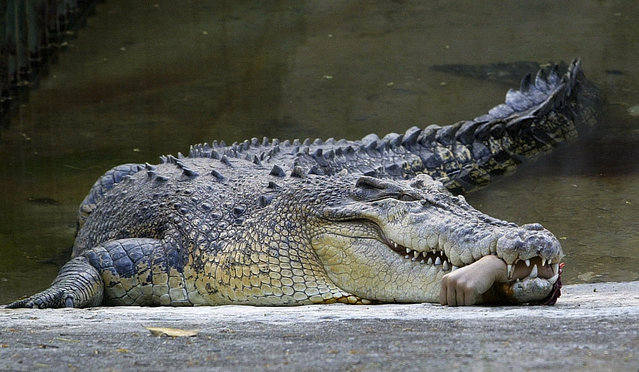
A crocodile at a zoo in the southern Taiwan city of Kaohsiung holds the forearm of a zoo veterinarian in its teeth, April  2007. Surgeons in Taiwan have reattached a vet's arm, after it was bitten off by a crocodile as he tried to give it an anaesthetic injection. His attacker is one of a pair of Nile crocodiles kept at Shoushan zoo. Nile crocodiles are known to be man-eaters, but are also listed as an endangered species. (Photo by Frank Lin/Reuters)

A crocodile at a zoo in the southern Taiwan city of Kaohsiung holds the forearm of a zoo veterinarian in its teeth, April 2007. Surgeons in Taiwan have reattached a vet's arm, after it was bitten off by a crocodile as he tried to give it an anaesthetic injection. His attacker is one of a pair of Nile crocodiles kept at Shoushan zoo. Nile crocodiles are known to be man-eaters, but are also listed as an endangered species. (Photo by Frank Lin/Reuters)
Details
31 Jul 2016 11:14:00
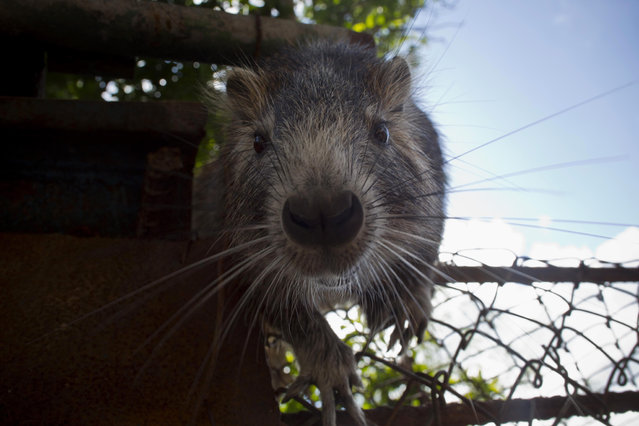
In this November 17, 2014 photo, Pancho, a domesticated huitia, confronts a camera, in Bainoa, Cuba. With their rope-like, dark tails, long front teeth, and whiskers that appear to be vibrating, huitias look like giant rats. They measure nearly a foot long (about 30 centimeters), with the largest ones weighing in bigger than a small dog. (Photo by Ramon Espinosa/AP Photo)

In this November 17, 2014 photo, Pancho, a domesticated huitia, confronts a camera, in Bainoa, Cuba. With their rope-like, dark tails, long front teeth, and whiskers that appear to be vibrating, huitias look like giant rats. They measure nearly a foot long (about 30 centimeters), with the largest ones weighing in bigger than a small dog. (Photo by Ramon Espinosa/AP Photo)
Details
21 Nov 2014 12:58:00
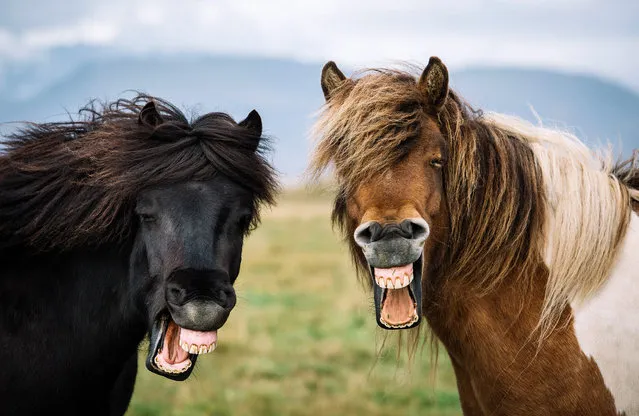
Two horses appear to burst into laughter before a sweet embrace. The horses both turn their head to look at the camera and flash their teeth, treating the lucky photographer to a rare shot. Moments later the pair show their affectionate side by coming together and “hugging”. Photographer Nir Amos, 34, said he was “amazed” to capture the horses “laughing” in a field near Skógar, in the south east of Iceland on July 31, 2018. (Photo by Nir Amos/Solent News & Photo Agency)

Two horses appear to burst into laughter before a sweet embrace. The horses both turn their head to look at the camera and flash their teeth, treating the lucky photographer to a rare shot. Moments later the pair show their affectionate side by coming together and “hugging”. Photographer Nir Amos, 34, said he was “amazed” to capture the horses “laughing” in a field near Skógar, in the south east of Iceland on July 31, 2018. (Photo by Nir Amos/Solent News & Photo Agency)
Details
05 Aug 2018 00:03:00
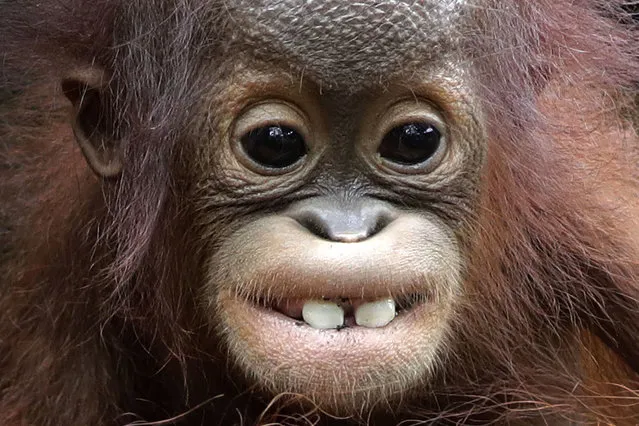
Khansa, an eight month old critically endangered Bornean orangutan shows off it's two front-teeth, at the Singapore Zoo on Thursday, January 11, 2018 in Singapore. The Singapore Zoo is active with its breeding programs as part of its wildlife preservation efforts. This is the Zoo's 46th successful orangutan birth. (Photo by Wong Maye-E/AP Photo)

Khansa, an eight month old critically endangered Bornean orangutan shows off it's two front-teeth, at the Singapore Zoo on Thursday, January 11, 2018 in Singapore. The Singapore Zoo is active with its breeding programs as part of its wildlife preservation efforts. This is the Zoo's 46th successful orangutan birth. (Photo by Wong Maye-E/AP Photo)
Details
14 Jan 2018 08:17:00
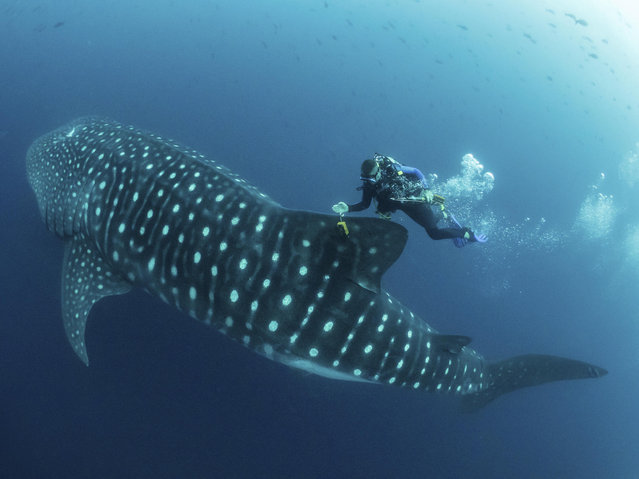
In this 2017 photo provided by Simon Pierce, Jonathan Green checks on a fin-mounted satellite tag on a whale shark in the Galapagos Islands area of Ecuador.  Despite typically being bigger than a double-decker bus, the elusive whale shark has only tiny, almost useless teeth. It's also one of the least understood animals in the ocean. (Photo by Simonjpierce.com via AP Photo)

In this 2017 photo provided by Simon Pierce, Jonathan Green checks on a fin-mounted satellite tag on a whale shark in the Galapagos Islands area of Ecuador. Despite typically being bigger than a double-decker bus, the elusive whale shark has only tiny, almost useless teeth. It's also one of the least understood animals in the ocean. (Photo by Simonjpierce.com via AP Photo)
Details
02 Mar 2018 00:03:00