Loading...
Done
Unnati, 6 years old, at home with his sister Ishika, 4 years old, in the Mahamai Ka Bagh neighborhood. Unnati was born to parents contaminated by a carcinogenic and mutagenic water supply. This year marks the 31st anniversary of the 1984 Union Carbide gas tragedy that killed thousands of citizens of Bhopal within 72 hours and has gone on to claim thousands more as a result of the polluted environment. (Photo by Giles Clarke/Getty Images)

Unnati, 6 years old, at home with his sister Ishika, 4 years old, in the Mahamai Ka Bagh neighborhood. Unnati was born to parents contaminated by a carcinogenic and mutagenic water supply. This year marks the 31st anniversary of the 1984 Union Carbide gas tragedy that killed thousands of citizens of Bhopal within 72 hours and has gone on to claim thousands more as a result of the polluted environment. (Photo by Giles Clarke/Getty Images)
Details
04 Dec 2015 08:01:00
Turkish World Record Holder in freediving Sahika Ercumen dives to raise awareness about pollution in sea waters in Kas district of Antalya, Turkiye on June 07, 2023. Every year 400 tons of one time use plastic are made globally and in Turkiye 91 percent of the plastics are not recycled. (Photo by Sebnem Coskun/Anadolu Agency via Getty Images)

Turkish World Record Holder in freediving Sahika Ercumen dives to raise awareness about pollution in sea waters in Kas district of Antalya, Turkiye on June 07, 2023. Every year 400 tons of one time use plastic are made globally and in Turkiye 91 percent of the plastics are not recycled. (Photo by Sebnem Coskun/Anadolu Agency via Getty Images)
Details
21 Jun 2023 02:15:00
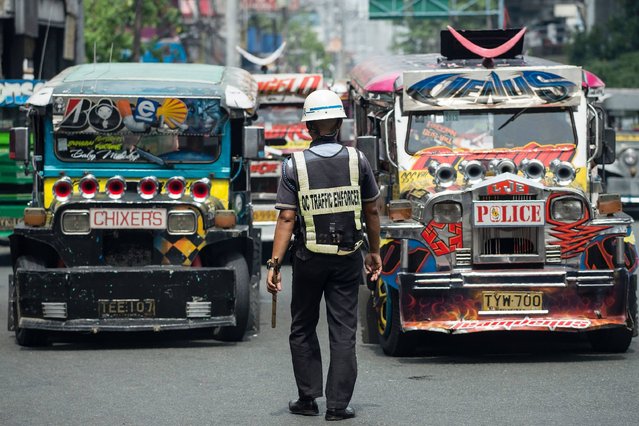
Jeepneys are seen as an enforcer manages traffic at a busy street in Manila on May 30, 2017. Jeepneys, once hailed as the “King of the Road” and a cultural symbol in the Phillipines to rival New York's yellow taxis, may soon disappear from Manila's gridlocked streets, as authorities move to phase out the Philippines' iconic World War II-era minibuses, citing pollution and safety concerns. (Photo by Noel Celis/AFP Photo)

Jeepneys are seen as an enforcer manages traffic at a busy street in Manila on May 30, 2017. Jeepneys, once hailed as the “King of the Road” and a cultural symbol in the Phillipines to rival New York's yellow taxis, may soon disappear from Manila's gridlocked streets, as authorities move to phase out the Philippines' iconic World War II-era minibuses, citing pollution and safety concerns. (Photo by Noel Celis/AFP Photo)
Details
31 May 2017 07:14:00
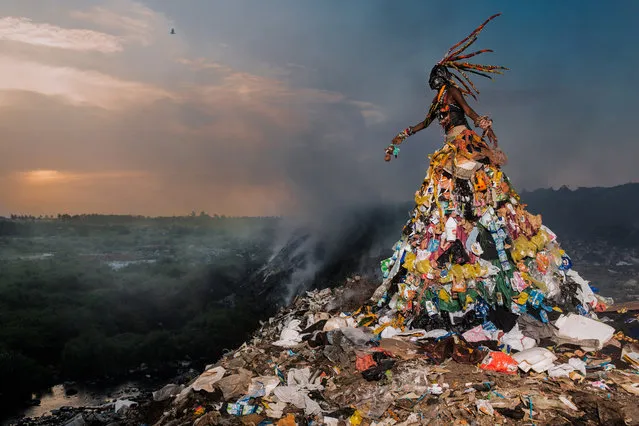
Fabrice Monteiro travelled to the most polluted places in Africa and created terrifying characters who roamed their midst dressed in eerie debris. They are spirits, he says, on a mission to make humans change their ways. Informed by Africa’s environmental problems, Fabrice Monteiro’s photographs aim to highlight urgent ecological issues all over the world. His series “The Prophecy” is on show at Photo Basel 2017 until 18 June. (Photo by Fabrice Monteiro/Photo Basel 2017/Mariane Ibrahim Gallery/The Guardian)

Fabrice Monteiro travelled to the most polluted places in Africa and created terrifying characters who roamed their midst dressed in eerie debris. They are spirits, he says, on a mission to make humans change their ways. Informed by Africa’s environmental problems, Fabrice Monteiro’s photographs aim to highlight urgent ecological issues all over the world. His series “The Prophecy” is on show at Photo Basel 2017 until 18 June. (Photo by Fabrice Monteiro/Photo Basel 2017/Mariane Ibrahim Gallery/The Guardian)
Details
17 Jun 2017 08:38:00
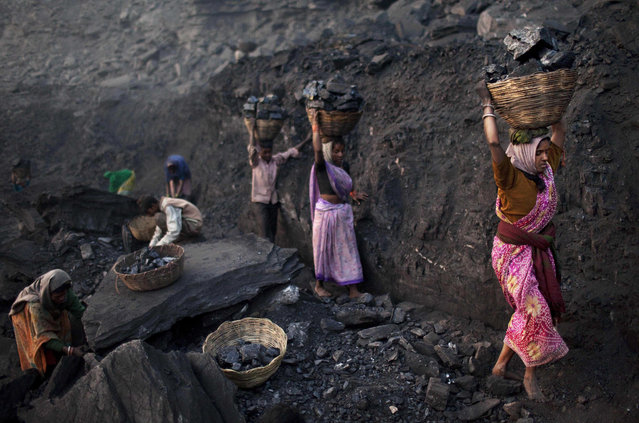
In this Friday, January 7, 2011 photo, people carry baskets of coal scavenged illegally at an open-cast mine in the village of Bokapahari in the eastern Indian state of Jharkhand where a community of coal scavengers live and work. The world's biggest coal users – China, the United States and India – have boosted coal mining in 2017, in an abrupt departure from last year's record global decline for the heavily polluting fuel and a setback to efforts to rein in climate change emissions. (Photo by Kevin Frayer/AP Photo)

In this Friday, January 7, 2011 photo, people carry baskets of coal scavenged illegally at an open-cast mine in the village of Bokapahari in the eastern Indian state of Jharkhand where a community of coal scavengers live and work. The world's biggest coal users – China, the United States and India – have boosted coal mining in 2017, in an abrupt departure from last year's record global decline for the heavily polluting fuel and a setback to efforts to rein in climate change emissions. (Photo by Kevin Frayer/AP Photo)
Details
28 Jun 2017 08:08:00
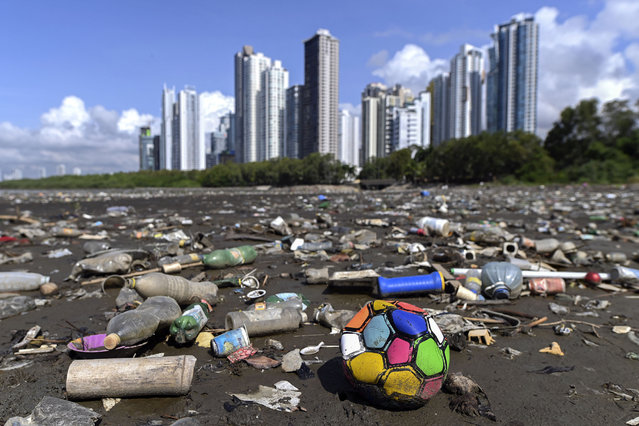
Garbage, including plastic waste, is seen at the beach of Costa del Este, in Panama City, on April 19, 2021. Every two weeks, Marine Biology students descend about five meters in the sea to take care of a coral nursery of the staghorn species (Acropora cervicornis) in Portobelo, Panama, with which they aim to restore reefs damaged by climate change and pollution, as part of the Reef2Reef project. (Photo by Luis Acosta/AFP Photo)

Garbage, including plastic waste, is seen at the beach of Costa del Este, in Panama City, on April 19, 2021. Every two weeks, Marine Biology students descend about five meters in the sea to take care of a coral nursery of the staghorn species (Acropora cervicornis) in Portobelo, Panama, with which they aim to restore reefs damaged by climate change and pollution, as part of the Reef2Reef project. (Photo by Luis Acosta/AFP Photo)
Details
21 Jun 2021 07:30:00
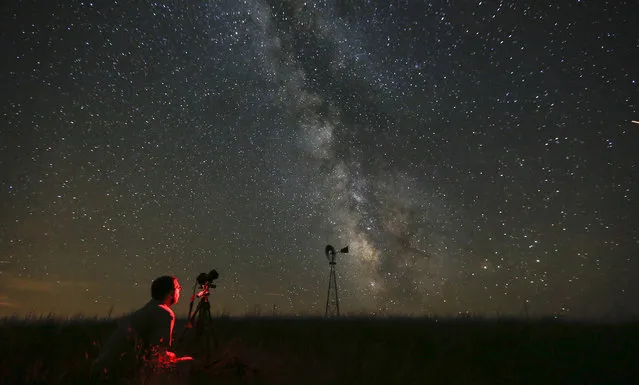
In this Wednesday, July 23, 2014 file photo, Omaha photographer Lane Hickenbottom photographs the night sky in a pasture near Callaway, Neb. With no moon in the sky, the Milky Way was visible to the naked eye. More than one-third of the world’s population can no longer see the Milky Way because of man-made lights, according to a scientific paper by Light Pollution Science and Technology Institute's Fabio Falchi and his team members, published on Friday, June 10, 2016. (Photo by Travis Heying/The Wichita Eagle via AP Photo)

In this Wednesday, July 23, 2014 file photo, Omaha photographer Lane Hickenbottom photographs the night sky in a pasture near Callaway, Neb. With no moon in the sky, the Milky Way was visible to the naked eye. More than one-third of the world’s population can no longer see the Milky Way because of man-made lights, according to a scientific paper by Light Pollution Science and Technology Institute's Fabio Falchi and his team members, published on Friday, June 10, 2016. (Photo by Travis Heying/The Wichita Eagle via AP Photo)
Details
11 Jun 2016 12:37:00
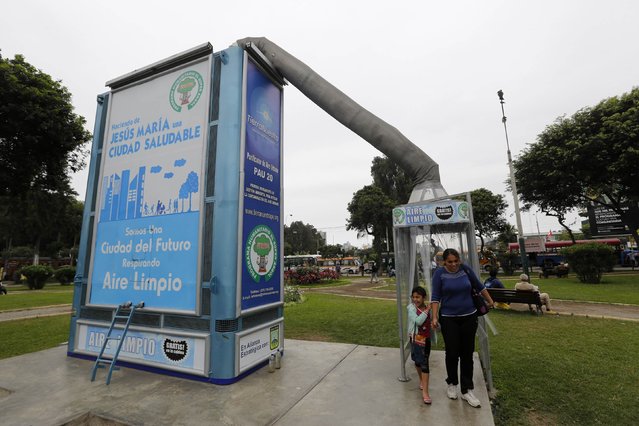
People leave a giant air purifier, which its inventor calls a “super tree”, in Lima's district of Jesus Maria November 24, 2014. In Peru's notoriously polluted capital Lima, local inventor Jorge Gutierrez, a retired naval engineer, is deploying the giant air purifiers that double as billboards to suck up carbon dioxide and dangerous levels of smog. (Photo by Mariana Bazo/Reuters)

People leave a giant air purifier, which its inventor calls a “super tree”, in Lima's district of Jesus Maria November 24, 2014. In Peru's notoriously polluted capital Lima, local inventor Jorge Gutierrez, a retired naval engineer, is deploying the giant air purifiers that double as billboards to suck up carbon dioxide and dangerous levels of smog. (Photo by Mariana Bazo/Reuters)
Details
28 Nov 2014 11:48:00