Loading...
Done
In this image released on October 1, Jazzelle Zanaughtti is seen onstage during Rihanna's Savage X Fenty Show Vol. 2 presented by Amazon Prime Video at the Los Angeles Convention Center in Los Angeles, California; and broadcast on October 2, 2020. (Photo by Jerritt Clark/Getty Images for Rihanna's Savage X Fenty Show Presented by Amazon Prime Video)

In this image released on October 1, model Jazzelle Zanaughtti is seen onstage during Rihanna's Savage X Fenty Show Vol. 2 presented by Amazon Prime Video at the Los Angeles Convention Center in Los Angeles, California; and broadcast on October 2, 2020. (Photo by Jerritt Clark/Getty Images for Rihanna's Savage X Fenty Show Presented by Amazon Prime Video)
Details
05 Oct 2020 00:03:00
A model shows creations of ACUOD by CHANU during Amazon Fashion Week TOKYO in Tokyo, Japan, March 21, 2019. (Photo by Kim Kyung-hoon/Reuters)

A model shows creations of ACUOD by CHANU during Amazon Fashion Week TOKYO in Tokyo, Japan, March 21, 2019. (Photo by Kim Kyung-hoon/Reuters)
Details
23 Mar 2019 00:03:00
The American actress Jennifer Lopez in London on Thursday 7th November, 2024 to promote her film Unstoppable which will be released on Amazon Prime Video in January 2025. (Photo by Instagram)

The American actress Jennifer Lopez in London on Thursday 7th November, 2024 to promote her film Unstoppable which will be released on Amazon Prime Video in January 2025. (Photo by Instagram)
Details
21 Nov 2024 15:42:00
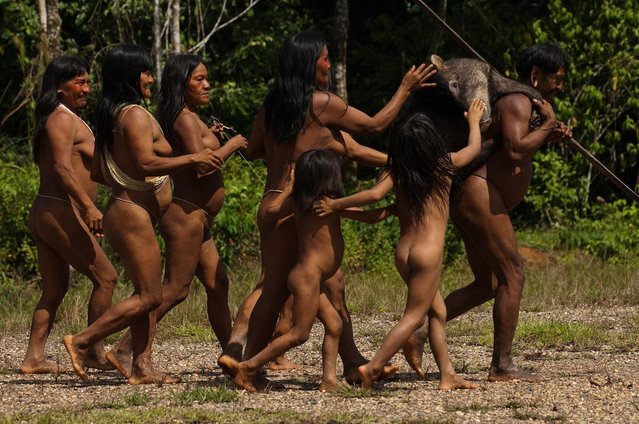
Spectacular images offering insight into the lives of the Huaorani people in the Ecuadorian Amazon have been revealed showing how they use traditional methods to hunt monkeys for food. The stunning pictures were taken by conservation photographer Pete Oxford from Torquay, Devon in the Ecuadorian Amazon. “The Huaorani Indians are a forest people highly in tune with their environment. Many are now totally acculturated since the 1950s by missionaries”, said Pete. “Today they face radical change to their culture to the proximity of oil exploration within their territory and the Yasuni National Park and Biosphere Reserve, they are vastly changed. Some still live very traditionally and for this shoot, through my Huaorani friend, a direct relative of those photographed he wanted to depict them as close to their original culture as possible. They still largely hunt with blow pipes and spears eating a lot of monkeys and peccaries”. The Huaorani are also known as the Waorani, Waodani or the Waos and are native Amerindians. Their lands are located between the Curaray and Napo rivers and speak the Huaorani language. Pete says that during his visit he was welcomed into the group and hopes that ancient cultures can be saved. Here: The tribe were seen celebrating after a hunter returned to camp with a wild pig. (Photo by Pete Oxford/Mediadrumworld.com)

Spectacular images offering insight into the lives of the Huaorani people in the Ecuadorian Amazon have been revealed showing how they use traditional methods to hunt monkeys for food. The stunning pictures were taken by conservation photographer Pete Oxford from Torquay, Devon in the Ecuadorian Amazon. Here: The tribe were seen celebrating after a hunter returned to camp with a wild pig. (Photo by Pete Oxford/Mediadrumworld.com)
Details
20 Jan 2017 07:58:00
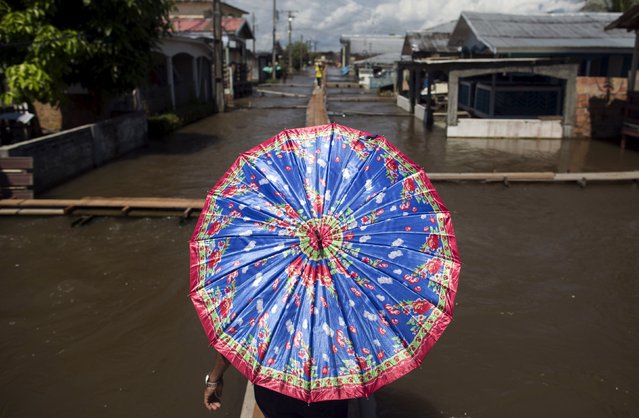
A resident walks on a makeshift walkway above a flooded street from the rising Rio Solimoes, one of the two main branches of the Amazon River, in Careiro da Varzea of Amazonas State, Brazil, June 30, 2015. According to the state Civil Defense, more than 460,000 people were affected by strong rains in the state. (Photo by Bruno Kelly/Reuters)

A resident walks on a makeshift walkway above a flooded street from the rising Rio Solimoes, one of the two main branches of the Amazon River, in Careiro da Varzea of Amazonas State, Brazil, June 30, 2015. According to the state Civil Defense, more than 460,000 people were affected by strong rains in the state. (Photo by Bruno Kelly/Reuters)
Details
02 Jul 2015 14:03:00
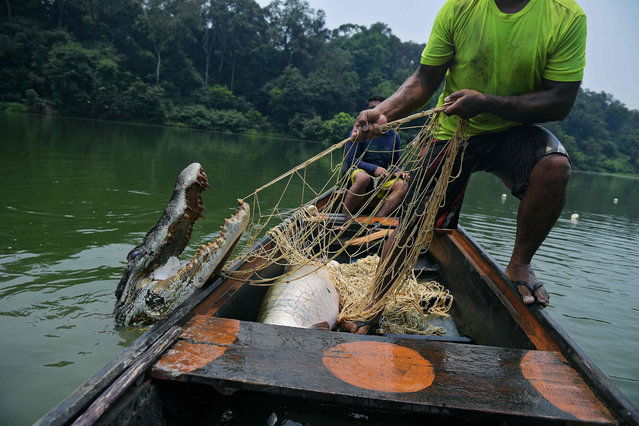
Fishermen pull up a live 2.5 metre crocodile in their net in the Western Amazon region, Brazil on September 20, 2017. The fishermen were fishing for a large river fish called Arapaima but sometimes crocodiles become stuck in the nets as well. (Photo by Carl de Souza/AFP Photo)

Fishermen pull up a live 2.5 metre crocodile in their net in the Western Amazon region, Brazil on September 20, 2017. The fishermen were fishing for a large river fish called Arapaima but sometimes crocodiles become stuck in the nets as well. (Photo by Carl de Souza/AFP Photo)
Details
24 Sep 2017 06:47:00
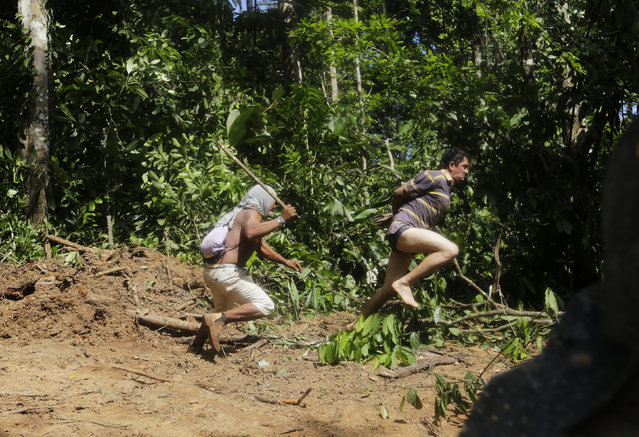
A Ka'apor Indian warrior (L) chases a logger who tried to escape after they captured him during a jungle expedition to search for and expel loggers from the Alto Turiacu Indian territory, near the Centro do Guilherme municipality in the northeast of Maranhao state in the Amazon basin, August 7, 2014. (Photo by Lunae Parracho/Reuters)

A Ka'apor Indian warrior (L) chases a logger who tried to escape after they captured him during a jungle expedition to search for and expel loggers from the Alto Turiacu Indian territory, near the Centro do Guilherme municipality in the northeast of Maranhao state in the Amazon basin, August 7, 2014. Tired of what they say is a lack of sufficient government assistance in keeping loggers off their land, the Ka'apor Indians, who along with four other tribes are the legal inhabitants and caretakers of the territory, have sent their warriors out to expel all loggers they find and set up monitoring camps in the areas that are being illegally exploited. (Photo by Lunae Parracho/Reuters)
Details
05 Sep 2014 11:41:00
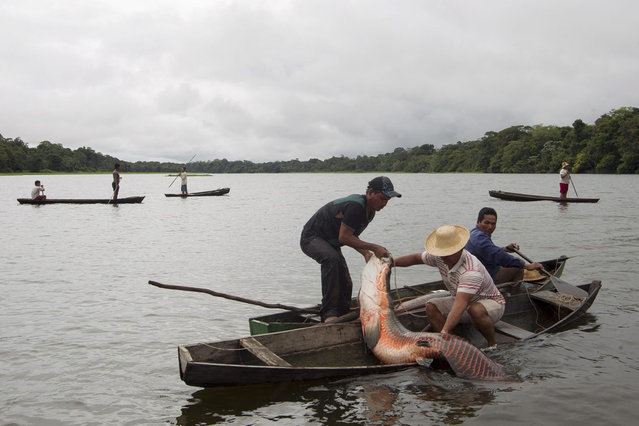
Villagers from the Porto Novo community load into their canoes arapaima or pirarucu, the largest freshwater fish species in South America and one of the largest in the world, while fishing in Poco Fundo lake along a branch of the Solimoes river, one of the main tributaries of the Amazon, in the Mamiraua nature reserve near Fonte Boa about 600 km (373 miles) west of Manaus, November 26, 2013. (Photo by Bruno Kelly/Reuters)

Villagers from the Porto Novo community load into their canoes arapaima or pirarucu, the largest freshwater fish species in South America and one of the largest in the world, while fishing in Poco Fundo lake along a branch of the Solimoes river, one of the main tributaries of the Amazon, in the Mamiraua nature reserve near Fonte Boa about 600 km (373 miles) west of Manaus, November 26, 2013. Catching the arapaima, a fish that is sought after for its meat and is considered by biologists to be a living fossil, is only allowed once a year by Brazil's environmental protection agency. The minimum size allowed for a fisherman to keep an arapaima is 1.5 meters (4.9 feet). (Photo by Bruno Kelly/Reuters)
Details
17 Dec 2013 08:03:00