Loading...
Done


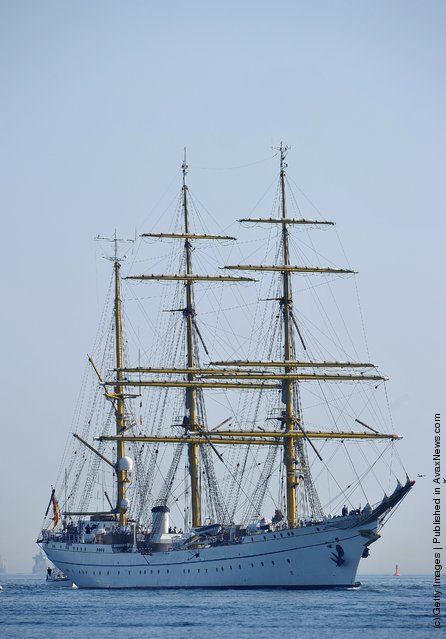
“The Gorch Fock is a tall ship of the German Navy (Deutsche Marine). She is the second ship of that name and a sister ship of the Gorch Fock built in 1933. Both ships are named in honor of the German writer Johann Kinau who wrote under the pseudonym "Gorch Fock" and died in the battle of Jutland/Skagerrak in 1916. The modern-day Gorch Fock was built in 1958 and has since then undertaken 146 cruises (as of October 2006), including one tour around the world in 1988. She is sometimes referred to (unofficially) as the Gorch Fock II to distinguish her from her older sister ship”. – Wikipedia

Photo: The “Gorch Fock” German Navy tall ship sails towards Kiel on May 6, 2011 in Kiel, Germany. The ship returns to Germany following investigations in January while it was in port in Ushuia, Argentina, into allegations of attempted mutiny following the death of a female crew member. German Defense Minister at the time Karl-Theodor zu Guttenberg suspended Captain Norbert Schatz, and though investigators absolved Schatz of wrongdoing, critics charge the investigation was inadequate. The "Gorch Fock" is the German Navy's flagship training vessel. (Photo by Stuart Franklin/Getty Images)
Details
06 May 2011 11:38:00
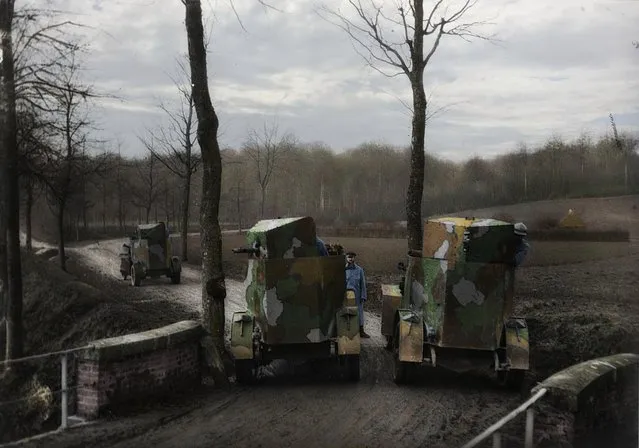
The expertly colourised shots were brought to life by French bank technician, Frédéric Duriez (51). The images were provided by the Valois collection which belongs to the BDIC. “By colourising these photos, I reduce the time that separates us today from this conflict”, said Frédéric. “A black and white photo does not attract the attention of young people, if you colour it, then people will look at it with curiosity. After this, we see the greater the misery and distress of these French fighters”. The total number of casualties in WW1 was more that 38 million. By the end of the war, over eight-million men had been called up to fight in the French army. France suffered 4.2 million casualties during the war with 1.3 million people dead. Here: Car cannon sections in firing position, Auxi-le-Château. (Photo by Frédéric Duriez/BDIC/Mediadrumworld.com)

The expertly colourised shots were brought to life by French bank technician, Frédéric Duriez (51). The images were provided by the Valois collection which belongs to the BDIC. “By colourising these photos, I reduce the time that separates us today from this conflict”, said Frédéric. Here: Car cannon sections in firing position, Auxi-le-Château. (Photo by Frédéric Duriez/BDIC/Mediadrumworld.com)
Details
03 May 2017 08:41:00
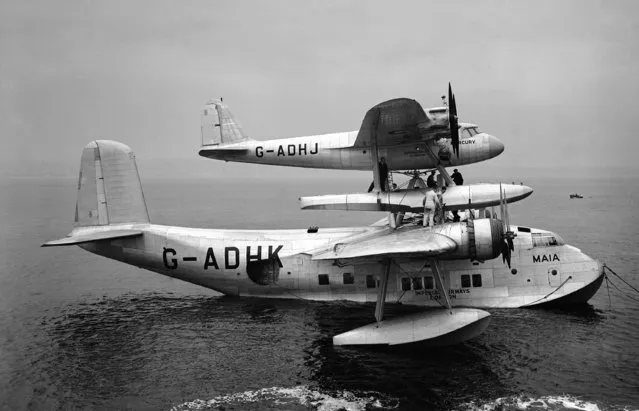
Mercury and Maia, fueled and overhauled, are waiting in the Tay at Dundee, for favorable weather to start the flight to the Cape, a distance of 6,370 miles. The composite machine moored in the Tay River, at Dundee, on September 23, 1938. (Photo by AP Photo)

Mercury and Maia, fueled and overhauled, are waiting in the Tay at Dundee, for favorable weather to start the flight to the Cape, a distance of 6,370 miles. The composite machine moored in the Tay River, at Dundee, on September 23, 1938. (Photo by AP Photo)
Details
04 Oct 2017 06:59:00
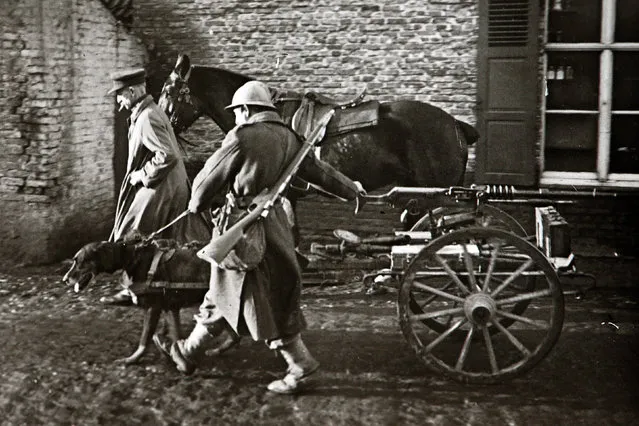
An undated archive picture shows a dog pulling a Belgian machine gun at an unknown location in northern France. (Photo by Collection Odette Carrez/Reuters)

An undated archive picture shows a dog pulling a Belgian machine gun at an unknown location in northern France. A Viscount in the Armoured Cavalry Branch of the French Army left behind a collection of hundreds of glass plates taken during World War One (WWI) that have never before been published. The images, by an unknown photographer, show the daily life of soldiers in the trenches, destruction of towns and military leaders. The year 2014 marks the 100th anniversary of the start of WWI. (Photo by Collection Odette Carrez/Reuters)
Details
23 May 2014 09:11:00
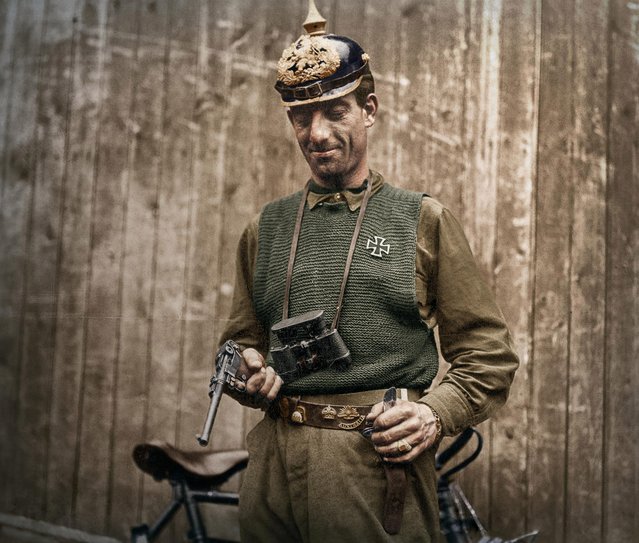
One image shows an unidentified American soldier posing with a pistol, helmet, and Iron Cross medal taken from a German soldier, 1918. (Photo by Mario Unger/Mediadrumworld)

The faces of war have been brought back to life after a series of World War One photographs were expertly colourised. The black and white snaps were painstakingly restored and colourised by photographer Mario Unger (53) from Rotenturm, Austria. Here: One image shows an unidentified American soldier posing with a pistol, helmet, and Iron Cross medal taken from a German soldier, 1918. (Photo by Mario Unger/Mediadrumworld)
Details
04 Dec 2017 07:47:00
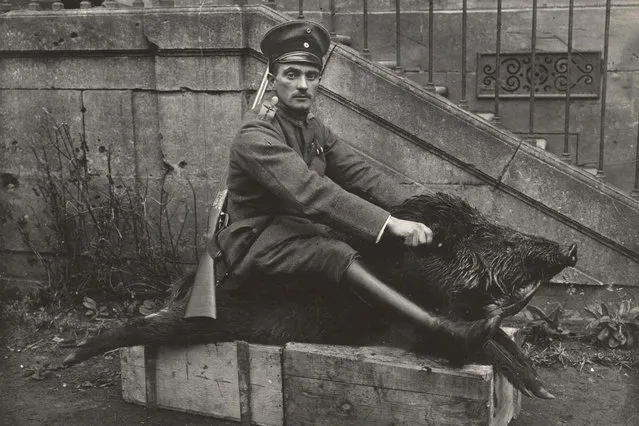
A German Air Force Officer sits astride a dead boar outside a house where he is stationed near the Western Front, in this 1918 handout picture. This picture is part of a previously unpublished set of World War One (WWI) images from a private collection. The pictures offer an unusual view of varied and contrasting aspects of the conflict, from high tech artillery to mobile pigeon lofts, and from officers partying in their headquarters to the grim reality of life and death in the trenches. The year 2014 marks the centenary of the start of the war. (Photo by Reuters/Archive of Modern Conflict London)

A German Air Force Officer sits astride a dead boar outside a house where he is stationed near the Western Front, in this 1918 handout picture. This picture is part of a previously unpublished set of World War One (WWI) images from a private collection. The pictures offer an unusual view of varied and contrasting aspects of the conflict, from high tech artillery to mobile pigeon lofts, and from officers partying in their headquarters to the grim reality of life and death in the trenches. The year 2014 marks the centenary of the start of the war. (Photo by Reuters/Archive of Modern Conflict London)
Details
26 Jun 2014 12:13:00
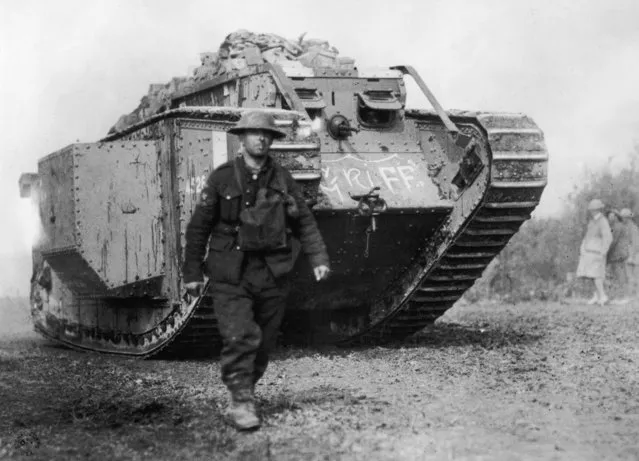
An American soldier walks ahead of an MKIV British-made tank, circa 1918. (Photo by Hulton Archive/Getty Images)

An American soldier walks ahead of an MKIV (Mark IV) British-made tank, circa 1918. (Photo by Hulton Archive/Getty Images)
Details
16 Nov 2018 00:05:00


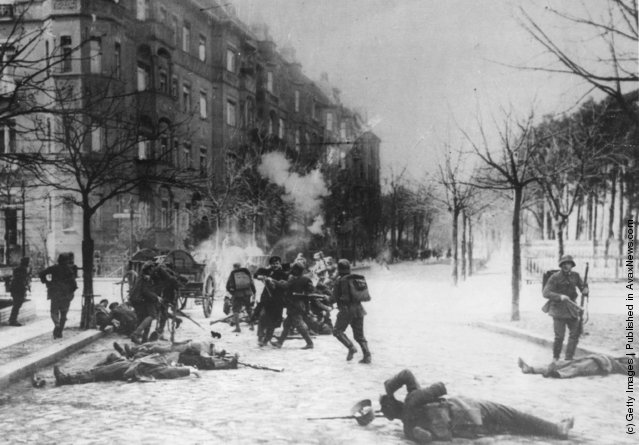
Street fighting in Berlin between Government troops and Spartacists, during the Spartacist uprising which followed Germany's defeat in World War I. (Photo by Keystone/Getty Images). 1919
Details
03 May 2011 09:09:00