Loading...
Done
Aline, along with other rangers and park staff visit the gorilla's in the parks Mikeno sector, where the majority of the gorilla families live in Virunga National Park. Therefore there has been a surge of poaching and violence in the area. For the first time, women have taken up the most dangerous job in wildlife, becoming para-military rangers at the Virunga National Park in DR Congo. Virunga is Africa's oldest national park and home to over 200 of the world's 800 remaining mountain gorillas. For two decades it has been at the centre of a war. Hundreds of rebels operate in the park and over 150 park rangers have died protecting it from them. (Photo by Monique Jaques)

Aline, along with other rangers and park staff visit the gorilla's in the parks Mikeno sector, where the majority of the gorilla families live in Virunga National Park. Therefore there has been a surge of poaching and violence in the area. For the first time, women have taken up the most dangerous job in wildlife, becoming para-military rangers at the Virunga National Park in DR Congo. (Photo by Monique Jaques)
Details
08 Oct 2016 11:46:00
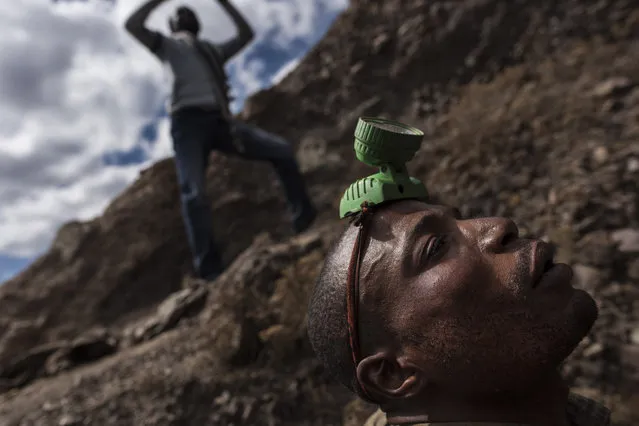
A “creuseur”, or digger, a plastic lantern on his head, readies to enter a copper and cobalt mine in Kawama, Democratic Republic of Congo on June 8, 2016. Cobalt is used in the batteries for electric cars and mobile phones. Working conditions are dangerous, often with no safety equipment or structural support for the tunnels. The diggers say they are paid on average US$2-3/day. (Photo by Michael Robinson Chavez/The Washington Post)

A “creuseur”, or digger, a plastic lantern on his head, readies to enter a copper and cobalt mine in Kawama, Democratic Republic of Congo on June 8, 2016. Cobalt is used in the batteries for electric cars and mobile phones. Working conditions are dangerous, often with no safety equipment or structural support for the tunnels. The diggers say they are paid on average US$2-3/day. (Photo by Michael Robinson Chavez/The Washington Post)
Details
30 Dec 2016 10:29:00
Fangtooth Moray

The Fangtooth Moray (sometimes Tiger Moray) is a moray eel of the family Muraenidae found throughout the eastern Atlantic Ocean, including the Canary Islands and Madeira. The Fangtooth Moray is distinctive for its bright yellow colouring and elongated jaw, which is filled with a large number of long "glasslike" teeth. It can reach up to 120 cm in length.
Details
06 Jun 2014 10:36:00
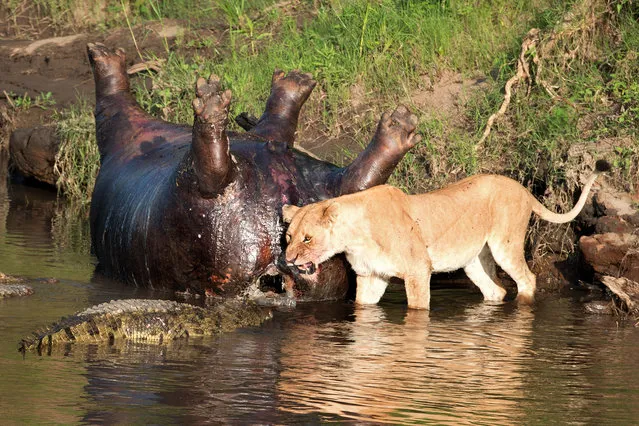
Lion fights crocs over hippo. (Photo by Richard Chew/Caters News)

“These photographs show the food chain in action as a hungry lion braved a river full of crocodiles to try and sink his teeth into a dead hippo. The photos were taken in the Maasi Mara nature reserve, in Kenya and show hungry lion braving a crocodile-infested river to get to an upside down hippo, which had died overnight of natural causes”. – Caters News. (Photo by Richard Chew/Caters News)
Details
25 Mar 2014 11:09:00
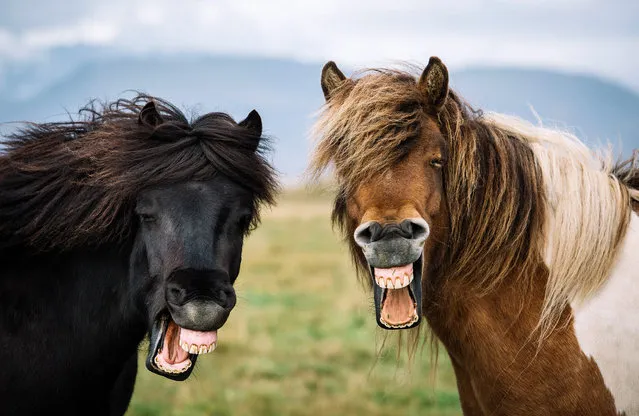
Two horses appear to burst into laughter before a sweet embrace. The horses both turn their head to look at the camera and flash their teeth, treating the lucky photographer to a rare shot. Moments later the pair show their affectionate side by coming together and “hugging”. Photographer Nir Amos, 34, said he was “amazed” to capture the horses “laughing” in a field near Skógar, in the south east of Iceland on July 31, 2018. (Photo by Nir Amos/Solent News & Photo Agency)

Two horses appear to burst into laughter before a sweet embrace. The horses both turn their head to look at the camera and flash their teeth, treating the lucky photographer to a rare shot. Moments later the pair show their affectionate side by coming together and “hugging”. Photographer Nir Amos, 34, said he was “amazed” to capture the horses “laughing” in a field near Skógar, in the south east of Iceland on July 31, 2018. (Photo by Nir Amos/Solent News & Photo Agency)
Details
05 Aug 2018 00:03:00
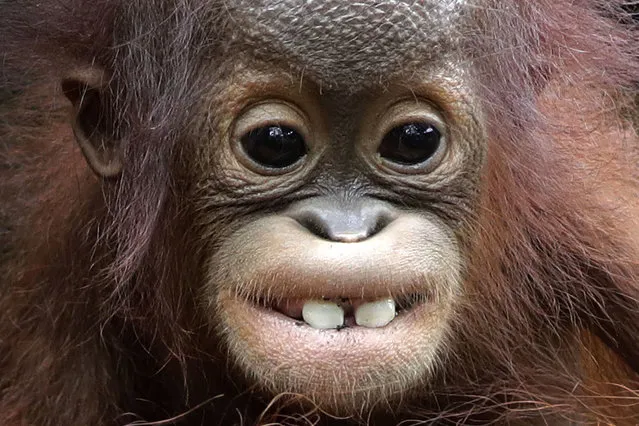
Khansa, an eight month old critically endangered Bornean orangutan shows off it's two front-teeth, at the Singapore Zoo on Thursday, January 11, 2018 in Singapore. The Singapore Zoo is active with its breeding programs as part of its wildlife preservation efforts. This is the Zoo's 46th successful orangutan birth. (Photo by Wong Maye-E/AP Photo)

Khansa, an eight month old critically endangered Bornean orangutan shows off it's two front-teeth, at the Singapore Zoo on Thursday, January 11, 2018 in Singapore. The Singapore Zoo is active with its breeding programs as part of its wildlife preservation efforts. This is the Zoo's 46th successful orangutan birth. (Photo by Wong Maye-E/AP Photo)
Details
14 Jan 2018 08:17:00
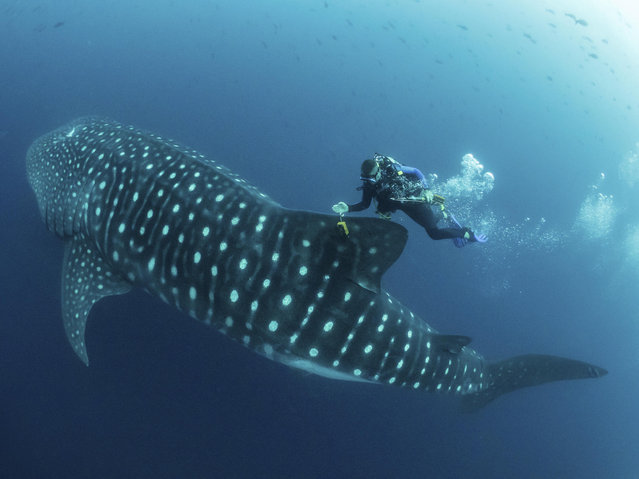
In this 2017 photo provided by Simon Pierce, Jonathan Green checks on a fin-mounted satellite tag on a whale shark in the Galapagos Islands area of Ecuador.  Despite typically being bigger than a double-decker bus, the elusive whale shark has only tiny, almost useless teeth. It's also one of the least understood animals in the ocean. (Photo by Simonjpierce.com via AP Photo)

In this 2017 photo provided by Simon Pierce, Jonathan Green checks on a fin-mounted satellite tag on a whale shark in the Galapagos Islands area of Ecuador. Despite typically being bigger than a double-decker bus, the elusive whale shark has only tiny, almost useless teeth. It's also one of the least understood animals in the ocean. (Photo by Simonjpierce.com via AP Photo)
Details
02 Mar 2018 00:03:00
A 40-tonne humpback launching out of the water in an incredible breach in New South Wales, Australia on October 2022 in front of a sunset. The humpback whale can grow up to 56 feet long and typically covers 9,900 miles a year as it travels through the oceans of the world. Humpback whales are a species of Baleen whale, meaning they don't have teeth. Instead, they have baleen which helps them to filter feed. Their main source of food is krill or tiny bait fish. (Photo by Jodie Lowe/Media Drum Images)

A 40-tonne humpback launching out of the water in an incredible breach in New South Wales, Australia on October 2022 in front of a sunset. The humpback whale can grow up to 56 feet long and typically covers 9,900 miles a year as it travels through the oceans of the world. Humpback whales are a species of Baleen whale, meaning they don't have teeth. Instead, they have baleen which helps them to filter feed. Their main source of food is krill or tiny bait fish. (Photo by Jodie Lowe/Media Drum Images)
Details
30 Oct 2022 04:28:00