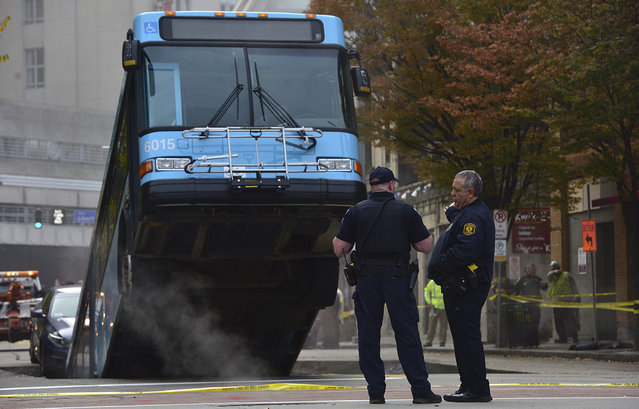
Pittsburgh police officers stand near a Port Authority bus that had fallen into a sinkhole along 10th Street and Penn Avenue in Pittsburgh on Monday, October 28, 2019. The bus and a car fell in the sinkhole shortly before 8 a.m. One person was taken to the hospital for a minor injury. (Photo by Kristina Serafini/Pittsburgh Tribune-Review via AP Photo)
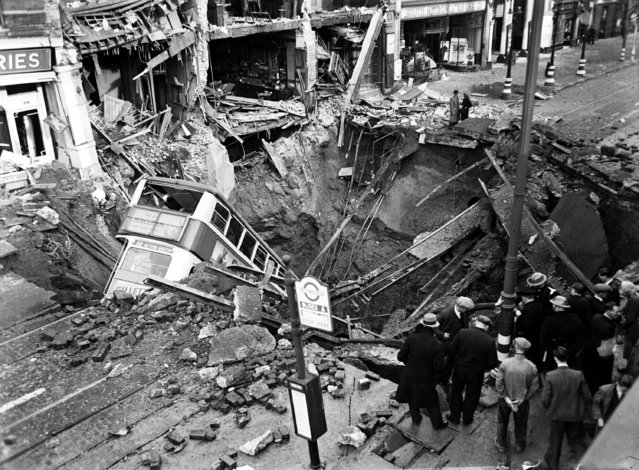
Following a large air raid by German bombers, local people, coming out of their air raid shelters found a bus standing on end in a large crater, in Balham, London, October 15, 1940. (Photo by AP Photo)
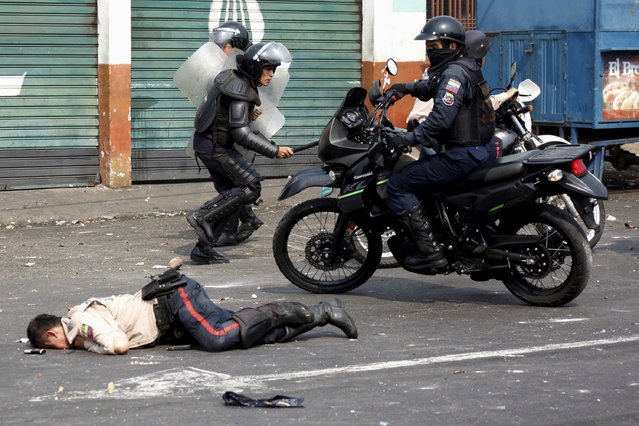
A police officer lies on the street after being run over by a bus during a protest against the increase in the price of public transport in San Cristobal, Venezuela March 29, 2016. (Photo by Carlos Eduardo Ramirez/Reuters)
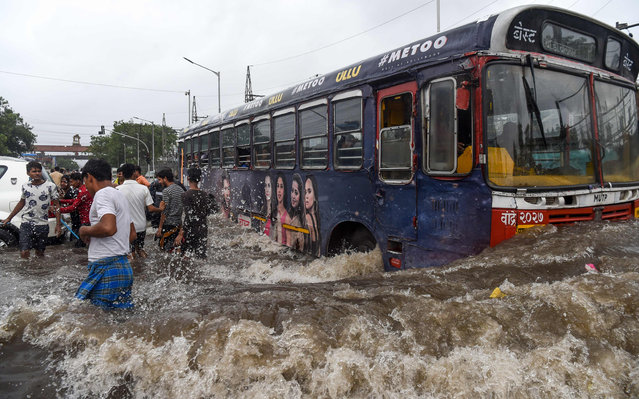
A public bus makes its way on a flooded road after heavy monsoon rains in Mumbai, India on August 4, 2019. India receives its monsoon rains from June to September. (Photo by Indranil Mukherjee/AFP Photo)
A woman wearing a protective mask stands as she waits for the bus at the sidewalk, after Indonesia confirmed its first cases of coronavirus, in Jakarta, Indonesia, March 4, 2020. (Photo by Willy Kurniawan/Reuters)
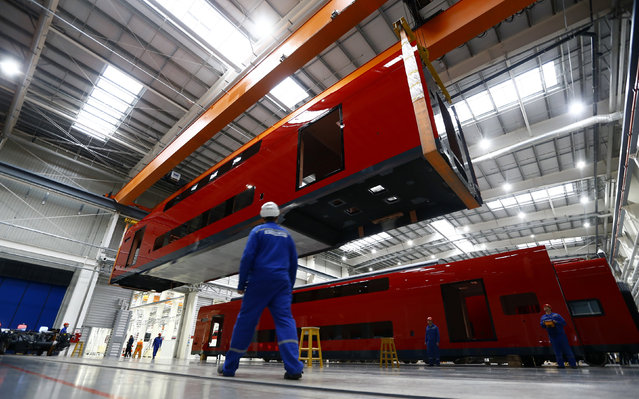
Employees work on an electric train assembly line at the “Stadler Minsk” plant in Fanipol, Belarus February 10, 2016. (Photo by Vasily Fedosenko/Reuters)
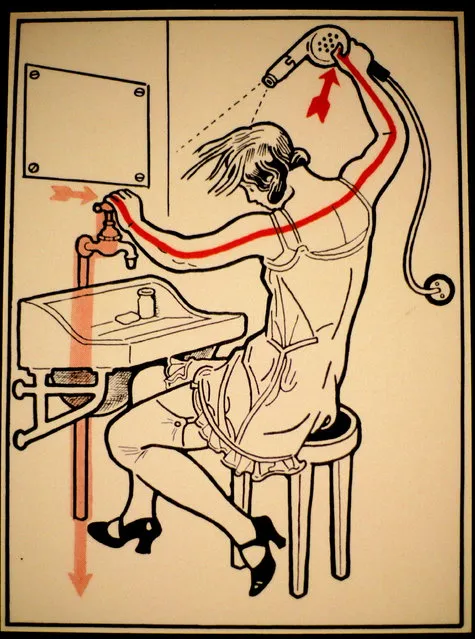
The book “Elektroschutz in 132 Bildern” (Electrical Protection in 132 Pictures) was published in Vienna in the early 1900s by a Viennese physician named Stefan Jellinek (1878-1968, a founder of the Electro-Pathological Museum). The pictures are nice and direct and unambiguous; they teach, graphically, that the surest way to kill yourself with electricity is to form a complete path from source (usually the bright red arrow) to ground (the screened back, pink arrow). Arrowheads provide the path for current flow. (Photo by The Vienna Technical Museum)