Loading...
Done
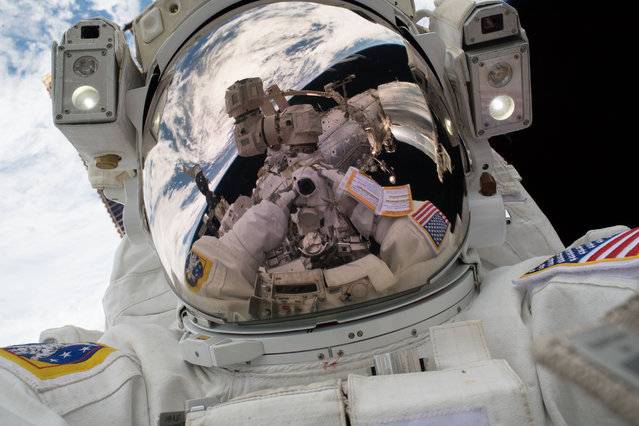
Spacewalker Mark Vande Hei took his own photograph during the first spacewalk of 2018,  on January 23, 2018. These sky-high pictures are better known as “space-selfies”. (Photo by Mark Vande Hei/NASA)

Spacewalker Mark Vande Hei took his own photograph during the first spacewalk of 2018, on January 23, 2018. These sky-high pictures are better known as “space-selfies”. (Photo by Mark Vande Hei/NASA)
Details
05 Feb 2018 06:27:00
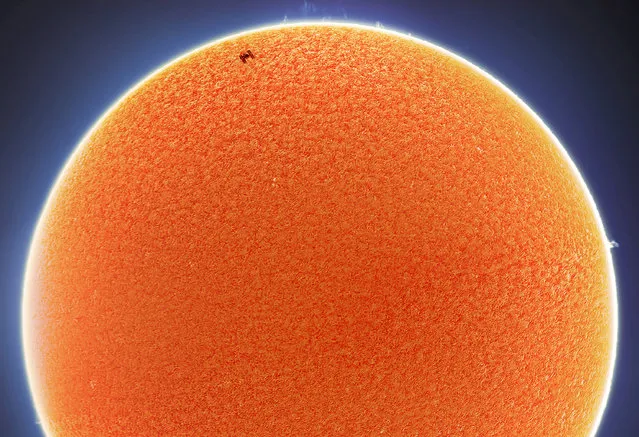
The International Space Station (ISS) moving in front of the sun in November 2020 by astrophotographer Andrew McCarthy. These incredible photos capture the clearest images ever taken of the International Space Station (ISS) moving in front of both the moon and the sun. The photos, taken within days of one another, were captured in the space of less than a second, as the space station could be clearly seen zooming across against the bright backdrops of both moon and sun. Photographer Andrew McCarthy, from California, USA, said the photo of the ISS in front of the sun, in broad daylight, was “one of my trickiest shots ever”. (Photo by Andrew McCarthy/South West News Service)

The International Space Station (ISS) moving in front of the sun in November 2020 by astrophotographer Andrew McCarthy. These incredible photos capture the clearest images ever taken of the International Space Station (ISS) moving in front of both the moon and the sun. The photos, taken within days of one another, were captured in the space of less than a second, as the space station could be clearly seen zooming across against the bright backdrops of both moon and sun. Photographer Andrew McCarthy, from California, USA, said the photo of the ISS in front of the sun, in broad daylight, was “one of my trickiest shots ever”. (Photo by Andrew McCarthy/South West News Service)
Details
28 Nov 2020 00:05:00
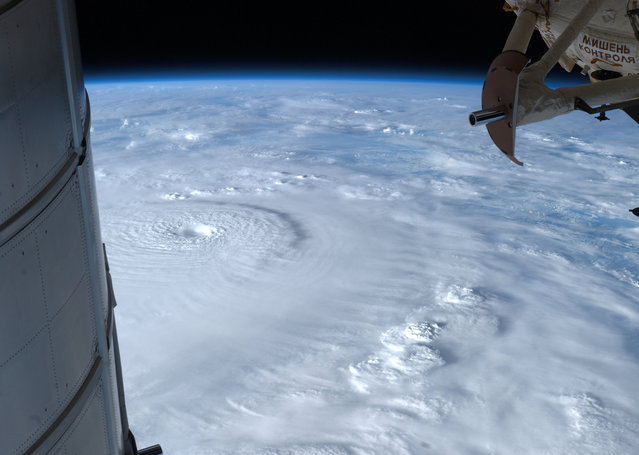
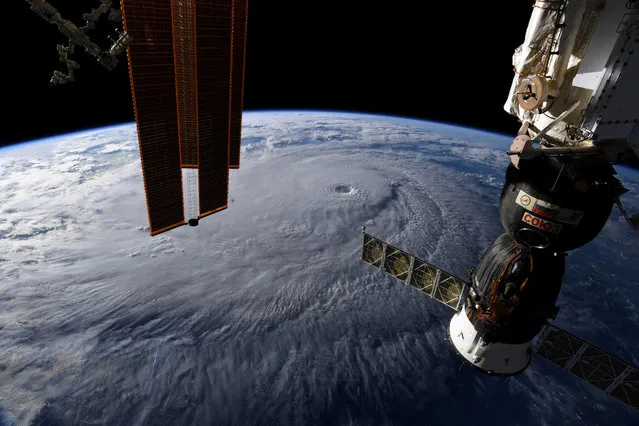
A photo taken from the International Space Station shows Hurricane Lane in the early morning hours near Hawaii, August 22, 2018. (Photo by Courtesy @astro_ricky/NASA/Handout via Reuters)

A photo taken from the International Space Station shows Hurricane Lane in the early morning hours near Hawaii, August 22, 2018. (Photo by Courtesy @astro_ricky/NASA/Handout via Reuters)
Details
01 Jan 2019 00:01:00
Typhoon Bopha moves toward the Philippines, observed from the ISS, on December 2, 2012. (Photo by AP Photo/NASA/The Atlantic)

Typhoon Bopha moves toward the Philippines, observed from the ISS, on December 2, 2012. (Photo by AP Photo/NASA via The Atlantic)
Details
02 Apr 2013 12:22:00
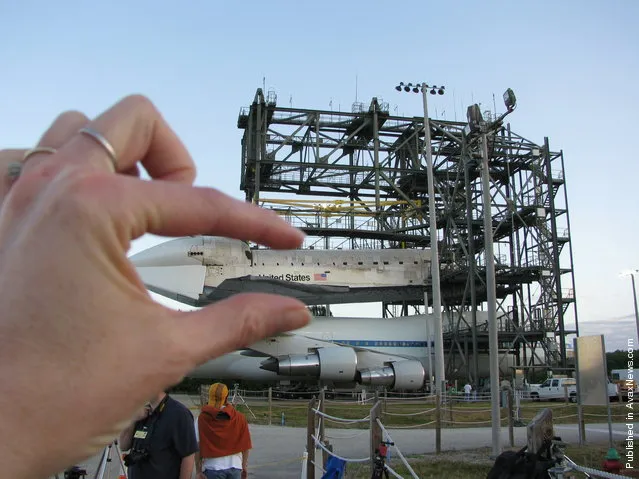
Space shuttle Discovery sits atop NASA's 747 Shuttle Carrier Aircraft (SCA) ready to transport it from Kennedy Space Center to the Washington D.C.

Space shuttle Discovery sits atop NASA's 747 Shuttle Carrier Aircraft (SCA) ready to transport it from Kennedy Space Center to the Washington D.C., on April 17, 2012 in Cape Canaveral, Florida. Following the retirement of the shuttle fleet, Discovery will fly to Washington for display at the Smithsonian's National Air and Space Museum. (Photo by Lofty Ambitions)
Details
19 Apr 2012 12:39:00


Soviet cosmonaut and the first man to travel in space, Yury Alekseyvich Gagarin (1934–1968) arriving in London for a Russian trade fair. (Photo by Douglas Miller/Getty Images)
Details
11 Apr 2011 10:24:00
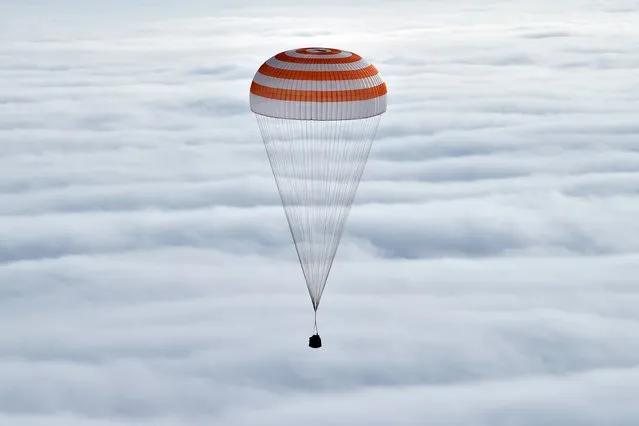
A Soyuz capsule carrying International Space Station (ISS) crew members U.S. astronaut Scott Kelly, Russian cosmonauts Sergei Volkov and Mikhail Korniyenko descends beneath a parachute near the town of Dzhezkazgan (Zhezkazgan), Kazakhstan, March 2, 2016. (Photo by Kirill Kudryavtsev/Reuters)

A Soyuz capsule carrying International Space Station (ISS) crew members U.S. astronaut Scott Kelly, Russian cosmonauts Sergei Volkov and Mikhail Korniyenko descends beneath a parachute near the town of Dzhezkazgan (Zhezkazgan), Kazakhstan, March 2, 2016. (Photo by Kirill Kudryavtsev/Reuters)
Details
03 Mar 2016 11:12:00
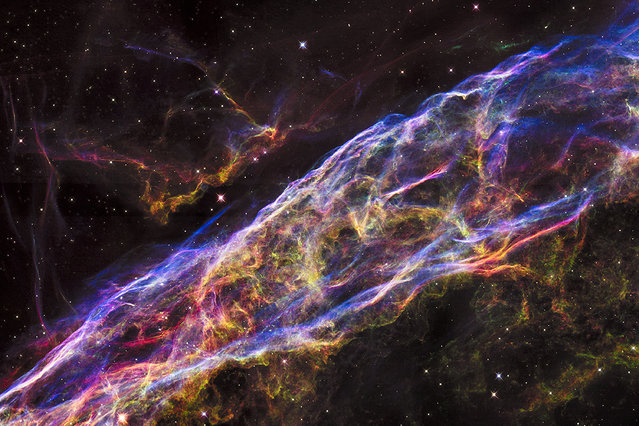
A small section of the expanding remains of the Veil Nebula, a massive star that exploded about 8,000 years ago. The entire nebula is 110 light-years across, covering six full moons on the sky as seen from Earth, and resides about 2,100 light-years away in the constellation Cygnus, the Swan. Image taken by NASA's Hubble Space Telescope. Released September 24, 2015. (Photo by Reuters/NASA/ESA/Hubble Heritage Team)

A small section of the expanding remains of the Veil Nebula, a massive star that exploded about 8,000 years ago. The entire nebula is 110 light-years across, covering six full moons on the sky as seen from Earth, and resides about 2,100 light-years away in the constellation Cygnus, the Swan. Image taken by NASA's Hubble Space Telescope. Released September 24, 2015. (Photo by Reuters/NASA/ESA/Hubble Heritage Team)
Details
10 Dec 2015 08:01:00