Loading...
Done
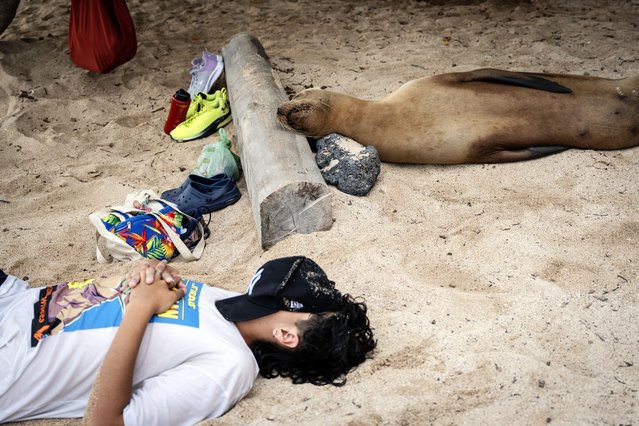
Sea lion is seen among people on a beach in San Cristobal island, part of Galapagos archipelago on February 11, 2025. Located in Ecuadorone of South America's most fascinating countriesthe Galapagos National Park spans 13 main islands and numerous islets, captivating biologists, environmental scientists, and tourists with its rich ecology. (Photo by Ozge Elif Kizil/Anadolu via Getty Images)

Sea lion is seen among people on a beach in San Cristobal island, part of Galapagos archipelago on February 11, 2025. Located in Ecuadorone of South America's most fascinating countriesthe Galapagos National Park spans 13 main islands and numerous islets, captivating biologists, environmental scientists, and tourists with its rich ecology. (Photo by Ozge Elif Kizil/Anadolu via Getty Images)
Details
13 Apr 2025 03:15:00
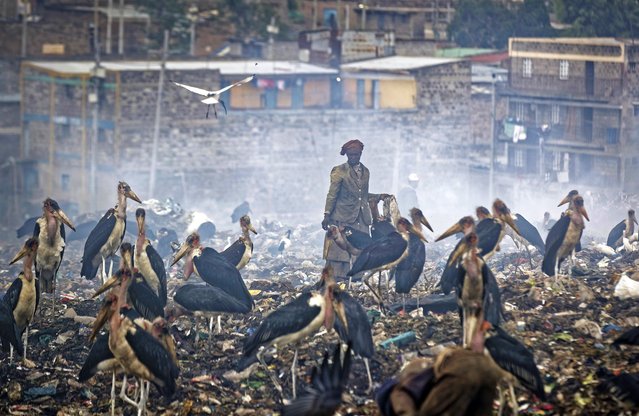
In this photo taken Wednesday, December 5, 2018, a woman who scavenges recyclable materials from garbage for a living is seen through a cloud of smoke from burning trash, surrounded by Marabou storks who feed on the garbage, at the dump in the Dandora slum of Nairobi, Kenya. As the world meets again to tackle the growing threat of climate change, how the continent tackles the growing solid waste produced by its more than 1.2 billion residents, many of them eager consumers in growing economies, is a major question in the fight against climate change. (Photo by Ben Curtis/AP Photo)

In this photo taken Wednesday, December 5, 2018, a woman who scavenges recyclable materials from garbage for a living is seen through a cloud of smoke from burning trash, surrounded by Marabou storks who feed on the garbage, at the dump in the Dandora slum of Nairobi, Kenya. As the world meets again to tackle the growing threat of climate change, how the continent tackles the growing solid waste produced by its more than 1.2 billion residents, many of them eager consumers in growing economies, is a major question in the fight against climate change. (Photo by Ben Curtis/AP Photo)
Details
14 Jan 2019 00:01:00
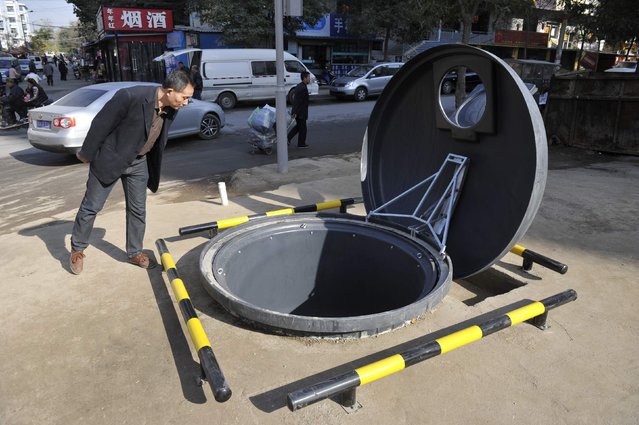
A resident looks into a newly-built giant trash can, partially buried underground, next to a street in Taiyuan, Shanxi province November 6, 2014. The trash can, which has a diameter of 1.9 meters and a depth of 2.8 meters, could contain approximately 10 cubic metres of garbage. It was built to replace an open-air garbage dump site, local media reported. (Photo by Reuters/Stringer)

A resident looks into a newly-built giant trash can, partially buried underground, next to a street in Taiyuan, Shanxi province November 6, 2014. The trash can, which has a diameter of 1.9 meters and a depth of 2.8 meters, could contain approximately 10 cubic metres of garbage. It was built to replace an open-air garbage dump site, local media reported. (Photo by Reuters/Stringer)
Details
08 Nov 2014 12:40:00
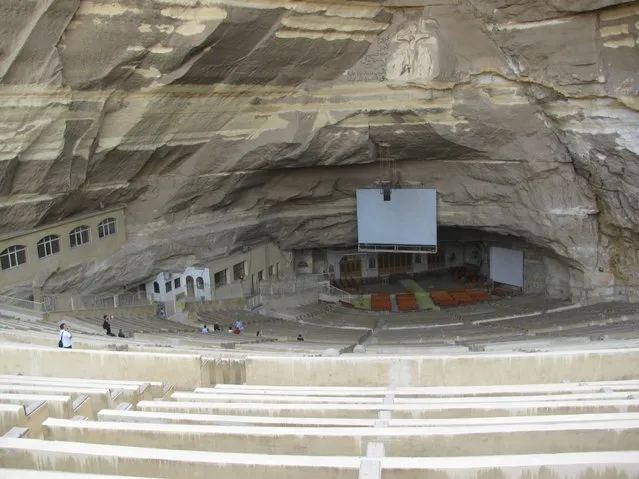
Cave Church Mountain

Located in the Mokattam Mountain in southeastern Cairo, Egypt, the Monastery of Saint Simon or the Cave Church is a beautiful and mystical location. The area is also known under the name of the “garbage city” because of the large population of garbage collectors or Zabbaleen that live here and who are the descendants of farmers who started migrating from Upper Egypt to Cairo in the 1940s.
Details
25 Sep 2013 12:58:00
Two Afghan children  stand amid piles of garbage next to their home, in Kabul, Afghanistan, Monday, April 18, 2022. (Photo by Ebrahim Noroozi/AP Photo)

Two Afghan children stand amid piles of garbage next to their home, in Kabul, Afghanistan, Monday, April 18, 2022. (Photo by Ebrahim Noroozi/AP Photo)
Details
22 Apr 2022 06:25:00
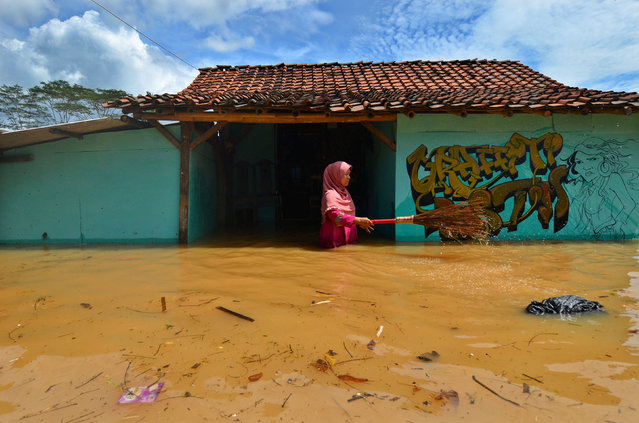
A woman villager cleans garbage in front of her house as flood hits Tanjungsari village in Tasikmalaya, Indonesia, February 23, 2018. (Photo by Adeng Bustomi/Reuters/Antara Foto)

A woman villager cleans garbage in front of her house as flood hits Tanjungsari village in Tasikmalaya, Indonesia, February 23, 2018. (Photo by Adeng Bustomi/Reuters/Antara Foto)
Details
24 Feb 2018 06:10:00


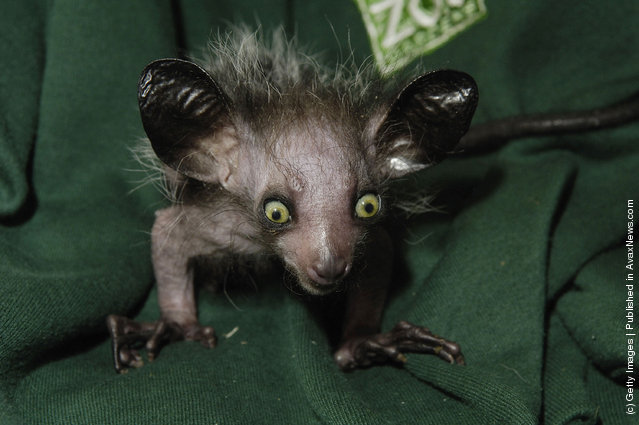
“The aye-aye (Daubentonia madagascariensis) is a lemur, a strepsirrhine primate native to Madagascar that combines rodent-like teeth and a special thin middle finger to fill the same ecological niche as a woodpecker. It is the world's largest nocturnal primate, and is characterized by its unusual method of finding food; it taps on trees to find grubs, then gnaws holes in the wood and inserts its narrow middle finger to pull the grubs out. The only other animal species known to find food in this way is the striped possum. From an ecological point of view the aye-aye fills the niche of a woodpecker as it is capable of penetrating wood to extract the invertebrates within”. – Wikipedia

Photo: In this handout image from Bristol Zoo is seen the first captive bred aye-aye in the UK named “Kintana” (meaning star in Malagasy) April 15, 2005 at Bristol Zoo Gardens, England. The zoo announced today only the second baby aye-aye to be hand-reared in the world (the first was in Jersey Zoo) and has now made his first public appearance since his birth on 11 February 2005. (Photo by Rob Cousins/Bristol Zoo via Getty Images)
Details
13 Apr 2011 13:33:00
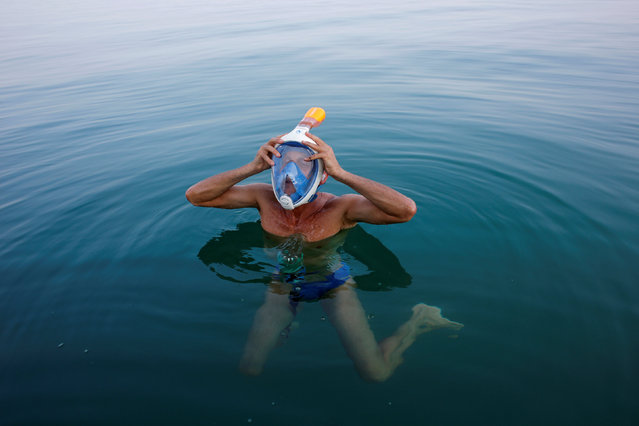
An environmental activist adjusts his mask while taking part in “The Dead Sea Swim Challenge”, swimming from the Jordanian to Israeli shore, to draw attention to the ecological threats facing the Dead Sea, in Kibbutz Ein Gedi, Israel November 15, 2016. (Photo by Nir Elias/Reuters)

An environmental activist adjusts his mask while taking part in “The Dead Sea Swim Challenge”, swimming from the Jordanian to Israeli shore, to draw attention to the ecological threats facing the Dead Sea, in Kibbutz Ein Gedi, Israel November 15, 2016. Swimmers from around the world plunged into the salty waters of the Dead Sea on Tuesday to attempt a seven-hour swim across the fabled lake in a bid to draw attention to its environmental degradation. Wearing protective masks and snorkels, 25 swimmers paddled through the muddy water to attempt the 9-mile (15-kilometer) swim from Jordan to Israel. (Photo by Nir Elias/Reuters)
Details
16 Nov 2016 10:59:00