Loading...
Done
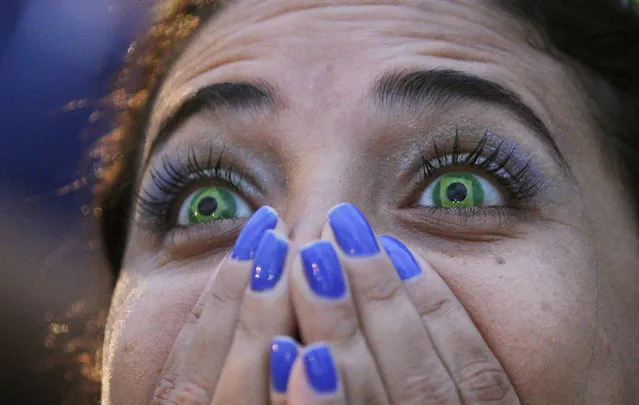
A Brazil soccer fan wearing contact lenses that mimic the Brazilian flag reacts as she watches her team play Germany in a World Cup semifinal game via live telecast inside the FIFA Fan Fest area on Copacabana beach in Rio de Janeiro, Brazil, Tuesday, July 8, 2014. (Photo by Leo Correa/AP Photo)

A Brazil soccer fan wearing contact lenses that mimic the Brazilian flag reacts as she watches her team play Germany in a World Cup semifinal game via live telecast inside the FIFA Fan Fest area on Copacabana beach in Rio de Janeiro, Brazil, Tuesday, July 8, 2014. (Photo by Leo Correa/AP Photo)
Details
09 Jul 2014 13:24:00


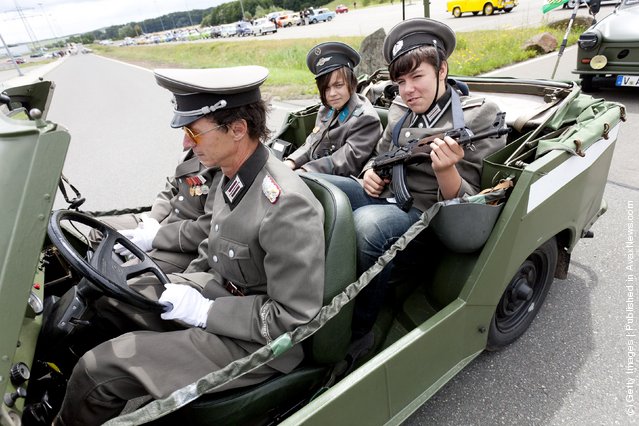
“The Trabant is a car that was produced by former East German auto maker VEB Sachsenring Automobilwerke Zwickau in Zwickau, Sachsen. It was the most common vehicle in East Germany, and was also exported to countries both inside and outside the communist bloc. The main selling points was that it had room for four adults and luggage in a compact, light and durable shell and that it was fast (when introduced) and durable. With its mediocre performance, smoky two-stroke engine, and production shortages, the Trabant is often cited as an example of the disadvantages of centralized planning; on the other hand, it is regarded with derisive affection as a symbol of the failed former East Germany and of the fall of communism (in former West Germany, as many East Germans streamed into West Berlin and West Germany in their Trabants after the opening of the Berlin Wall in 1989). It was in production without any significant changes for nearly 30 years with 3,096,099 Trabants produced in total”. – Wikipedia

Photo: Enthusiasts weared in uniforms of the former eastern german army trive in a military Trabant car as fans and owners of East German-era Trabant cars gather at the 2011 International Trabantfahrer Treffen (International Trabant Drivers Meeting) on June 26, 2011 in Zwickau, Germany. The Trabant, also known as the Trabi, was among the main cars produced in communist East Germany and built by VEB Sachsenring Automobilwerke in Zwickau for 30 years until 1989. Today the car has cult status for many followers and one company, IndiKar, is even seeking to revive the brand in a modern, electric version. (Photo by Carsten Koall/Getty Images)

Details
27 Jun 2011 12:21:00


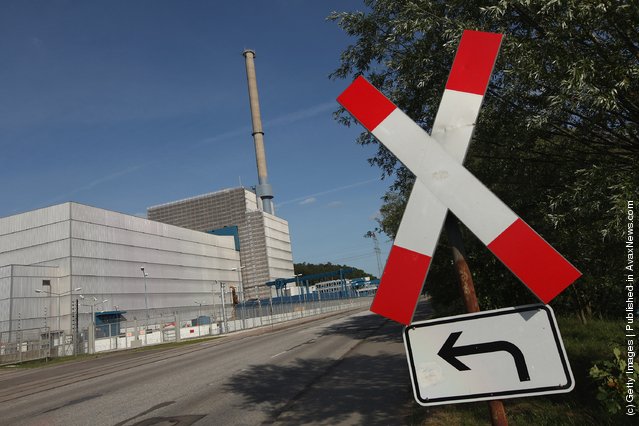
A sign marks a railway crossing next to the troubled Kruemmel nuclear power plant on June 2, 2011 in Geesthacht, Germany. The German government recently announced it will phase out the country's 17 remaining nuclear reactors by 2022 in a policy initiative that represents a radical reversal from its previous policy and was sparked by the disaster at Fukushima. Kruemmel went into operation in 1983 but was taken offline following a fire in 2007. (Photo by Sean Gallup/Getty Images)
Details
03 Jun 2011 09:12:00
“Jessica”, a silicon s*x doll for sexual encounters lies on a bed at the “Bordoll” brothel on April 17, 2019 in Dortmund, Germany. (Photo by Lukas Schulze/Bongarts/Getty Images)

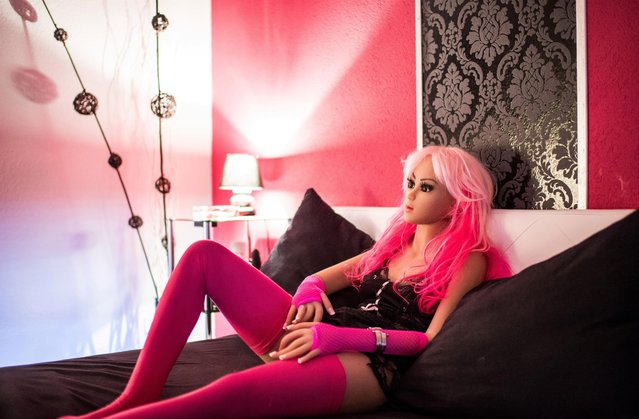
“Jessica”, a silicon sеx doll for sexual encounters lies on a bed at the “Bordoll” brothel on April 17, 2019 in Dortmund, Germany. Bordoll is Germany's first brothel to specialize in sеx dolls. It currently offers 13 female dolls and one male doll and will soon be expanding its female line-up. Schwarz says “sеx dolls are so popular because the client can do what he wants to and nobody complains”. (Photo by Lukas Schulze/Bongarts/Getty Images)
Details
19 Apr 2018 00:03:00
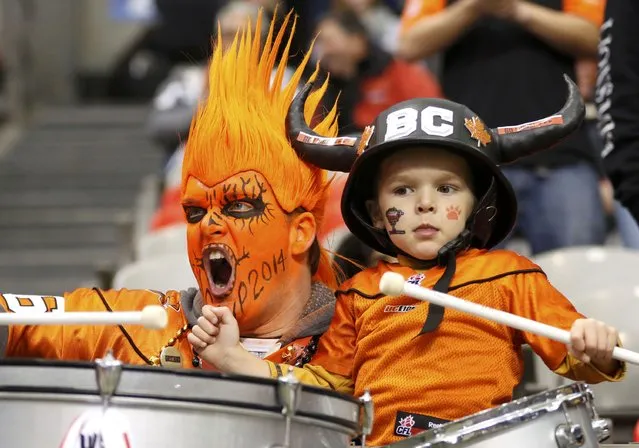
Fans cheer in the stands ahead of  the CFL's 102nd Grey Cup football championship between the Calgary Stampeders and the Hamilton Tiger Cats in Vancouver, British Columbia, November 30, 2014. (Photo by Todd Korol/Reuters)

Fans cheer in the stands ahead of the CFL's 102nd Grey Cup football championship between the Calgary Stampeders and the Hamilton Tiger Cats in Vancouver, British Columbia, November 30, 2014. (Photo by Todd Korol/Reuters)
Details
02 Dec 2014 11:38:00
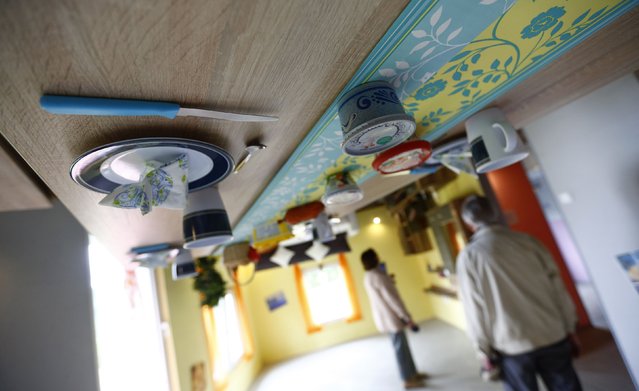
Visitors walk past the fully equipped dining table inside the “Crazy House”, which is completely built upside-down, in the village of Affoldern near the Edersee lake, May 7, 2014. Three friends came up with the idea to build the tourist attraction, which cost about 200,000 euros and took some six weeks to complete. (Photo by Kai Pfaffenbach/Reuters)

Visitors walk past the fully equipped dining table inside the “Crazy House”, which is completely built upside-down, in the village of Affoldern near the Edersee lake, May 7, 2014. Three friends came up with the idea to build the tourist attraction, which cost about 200,000 euros and took some six weeks to complete. (Photo by Kai Pfaffenbach/Reuters)
Details
11 May 2014 12:15:00
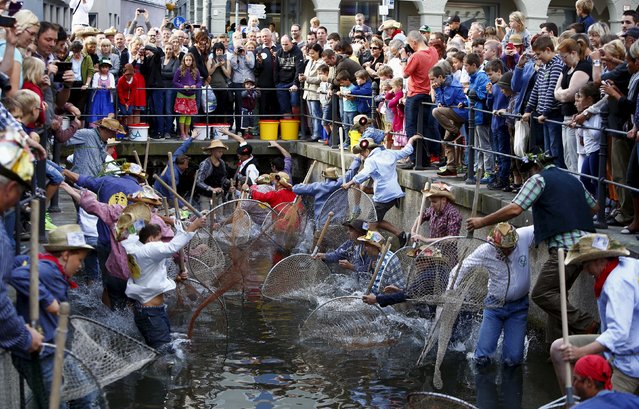
Fishermen jump into a small river to catch trout as they celebrate Fischertag (Fisherman's Day) in downtown Memmingen, southern Germany, July 25, 2015. The annual Fisherman's Day (Fischertag) tradition goes back to the year of 1465 where every fisherman who were born in Memmingen tries to catch trout from the river. The participant who catches the biggest trout will be named the “Fisher King” for one year. (Photo by Michaela Rehle/Reuters)

Fishermen jump into a small river to catch trout as they celebrate Fischertag (Fisherman's Day) in downtown Memmingen, southern Germany, July 25, 2015. The annual Fisherman's Day (Fischertag) tradition goes back to the year of 1465 where every fisherman who were born in Memmingen tries to catch trout from the river. The participant who catches the biggest trout will be named the “Fisher King” for one year. (Photo by Michaela Rehle/Reuters)
Details
26 Jul 2015 10:37:00
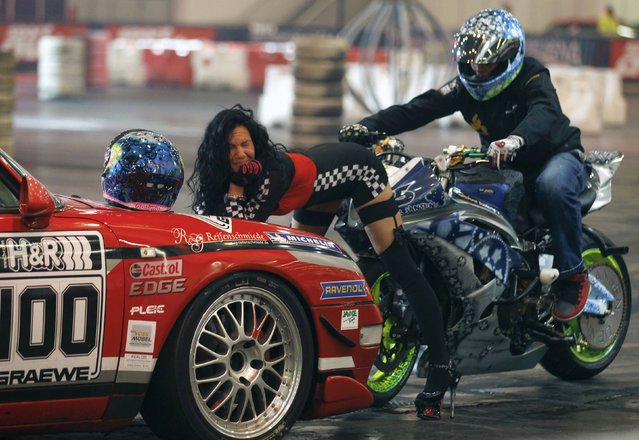
A model poses with a motorcycle and a car on a racing track at the Essen Motor Show in Essen, Germany, November 27, 2015. (Photo by Ina Fassbender/Reuters)

A model poses with a motorcycle and a car on a racing track at the Essen Motor Show in Essen, Germany, November 27, 2015. (Photo by Ina Fassbender/Reuters)
Details
29 Nov 2015 08:03:00