Loading...
Done
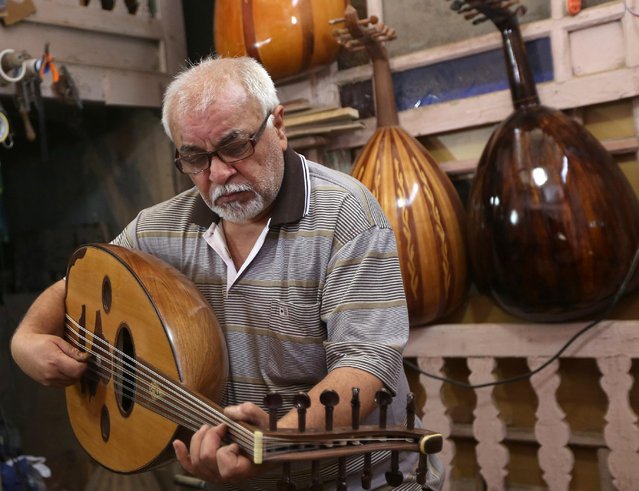
In this photo taken Saturday, June 20, 2015, Mahmoud Abdulnabi tries out an oud, an Arabic instrument related to the lute, at his workshop in Baghdad, Iraq. “The oud is different than other musical instruments”, said Abdulnabi, who has crafted ouds played by some of Iraq's best known musicians, many of whom look down from headshots on the walls. “If you feel joyful, it can play your joy. If the circumstances are sad it can play your sorrow and... help to empty whatever is in your chest”. (Photo by Hadi Mizban/AP Photo)

In this photo taken Saturday, June 20, 2015, Mahmoud Abdulnabi tries out an oud, an Arabic instrument related to the lute, at his workshop in Baghdad, Iraq. “The oud is different than other musical instruments”, said Abdulnabi, who has crafted ouds played by some of Iraq's best known musicians, many of whom look down from headshots on the walls. “If you feel joyful, it can play your joy. If the circumstances are sad it can play your sorrow and... help to empty whatever is in your chest”. (Photo by Hadi Mizban/AP Photo)
Details
05 Jul 2015 10:32:00
Hindu devotees light “Diyas” (earthen lamps) on a Rangoli, a framework of decorated pattern, as part of Diwali festivities in a temple premises in Dhaka, Bangladesh on November 12, 2023. The festival takes place every year in accordance with the Hindu lunar calendar. The word “Diwali” is derived from the Sanskrit word “Deepavali”, meaning series of lighted lamps; hence, it is also known as the festival of lights. Diwali is typically celebrated by socializing and exchanging gifts with family and friends. Many light oil lamps or candles to symbolize a victory of light over darkness, and fireworks are set off as part of the celebrations. (Photo by Joy Saha/Rex Features/Shutterstock)

Hindu devotees light “Diyas” (earthen lamps) on a Rangoli, a framework of decorated pattern, as part of Diwali festivities in a temple premises in Dhaka, Bangladesh on November 12, 2023. The festival takes place every year in accordance with the Hindu lunar calendar. The word “Diwali” is derived from the Sanskrit word “Deepavali”, meaning series of lighted lamps; hence, it is also known as the festival of lights. Diwali is typically celebrated by socializing and exchanging gifts with family and friends. Many light oil lamps or candles to symbolize a victory of light over darkness, and fireworks are set off as part of the celebrations. (Photo by Joy Saha/Rex Features/Shutterstock)
Details
18 Dec 2023 00:11:00
“Where the Summer Grass Leads”. (Kindra Nikole)

“Hello! My name is Kindra, and photography, over the last six months has become a happily all-consuming activity for me. Through my photos and creation of them, I escape into another world entirely, and then share that world with others. It brings me unending amounts of joy, and I never plan to stop!”. – Kindra Nikole

Photo: “Where the Summer Grass Leads”. (Photo by Kindra Nikole)
Details
25 Nov 2012 11:03:00
Patients from Rady Children's Hospital hug a bottlenose dolphin after being invited to swim and interact with dolphins at Sea World in San Diego, California  August 27, 2015. (Photo by Mike Blake/Reuters)

Patients from Rady Children's Hospital hug a bottlenose dolphin after being invited to swim and interact with dolphins at Sea World in San Diego, California August 27, 2015. Sea World has hosted Dolphin Interaction Program for seven years. It was started by dolphin trainer Joy Soto who battled and overcame non-Hodgkin’s lymphoma. (Photo by Mike Blake/Reuters)
Details
28 Aug 2015 12:19:00
The Topography Of Tears By Rose-Lynn Fisher

Do tears of joy look the same as ones of woe—or ones from chopping onions? In “The Topography of Tears,” the Los Angeles-based photographer Rose-Lynn Fisher explores the physical terrain of one hundred tears emitted during a range of emotional states and physical reactions. Using a Zeiss microscope with an attached digital camera, she captures the composition of tears enclosed in glass slides, magnified between 10x and 40x. “There are many factors that determine the look of each tear image, including the viscosity of the tear, the chemistry of the weeper, the settings of the microscope, and the way I process the images afterwards,” she says.
Details
21 May 2014 17:46:00
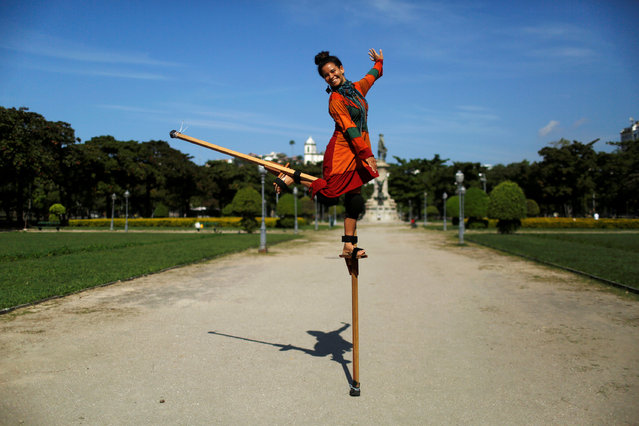
Raquel Poti, a 32-year-old street artist, poses at a park in Rio de Janeiro, Brazil, June 25, 2016. Raquel thinks the Olympics promotes a lifestyle that combines sports, culture and education. She is concerned about the large investment for the event while the population needs improvements in basic services. (Photo by Pilar Olivares/Reuters)

Just a week before Rio de Janeiro hosts South America's first Olympics, city residents expressed mixed feelings about the cost and security of the Games, while holding out hope they will bring joy to a nation facing economic and political crises. The conflicted thoughts mirror a recent survey by the Datafolha polling group showing that half of Brazilians were opposed to holding the Games, while 63 percent think the costs of hosting the event will outweigh benefits. (Photo by Pilar Olivares/Reuters)
Details
03 Aug 2016 11:51:00
Aerial Views by  Ken Hong Leung

H. Leung has been acclaimed since 1952 for his brilliant artistic style. A master of oil on canvas, he achieves a haunting quality in his works that absorbs the viewer’s emotions like an irresistible melody. His brush, like a wand, seems to weave a sense of enchantment. In his landscapes and waterside villages, visions of Shangri-La come to mind, superbly mixed with subtle orchestrations of peacefulness and drama.

Technique is both a creative and expressive force in the art of H. Leung. Distinctively semi-abstract, his images allow the viewer’s eye to supply what is merely suggested. This very involving result adds power not only to the impact of his designs, it increases the joy that owning his works provides.
Details
26 Aug 2012 12:10:00
All the drugery of dishwashing in this three-times -a day task, which comes to the house wife who does her own house work, has been eliminated by the new dish washer shown in the photograph on April 25, 1921. It is the invention of a Cincinnati school teacher, who sought to make things a bit more pleasant for his wife. Incedently, his idea was worth 12,00 to him, for a manufacturing concern thought so much of the “dish-washer” they purchased the rights and will seek to add a little joy to thousands of other housewives. With the aid of only hot water, dishes placed in a wire rack and set into the drum are made clean and spotless in two minutes. (Photo by Bettmann Archive/Getty Images)

All the drugery of dishwashing in this three-times -a day task, which comes to the house wife who does her own house work, has been eliminated by the new dish washer shown in the photograph on April 25, 1921. It is the invention of a Cincinnati school teacher, who sought to make things a bit more pleasant for his wife. Incedently, his idea was worth 12,00 to him, for a manufacturing concern thought so much of the “dish-washer” they purchased the rights and will seek to add a little joy to thousands of other housewives. With the aid of only hot water, dishes placed in a wire rack and set into the drum are made clean and spotless in two minutes. (Photo by Bettmann Archive/Getty Images)
Details
08 Jul 2021 10:25:00